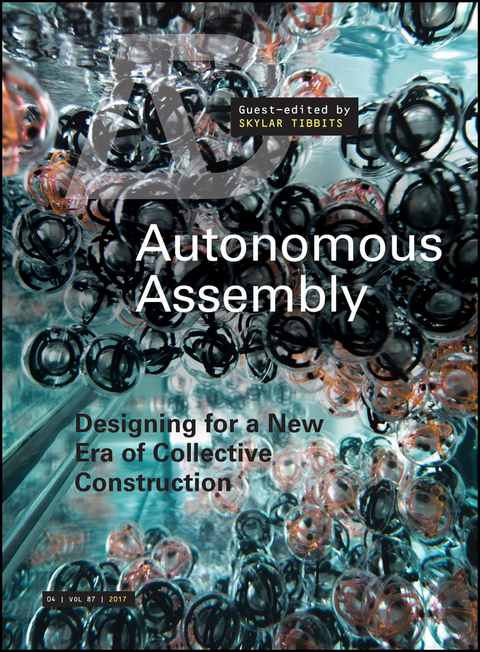
Autonomous Assembly (eBook)
John Wiley & Sons (Verlag)
978-1-119-10236-6 (ISBN)
We are now on the brink of a new era in construction - that of autonomous assembly. For some time, the widespread adoption of robotic and digital fabrication technologies has made it possible for architects and academic researchers to design non-standard, highly customised structures. These technologies have largely been limited by scalability, focusing mainly on top-down, bespoke fabrication projects, such as experimental pavilions and structures. Autonomous assembly and bottom-up construction techniques hold the promise of greater scalability, adaptability and potentially evolved design possibilities. By capitalising on the advances made in swarm robotics, the collective construction of the animal/insect kingdom, and advances in physical computational, programmable materials or self-assembly, architects and designers are now able to build from the bottom up. This issue presents future scenarios of autonomous assembly by highlighting the viability of decentralised, collective assembly systems, demonstrating the potential to deliver reconfigurable and adaptive solutions.
Contributors include: Marcelo Coelho, Andong Liu, Robin Meier, Kieran Murphy and Heinrich Jaeger, Radhika Nagpal and Kirstin Petersen, and Zorana Zeravcic.
Featured architects: Aranda/Lasch, Arup, Philippe Block, Gramazio Kohler Architects, Ibañez Kim, Achim Menges, Caitlin Mueller, Jose Sanchez, Athina Papadopoulou and Jared Laucks, and Skylar Tibbits.Skylar Tibbits is the Director of the Self-Assembly Lab in MIT's Department of Architecture. He also teaches graduate and undergraduate design studios and co-teaches 'How to Make (Almost) Anything', a seminar at MIT's Media Lab. The Self-Assembly Lab recently invented and pioneered the field of 4D Printing with Stratasys Ltd and Autodesk Inc. Skylar is the recipient of a 2014 Inaugural WIRED Fellowship, a 2013 Architectural League Prize, The Next Idea Award at Ars Electronica 2013, the Visionary Innovation Award at the Manufacturing Leadership Summit, 2012 TED Senior Fellowship and was named a Revolutionary Mind in SEED Magazine's 2008 Design Issue.
We are now on the brink of a new era in construction that of autonomous assembly. For some time, the widespread adoption of robotic and digital fabrication technologies has made it possible for architects and academic researchers to design non-standard, highly customised structures. These technologies have largely been limited by scalability, focusing mainly on top-down, bespoke fabrication projects, such as experimental pavilions and structures. Autonomous assembly and bottom-up construction techniques hold the promise of greater scalability, adaptability and potentially evolved design possibilities. By capitalising on the advances made in swarm robotics, the collective construction of the animal/insect kingdom, and advances in physical computational, programmable materials or self-assembly, architects and designers are now able to build from the bottom up. This issue presents future scenarios of autonomous assembly by highlighting the viability of decentralised, collective assembly systems, demonstrating the potential to deliver reconfigurable and adaptive solutions. Contributors include: Marcelo Coelho, Andong Liu, Robin Meier, Kieran Murphy and Heinrich Jaeger, Radhika Nagpal and Kirstin Petersen, and Zorana Zeravcic. Featured architects: Aranda/Lasch, Arup, Philippe Block, Gramazio Kohler Architects, Iba ez Kim, Achim Menges, Caitlin Mueller, Jose Sanchez, Athina Papadopoulou and Jared Laucks, and Skylar Tibbits.
Skylar Tibbits is the Director of the Self-Assembly Lab in MIT's Department of Architecture. He also teaches graduate and undergraduate design studios and co-teaches 'How to Make (Almost) Anything', a seminar at MIT's Media Lab. The Self-Assembly Lab recently invented and pioneered the field of 4D Printing with Stratasys Ltd and Autodesk Inc. Skylar is the recipient of a 2014 Inaugural WIRED Fellowship, a 2013 Architectural League Prize, The Next Idea Award at Ars Electronica 2013, the Visionary Innovation Award at the Manufacturing Leadership Summit, 2012 TED Senior Fellowship and was named a Revolutionary Mind in SEED Magazine's 2008 Design Issue.
About the Guest-Editor 05
Skylar Tibbits
Introduction From Automated to Autonomous Assembly 06
Skylar Tibits
Combinatorial Commons
Social Remixing in a Sharing Economy 16
Jose Sanchez
How Specific Interactions Drive the Complex Organisation of Building Blocks 22
Zorana Zeravcic
From Self-Assembly to Evolutionary Structures 28
Athina Papadopoulou, Jared Laucks and Skylar Tibbits
The Vanishing Actor
How to Let Things Happen: The Art of Order Without Orders 38
Robin Meier and Bastien Gallet
Complex Design by Simple Robots
A Collective Embodied Intelligence Approach to Construction 44
Kirstin Petersen and Radhika Nagpal
Crowd-Driven Pattern Formation
Computational Strategies for Large-Scale Design and Assembly 50
Marcelo Coelho and Tovi Grossman
The Immersive
Stagecraft to Urbanism 60
Simon Kim and Mariana Ibañez
Baskets and Architecture
Ritualisitic Making and Collective Design 66
Benjamin Aranda and Chris Lasch
Aleatory Construction Based on Jamming
Stability Through Self-Confinement 74
Kieran Murphy, Leah Roth, Dan Peterman and Heinrich Jaeger
Granular Jamming of Loadbearing and Reversible Structures
Rock Print and Rock Wall 82
Petrus Aejmelaeus-Lindström, Ammar Mirjan, Fabio Gramazio and Matthias Kohler, Schendy Kernizan, Björn Sparrman, Jared Laucks and Skylar Tibbits
Granular Construction
Designed Particles for Macro-Scale Architectural Structures 88
Karola Dierichs and Achim Menges
Distributed Structures
Digital Tools for Collective Design 94
Caitlin Mueller
Compressive Assemblies
Bottom-Up Performance for a New Form of Construction 104
Philippe Block, Matthias Rippmann and Tom Van Mele
Disarmed Strategies
New Machines and Techniques for an Era of Computational Contextualism in Architecture 110
Hannes Mayer, Fabio Gramazio and Matthias Kohler
2060
An Autonomously Crafted Built Environment 120
Alvise Simondetti, Chris Luebkeman and Gereon Uerz
Counterpoint
Autonomous Assembly as the Fourth Approach to Generic Construction 128
Andong Lu
Contributors 134
| Erscheint lt. Verlag | 5.2.2018 |
|---|---|
| Reihe/Serie | Architectural Design | Architectural Design |
| Mitarbeit |
Gast Herausgeber: Skylar Tibbits |
| Sprache | englisch |
| Themenwelt | Technik ► Architektur |
| Schlagworte | academic • Adoption • Architects • architectural theory • Architecture • Architektur • Architekturtheorie • Architektur / Theorie • Assembly • Autonomous • Bauentwurf • brink • Building Design • Construction • ERA • Experimental • largely • New • Pavilions • Planning • Planung • possible • Projects • Researchers • Robotic • Scalability • Structures • Technologies • Time • topdown • widespread |
| ISBN-10 | 1-119-10236-7 / 1119102367 |
| ISBN-13 | 978-1-119-10236-6 / 9781119102366 |
| Informationen gemäß Produktsicherheitsverordnung (GPSR) | |
| Haben Sie eine Frage zum Produkt? |
 PDF (Adobe DRM)
Kopierschutz: Adobe-DRM
Adobe-DRM ist ein Kopierschutz, der das eBook vor Mißbrauch schützen soll. Dabei wird das eBook bereits beim Download auf Ihre persönliche Adobe-ID autorisiert. Lesen können Sie das eBook dann nur auf den Geräten, welche ebenfalls auf Ihre Adobe-ID registriert sind.
Details zum Adobe-DRM
Dateiformat: PDF (Portable Document Format)
Mit einem festen Seitenlayout eignet sich die PDF besonders für Fachbücher mit Spalten, Tabellen und Abbildungen. Eine PDF kann auf fast allen Geräten angezeigt werden, ist aber für kleine Displays (Smartphone, eReader) nur eingeschränkt geeignet.
Systemvoraussetzungen:
PC/Mac: Mit einem PC oder Mac können Sie dieses eBook lesen. Sie benötigen eine
eReader: Dieses eBook kann mit (fast) allen eBook-Readern gelesen werden. Mit dem amazon-Kindle ist es aber nicht kompatibel.
Smartphone/Tablet: Egal ob Apple oder Android, dieses eBook können Sie lesen. Sie benötigen eine
Geräteliste und zusätzliche Hinweise
Buying eBooks from abroad
For tax law reasons we can sell eBooks just within Germany and Switzerland. Regrettably we cannot fulfill eBook-orders from other countries.
aus dem Bereich