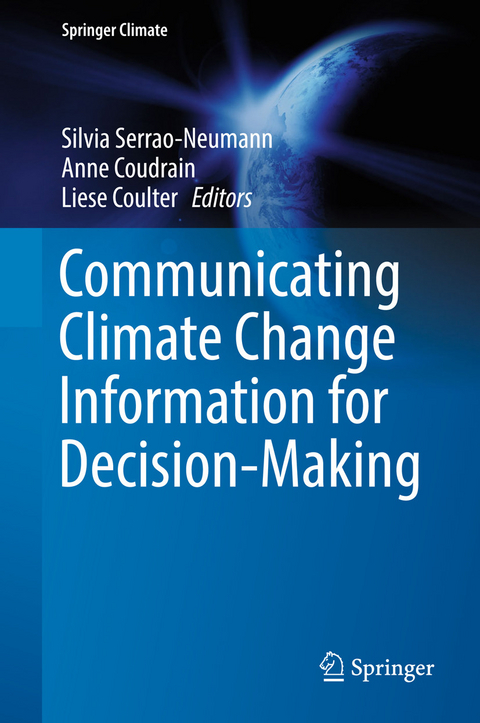
Communicating Climate Change Information for Decision-Making (eBook)
XIV, 219 Seiten
Springer International Publishing (Verlag)
9783319746692 (ISBN)
Silvia Serrao-Neumann is a Senior Research Fellow for the Cooperative Research Centre for Water Sensitive Cities (CRC-WSC) at the Cities Research Institute, Griffith University, Australia. Her research focuses on climate change adaptation from multiple perspectives, including: catchment scale landscape planning for water sensitive city-regions; cross-border planning and collaboration; disaster recovery under a stakeholder-focused collaborative panning approach; natural resource management; and action / intervention research applied to planning for climate change adaptation.
Silvia Serrao-Neumann is a Senior Research Fellow for the Cooperative Research Centre for Water Sensitive Cities (CRC-WSC) at the Cities Research Institute, Griffith University, Australia. Her research focuses on climate change adaptation from multiple perspectives, including: catchment scale landscape planning for water sensitive city-regions; cross-border planning and collaboration; disaster recovery under a stakeholder-focused collaborative panning approach; natural resource management; and action / intervention research applied to planning for climate change adaptation.Anne Coudrain is an engineer in water sciences (PhD - Paris School of Mines) and a Doctor of Sciences and auditor of the “Institut des Hautes Études pour la Science et la Technologie”. She is currently Honorary Research Director at the research unit Espace-dev in the science-societies field on climate change. Beginning her career in 1980 at the National Mining Industry Company in Mauritania, she researched the safety analysis of underground nuclear waste repositories, and the relationships between hydrosphere and climate, before becoming involved in managing research for development.Liese Coulter is a Lecturer in Science, Technology, and Society at Griffith University. Her research focuses on how climate knowledge is used to envision, communicate, and manage environmental and social issues associated with climate change. Previously, Liese was Communication Manager for the CSIRO Climate Change Adaptation Flagship, and the National Climate Change Adaptation Research Facility (NCCARF).
Part 1: Developing climate change information.- Chapter 1. Science and knowledge production for climate change adaptation: challenges and opportunities (Silvia Serrao-Neumann).- Chapter 2. Science and evidence-based climate change policy: Collaborative approaches to improve the science-policy interface (Edward Morgan).- Chapter 3. Conceptual analysis of climate change in the light of society-environment relationship; Observatories closer to both systems and societies (Mireille Fargette).- Chapter 4. Rethinking IPCC expertise from a multi-actor perspective (Maud H. Devès).- Chapter 5. Computational constraint models for decision support and holistic solution design (Carmen Gervet).- Part 2: Communicating climate change information.- Chapter 6. Uncertainty and future planning: the use of scenario planning for climate change adaptation planning and decision (Serrao-Neumann).- Chapter 7. Future climate narratives: combining personal and professional knowledge to adapt to climate change (Liese Coulter).- Chapter 8. Integrating research and practice in emerging climate services – Lessons from other transdisciplinary dialogues (Susanne Schuck-Zöller).- Chapter 9. Communicating climate information: travelling through the decision-making process (Ghislain Dubois).- Chapter 10. Transforming climate change policymaking: from informing to empowering the local community (Michael Howes).- Chapter 11. Resilience and vulnerability assessment as the basis for adaptation dialogue in information-poor environments: a Cambodian example (Chris Jacobson).- Part 3: Applying climate change information: Case studies.- Chapter 12. Scalable interactive platform for geographic evaluation of sea-level rise impact combining high performance computing and Web-GIS client (Agnès Tellez-Arenas).- Chapter 13. Coral reef monitoring coping with climate change, towards a socio-ecological system perspective (Gilbert David).- Chapter 14. The experience of the Brazilian climate and health observatory: seeking interaction between organizations and civil society (Renata Gracie).- Part 4: Conclusion.- Chapter 15. Informing decisions with climate change information (Liese Coulter).
| Erscheint lt. Verlag | 20.3.2018 |
|---|---|
| Reihe/Serie | Springer Climate | Springer Climate |
| Zusatzinfo | XIV, 219 p. 24 illus., 15 illus. in color. |
| Verlagsort | Cham |
| Sprache | englisch |
| Themenwelt | Sachbuch/Ratgeber ► Gesundheit / Leben / Psychologie |
| Naturwissenschaften ► Geowissenschaften | |
| Sozialwissenschaften ► Politik / Verwaltung | |
| Technik | |
| Schlagworte | climate change • climate change adaptation • Climate Change Management • Climate Change Mitigation • Climate Policy • Environmental change • Interdisciplinary climate research |
| ISBN-13 | 9783319746692 / 9783319746692 |
| Informationen gemäß Produktsicherheitsverordnung (GPSR) | |
| Haben Sie eine Frage zum Produkt? |
 PDF (Wasserzeichen)
DRM: Digitales Wasserzeichen
Dieses eBook enthält ein digitales Wasserzeichen und ist damit für Sie personalisiert. Bei einer missbräuchlichen Weitergabe des eBooks an Dritte ist eine Rückverfolgung an die Quelle möglich.
Dateiformat: PDF (Portable Document Format)
Mit einem festen Seitenlayout eignet sich die PDF besonders für Fachbücher mit Spalten, Tabellen und Abbildungen. Eine PDF kann auf fast allen Geräten angezeigt werden, ist aber für kleine Displays (Smartphone, eReader) nur eingeschränkt geeignet.
Systemvoraussetzungen:
PC/Mac: Mit einem PC oder Mac können Sie dieses eBook lesen. Sie benötigen dafür einen PDF-Viewer - z.B. den Adobe Reader oder Adobe Digital Editions.
eReader: Dieses eBook kann mit (fast) allen eBook-Readern gelesen werden. Mit dem amazon-Kindle ist es aber nicht kompatibel.
Smartphone/Tablet: Egal ob Apple oder Android, dieses eBook können Sie lesen. Sie benötigen dafür einen PDF-Viewer - z.B. die kostenlose Adobe Digital Editions-App.
Buying eBooks from abroad
For tax law reasons we can sell eBooks just within Germany and Switzerland. Regrettably we cannot fulfill eBook-orders from other countries.
aus dem Bereich