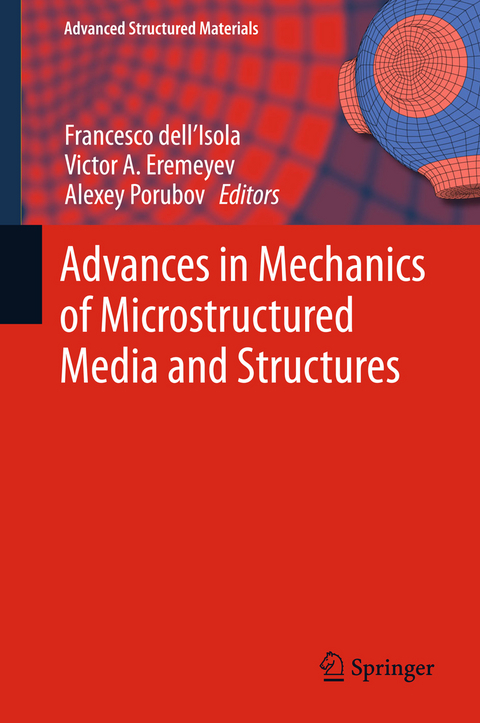
Advances in Mechanics of Microstructured Media and Structures (eBook)
VIII, 369 Seiten
Springer International Publishing (Verlag)
978-3-319-73694-5 (ISBN)
This book is an homage to the pioneering works of E. Aero and G. Maugin in the area of analytical description of generalized continua. It presents a collection of contributions on micropolar, micromorphic and strain gradient media, media with internal variables, metamaterials, beam lattices, liquid crystals, and others. The main focus is on wave propagation, stability problems, homogenization, and relations between discrete and continuous models.
Preface 6
Contents 8
Some Introductory and Historical Remarks on Mechanics of Microstructured Materials 10
1 Structured Media i.e. Modeling Complexity: A Change of Paradigm? 10
2 Did Piola Formulate Already A Method of Asymptotic Homogenization? 12
3 Variational Principles as a Guide for Formulating New Models: The Case of Hencky and Euler Beams 15
3.1 First Formulations of Hamilton Principle 16
3.2 Hencky Discrete Models and Euler Continuum Models for Beams 17
4 Discrete Versus Continuous Description: An Ancient Dichotomy 19
5 Some Conclusions: History of Mechanics as a Tool in Finding Models for Fabrics, 3D Printed Prototypes and Various Complex Systems 21
References 24
Exact Analytical Solutions for Nonautonomic Nonlinear Klein-Fock-Gordon Equation 30
1 Introduction 30
2 Methods of Construction of Exact Analytical Solutions for Nonautonomic NKFG Equation 31
3 Exact Analytical Solutions for the Nonautonomic Liouville Equation 37
4 Conclusion 41
References 42
3 Percolation Threshold for Elastic Problems: Self-consistent Approach and Padé Approximants 43
Abstract 43
1 Introduction 43
2 Self-consistent Approach 44
3 Padé Approximants for Virial Expansions 46
4 Conclusion 50
References 50
A 1D Continuum Model for Beams with Pantographic Microstructure: Asymptotic Micro-Macro Identification and Numerical Results 51
1 Introduction 52
2 Discrete Micro-model 53
2.1 Geometry 54
2.2 Mechanical Model 56
2.3 Asymptotic Expansion and Quasi-inextensibility Assumption 56
2.4 Piola's Ansatz 57
2.5 Micro-model Energy as a Function of Macro-model Descriptors 57
2.6 The Inextensibility Case 59
3 Continuum-Limit Macro-model 61
3.1 Rescaling of Stiffnesses and Heuristic Homogenization 61
3.2 Macro-model Energy as a Function of the Placement field 62
3.3 The Inextensibility Case 65
4 Numerical Simulations 66
4.1 Semi-circle Test 67
4.2 Three-Point Test 68
4.3 Modified Three-Point Test 69
5 Euler-Lagrange Equations 70
6 Conclusions 75
References 78
Numerical Simulation of Energy Localization in Dynamic Materials 83
1 Introduction 83
2 One-Dimensional Elasticity in Small-Strain Approximation 84
3 Numerical Simulation of Dynamic Material Behavior 86
4 Amplitude of Transmitted Pulses 88
4.1 Amplitude of Transmitted Pulses Versus Velocity Ratio 88
4.2 Amplitude of Transmitted Pulses Versus Wave Length 89
5 Conclusions 91
References 91
6 Fracture Prediction of Piezoelectric Ceramic by the 2-D Boundary Element Analysis 92
1 Introduction 92
2 Ferroelectricity 94
3 Constitutive Equations of Piezoelectric Ceramics 95
4 Methodology and Basic Formulations 96
4.1 Basic Equations for a 2-D Piezoelectric Solid 96
4.2 Fundamental Solution and Stroh Formulations 97
4.3 Basic Equations of Boundary Element Method 100
4.4 Numerical Implementation of Boundary Element Method 102
5 Multiscale Modeling 103
6 Results and Discussion 104
6.1 Cracked Plate 104
6.2 Piezoelectric Plate with Inclusion 105
7 Summary 107
Acknowledgements 108
References 108
Rotational Waves in Microstructured Materials 110
1 Introduction 110
2 Basic Stages of the Structural Modeling 113
3 The Discrete Model of a Square Lattice 115
4 Continual (Long-Wavelength) Approximation 117
5 The Low-Frequency (Two-Mode) Approximation 119
6 The Parametric Identification Problem 121
7 Numerical Estimates of Macroparameters 122
8 About the Role of Rotational Factor in Geodynamics 125
9 Conclusions 127
References 127
8 Localized Magnetoelastic Waves in a One and Two Dimensional ?Medium? 132
Abstract 132
1 Introduction 132
2 ?Equations of Magnetoelasticity? 133
3 Rod 135
4 Plate 139
5 Conclusions 147
Acknowledgements 147
References 147
Waves in Elastic Reduced Cosserat Medium with Anisotropy in the Term Coupling Rotational and Translational Strains or in the Dynamic Term 149
1 Introduction 149
2 General Equations for Reduced Cosserat Medium 151
3 Reduced Cosserat Medium with an Anisotropic Coupling Between Translational and Rotational Strains and Spherical Tensor of Inertia 153
3.1 Tensors Sl with the Same Eigen Vector 155
3.2 In the Vicinity of ?0 157
4 Reduced Cosserat Medium with Isotropic Elastic Energy and Axisymmetric Tensor of Inertia 158
4.1 General Case of Inertia Tensor: P-Wave and Special Shear-Rotational Waves 158
4.2 Axisymmetric Tensor of Inertia 159
5 Conclusion 161
References 161
Modeling Stress-Affected Chemical Reactions in Solids–A Rational Mechanics Approach 163
1 Introduction 164
2 Problem Statement 165
2.1 Chemical Affinity and Chemical Reaction Kinetics 165
2.2 Diffusion Problem 168
3 Analytical Solutions of Some Boundary-Value Problems 170
3.1 A Two-Dimensional Planar Reaction Front 170
3.2 Spherical Reaction Front 174
4 Numerical Calculations 177
4.1 Material Parameters 177
4.2 Results for the Planar Chemical Reaction Front 178
4.3 Results for a Spherical Chemical Reaction Front 183
5 Summary and Conclusions 187
References 188
11 Structural Transformations of Material Under Dynamic Loading 190
Abstract 190
1 Introduction 190
2 Two-Component Model 193
3 Discrete Model 195
4 Continuous Model 198
5 Conclusion 200
References 200
One-Dimensional Heat Conduction and Entropy Production 201
1 Introduction 202
2 The Simplest Thermodynamics of a One-Dimensional Medium 203
2.1 Energy Balance Equations 203
2.2 Entropy and the Second Law of Thermodynamics 204
2.3 Dissipative Inequality 205
2.4 Constitutive Equation 206
2.5 Modification of the Constitutive Equation 208
3 The Approach of P. A. Zhilin 209
4 Harmonic Crystal 211
4.1 Kinetic Temperature 211
4.2 Direction of the Heat Flux 212
4.3 Entropy for the Harmonic Crystal 213
5 Statistical Mechanics 214
6 Conclusions and Closing Remarks 215
References 216
13 Model of Media with Conserved Dislocation. Special Cases: Cosserat Model, Aero-Kuvshinskii Media Model, Porous Media Model 218
Abstract 218
1 Introduction 219
2 Theory of Medium with Conserved Dislocations 220
2.1 Kinematic Model 220
2.2 Variational Formulation of Model 225
2.3 Constitutive Equations 226
3 Cosserat Medium (Special Case of Medium with Conserved Dislocations) 232
3.1 Direct Integration of System of Equilibrium Equations 234
3.2 Physical Interpretation of Fundamental Solutions 235
3.3 Aero-Kuvshinskii Model 237
4 Theory of Porous Media 240
4.1 Identification of Moduli 241
4.2 General Solution in Theory of Porous Media 245
5 Model of Media with “Twinning” 248
5.1 Fundamental Solutions 249
6 Conclusion 250
Acknowledgements 251
References 251
Numerical Simulation of Circumsolar Ring Evolution 253
1 Introduction 253
2 The Model 254
3 The Numerical Method 257
4 The Simulation Results 257
4.1 The Protoplanetary Rings Evolution 257
4.2 The Clustering Conditions 259
5 Conclusions 260
References 262
Two-Dimensional Modeling of Diatomic Lattice 264
1 Introduction 264
2 Discrete Equations 266
3 Continuum Modeling 268
3.1 Continuum Limit of Discrete Equation 268
3.2 Continuum Equations in New Variables 269
3.3 Reconstruction of Continuum Potential Energy 270
3.4 Introduction of Nonlinearity 271
4 Conclusion 272
References 273
Mechanics of Metamaterials: An Overview of Recent Developments 274
1 Introduction 275
2 Anti-auxetic 2D Architectured Materials Under Small Strains 278
2.1 Orthotropic Lattice Architectures of Controlled Static Properties 278
2.2 Wave Propagation Attributes of 2D Anti-auxetic Material Architectures of High Anisotropy 280
3 Static and Wave Propagation Characteristics of Architectured Materials Under Large Strains 281
3.1 Microscopic and Mesoscopic Nonlinear Homogenization Problems 282
3.2 Control of the Transition from Non-auxetic to Auxetic Behaviors by Large Strains 284
3.3 Effective Incremental Frequency and Phase Velocity of a 1D Microstructured Beam 285
3.4 Incremental Dispersion Relation and Phase Velocity in 2D Homogenized Media 288
4 Modification of the Nature of Propagating Waves According to the Degree of Nonlinearity in 1D Elastic Microstructured Beams 289
5 Conclusions 294
References 295
Acoustic Approximation of the Governing Equations of Liquid Crystals Under Weak Thermomechanical and Electrostatic Perturbations 298
1 Introduction 299
2 Governing Equations 300
2.1 Integral Conservation Laws 300
2.2 Kinematics of a Micropolar Medium 302
2.3 Constitutive Equations 305
2.4 Equations of a Spatial Model 307
2.5 Equations of Plane Motion 310
3 Computational Algorithm 312
3.1 Two-Cyclic Splitting Method 312
3.2 Scheme for Heat Conduction Equation 315
3.3 Comparison with Exact Solution 317
3.4 Parallel Implementation of Algorithm 318
4 Resonant Excitation 320
4.1 Klein–Gordon Equation 320
4.2 Computations Based on Full Model 323
4.3 Two Equation of the Second Order 324
4.4 Stability of the Scheme 327
4.5 Numerical Results 330
5 Perturbation by Electric Field 332
5.1 Statement of the Problem 332
5.2 Numerical Method 334
5.3 Computational Results 337
6 Conclusions 339
References 340
Effect of Surface Stresses on Stability of Elastic Circular Cylinder 343
1 Introduction 343
2 Equilibrium of Body with Surface Stresses 344
3 Circular Cylinder with Surface Stresses 345
4 Linearized Equilibrium Equations 346
5 Numerical Results 351
6 Conclusion 353
References 354
Spherically Symmetric Deformations of Micropolar Elastic Medium with Distributed Dislocations and Disclinations 356
1 Introduction 356
2 Input Relations 357
3 Spherically Symmetric State 360
4 Solution of the Eigenstresses Problem in a Hollow Solid Sphere from Micropolar Material 364
5 Spherically Symmetric State with a Non-polar Elastic Medium with Distributed Dislocations and Disclinations 365
6 Conclusion 367
References 367
| Erscheint lt. Verlag | 27.2.2018 |
|---|---|
| Reihe/Serie | Advanced Structured Materials | Advanced Structured Materials |
| Zusatzinfo | VIII, 369 p. 110 illus., 78 illus. in color. |
| Verlagsort | Cham |
| Sprache | englisch |
| Themenwelt | Mathematik / Informatik ► Mathematik ► Statistik |
| Mathematik / Informatik ► Mathematik ► Wahrscheinlichkeit / Kombinatorik | |
| Technik ► Maschinenbau | |
| Schlagworte | beam lattices • Cosserat continuum • E. L. Aero • Gerard Maugin • liquid crystals • micromorphic media • micropolar media • strain gradient elasticity • thin-walled structures |
| ISBN-10 | 3-319-73694-9 / 3319736949 |
| ISBN-13 | 978-3-319-73694-5 / 9783319736945 |
| Informationen gemäß Produktsicherheitsverordnung (GPSR) | |
| Haben Sie eine Frage zum Produkt? |
 PDF (Wasserzeichen)
DRM: Digitales Wasserzeichen
Dieses eBook enthält ein digitales Wasserzeichen und ist damit für Sie personalisiert. Bei einer missbräuchlichen Weitergabe des eBooks an Dritte ist eine Rückverfolgung an die Quelle möglich.
Dateiformat: PDF (Portable Document Format)
Mit einem festen Seitenlayout eignet sich die PDF besonders für Fachbücher mit Spalten, Tabellen und Abbildungen. Eine PDF kann auf fast allen Geräten angezeigt werden, ist aber für kleine Displays (Smartphone, eReader) nur eingeschränkt geeignet.
Systemvoraussetzungen:
PC/Mac: Mit einem PC oder Mac können Sie dieses eBook lesen. Sie benötigen dafür einen PDF-Viewer - z.B. den Adobe Reader oder Adobe Digital Editions.
eReader: Dieses eBook kann mit (fast) allen eBook-Readern gelesen werden. Mit dem amazon-Kindle ist es aber nicht kompatibel.
Smartphone/Tablet: Egal ob Apple oder Android, dieses eBook können Sie lesen. Sie benötigen dafür einen PDF-Viewer - z.B. die kostenlose Adobe Digital Editions-App.
Buying eBooks from abroad
For tax law reasons we can sell eBooks just within Germany and Switzerland. Regrettably we cannot fulfill eBook-orders from other countries.
aus dem Bereich