


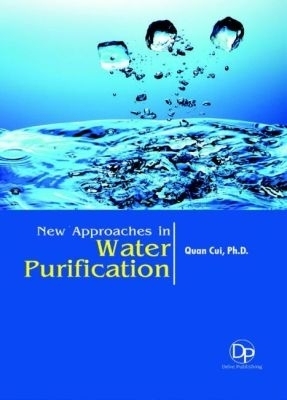
New Approaches in Water Purification
Seiten
2016
Delve Publishing (Verlag)
978-1-68095-835-5 (ISBN)
Delve Publishing (Verlag)
978-1-68095-835-5 (ISBN)
- Titel nicht im Sortiment
- Artikel merken
In the past decade, practical applications of a variety of new wastewater-treatment technologies, such as membrane filtration systems and advanced oxidation, have led to new ways of managing urban water systems and water resources. This book describes these new approaches in water purification, and describes technological advances that are in development.
In the past decade, practical applications of a variety of new wastewater-treatment technologies, such as membrane filtration systems and advanced oxidation, have led to new ways of managing urban water systems and water resources. These new treatment regimes, especially the integration of urban-water and waste-management systems, promise to dramatically improve the sustainability of our water resources. These new systems are creating new needs, which are driving further technology development. This book describes some of the approaches in water purification that are already being implemented; and describe technological advances that are under development. The major driver of change is, quite simply, population growth coupled with a rising global standard of living, a combination that has resulted in resource consumption (including water use) that exceeds the current resources of planet Earth. By about 2050, when the population is expected to reach about 9 billion, and if standards of living continue to rise, the amount consumed will be the resources of about three planet Earths. Obviously, this scenario is not sustainable. When the population of Earth was much smaller (e.g., fewer than 2 billion) and when per capita use of resources was much smaller, our traditional “take, make, waste” pattern of resource consumption was sustainable. Now, however, we need to recycle and reuse all types of resources (including water), and we must increase our use of renewable resources. Water purification means to remove undesirable chemicals, contaminants, suspended particles, parasites, bacteria, algae, viruses, fungi, dissolved material and gases from source water to gain water qualified for a variety of different purpose. The most desired use of purified water is drinking water. Besides this, purposes of purified water demands also include medical use, industrial use, chemical use, et al. The sources of purified water come from both inland water, including surface water and groundwater, and oceans. Topics in this book covered the developments and applications of water purification systems and water purifications technologies, including coagulation, filtration, disinfection, ultraviolet radiation, osmosis, distillation and nanotechnology.
In the past decade, practical applications of a variety of new wastewater-treatment technologies, such as membrane filtration systems and advanced oxidation, have led to new ways of managing urban water systems and water resources. These new treatment regimes, especially the integration of urban-water and waste-management systems, promise to dramatically improve the sustainability of our water resources. These new systems are creating new needs, which are driving further technology development. This book describes some of the approaches in water purification that are already being implemented; and describe technological advances that are under development. The major driver of change is, quite simply, population growth coupled with a rising global standard of living, a combination that has resulted in resource consumption (including water use) that exceeds the current resources of planet Earth. By about 2050, when the population is expected to reach about 9 billion, and if standards of living continue to rise, the amount consumed will be the resources of about three planet Earths. Obviously, this scenario is not sustainable. When the population of Earth was much smaller (e.g., fewer than 2 billion) and when per capita use of resources was much smaller, our traditional “take, make, waste” pattern of resource consumption was sustainable. Now, however, we need to recycle and reuse all types of resources (including water), and we must increase our use of renewable resources. Water purification means to remove undesirable chemicals, contaminants, suspended particles, parasites, bacteria, algae, viruses, fungi, dissolved material and gases from source water to gain water qualified for a variety of different purpose. The most desired use of purified water is drinking water. Besides this, purposes of purified water demands also include medical use, industrial use, chemical use, et al. The sources of purified water come from both inland water, including surface water and groundwater, and oceans. Topics in this book covered the developments and applications of water purification systems and water purifications technologies, including coagulation, filtration, disinfection, ultraviolet radiation, osmosis, distillation and nanotechnology.
Quan Cui obtained her PhD from Beijing Normal University in 2015. She worked as environmental impact assessment engineer for years. Aiming at linking science to policy, her study interest spans from ecosystem modelling to water resources management. She published peer-reviewed articles about using machine learning models in inflow forecasting, CO2 management and watershed ecosystem health assessment.
| Erscheinungsdatum | 16.03.2018 |
|---|---|
| Sprache | englisch |
| Maße | 152 x 229 mm |
| Gewicht | 1000 g |
| Themenwelt | Technik ► Umwelttechnik / Biotechnologie |
| ISBN-10 | 1-68095-835-6 / 1680958356 |
| ISBN-13 | 978-1-68095-835-5 / 9781680958355 |
| Zustand | Neuware |
| Informationen gemäß Produktsicherheitsverordnung (GPSR) | |
| Haben Sie eine Frage zum Produkt? |
Mehr entdecken
aus dem Bereich
aus dem Bereich
Senses and Movement
Buch | Softcover (2023)
De Gruyter (Verlag)
CHF 132,90
Kommentar der DIN 15905-5, LärmVibrationsArbSchV und …
Buch | Softcover (2023)
DIN Media (Verlag)
CHF 79,95
Buch | Softcover (2023)
DIN Media (Verlag)
CHF 105,55


