


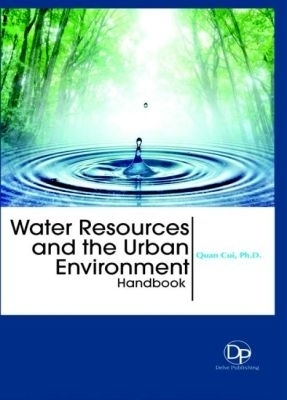
Water Resources and the Urban Environment Handbook
Seiten
2016
Delve Publishing (Verlag)
978-1-68095-800-3 (ISBN)
Delve Publishing (Verlag)
978-1-68095-800-3 (ISBN)
- Titel nicht im Sortiment
- Artikel merken
Pollutants from pharmaceuticals, industrial chemicals, and large-scale agriculture have posed new challenges for the water management sector. Coupled with demographic changes, climate change, and deteriorating water infrastructures, research and innovation in the water sector has become increasingly important. This book is targeted at researchers, water resources managers and decision-makers.
Water is important to life. However, human beings are facing an ever-greater demands for reliable, high-quality and stable water resources supplies for all kinds of water consumption. In response to the need for profound understanding of water resources, this handbook contains articles of several key issues in water resources and urban environment. While some of the articles address traditional topics such as water management diagnosis, surface water regulation, and water quality assessment, more recent issues such as hydrologic and hydraulic modeling, water scarcity assessment, water resources optimization, and water management policies are also explored. Other major topics discussed include: surface water quality and safety, water distribution systems, hydrologic and hydraulic computer modeling, international or regional water management, drinking water quality; and water resources issues related to ecosystem services.
This book is targeted at scientific researchers, water resources managers and decision-makers. In recent decades, emerging pollutants from pharmaceuticals, industrial chemicals, and large-scale agriculture have posed new challenges for the water management sector. Coupled with demographic changes, climate change, as well as aging and deteriorating water infrastructures, research and innovation in the water sector have become increasingly important for ensuring the long-term sustainability and quality of water resources. Despite these challenges, the adoption of appropriate practices and technologies that effectively address and tackle such emerging pollutants remains low. Improved knowledge transfer and better science communication among key stakeholders, including scientists, the private sector, and water utilities have been identified as central to addressing the low rate of uptake of appropriate technologies. In particular, small and medium-sized enterprises (SMEs) have emerged as key go-betweens for increasing innovation in the water sector and encouraging knowledge dissemination and uptake of research. More and more people are choosing to live in cities. With more than half of humanity urbanized, there is an urgent need to take an integrated and holistic view of the supply and demand for water in Cities. While many cities, particularly in developing countries, are facing acute scarcity in providing clean safe water, urban managers are daunted by the complex task of sanitation - managing the wastewater generated by cities, so that harmless, clean water is returned to the natural water cycle.
Water is important to life. However, human beings are facing an ever-greater demands for reliable, high-quality and stable water resources supplies for all kinds of water consumption. In response to the need for profound understanding of water resources, this handbook contains articles of several key issues in water resources and urban environment. While some of the articles address traditional topics such as water management diagnosis, surface water regulation, and water quality assessment, more recent issues such as hydrologic and hydraulic modeling, water scarcity assessment, water resources optimization, and water management policies are also explored. Other major topics discussed include: surface water quality and safety, water distribution systems, hydrologic and hydraulic computer modeling, international or regional water management, drinking water quality; and water resources issues related to ecosystem services.
This book is targeted at scientific researchers, water resources managers and decision-makers. In recent decades, emerging pollutants from pharmaceuticals, industrial chemicals, and large-scale agriculture have posed new challenges for the water management sector. Coupled with demographic changes, climate change, as well as aging and deteriorating water infrastructures, research and innovation in the water sector have become increasingly important for ensuring the long-term sustainability and quality of water resources. Despite these challenges, the adoption of appropriate practices and technologies that effectively address and tackle such emerging pollutants remains low. Improved knowledge transfer and better science communication among key stakeholders, including scientists, the private sector, and water utilities have been identified as central to addressing the low rate of uptake of appropriate technologies. In particular, small and medium-sized enterprises (SMEs) have emerged as key go-betweens for increasing innovation in the water sector and encouraging knowledge dissemination and uptake of research. More and more people are choosing to live in cities. With more than half of humanity urbanized, there is an urgent need to take an integrated and holistic view of the supply and demand for water in Cities. While many cities, particularly in developing countries, are facing acute scarcity in providing clean safe water, urban managers are daunted by the complex task of sanitation - managing the wastewater generated by cities, so that harmless, clean water is returned to the natural water cycle.
Quan Cui obtained her PhD from Beijing Normal University in 2015. She worked as environmental impact assessment engineer for years. Aiming at linking science to policy, her study interest spans from ecosystem modelling to water resources management. She published peer-reviewed articles about using machine learning models in inflow forecasting, CO2 management and watershed ecosystem health assessment.
| Erscheinungsdatum | 16.03.2018 |
|---|---|
| Sprache | englisch |
| Maße | 152 x 229 mm |
| Gewicht | 920 g |
| Themenwelt | Technik ► Umwelttechnik / Biotechnologie |
| ISBN-10 | 1-68095-800-3 / 1680958003 |
| ISBN-13 | 978-1-68095-800-3 / 9781680958003 |
| Zustand | Neuware |
| Informationen gemäß Produktsicherheitsverordnung (GPSR) | |
| Haben Sie eine Frage zum Produkt? |
Mehr entdecken
aus dem Bereich
aus dem Bereich
Senses and Movement
Buch | Softcover (2023)
De Gruyter (Verlag)
CHF 132,90
Kommentar der DIN 15905-5, LärmVibrationsArbSchV und …
Buch | Softcover (2023)
DIN Media (Verlag)
CHF 79,95
Buch | Softcover (2023)
DIN Media (Verlag)
CHF 105,55


