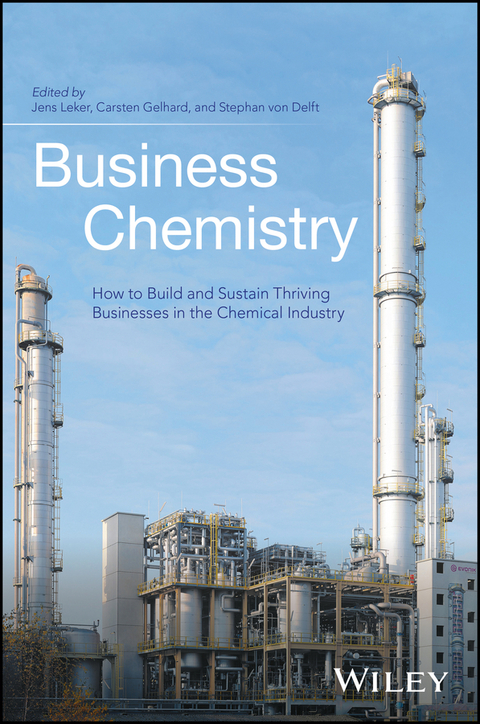
Business Chemistry (eBook)
John Wiley & Sons (Verlag)
978-1-118-85850-9 (ISBN)
Jens Leker is the Director of the Institute of Business Administration at the Department of Chemistry and Pharmacy, University of Münster, Germany. His research focuses on forecasting techniques, open innovation, and knowledge sharing in R&D collaboration in the chemical industry. He is a member of the German Chemical Society (GDCh), Head of the Advisory Board of the International Society of Professional Innovation Management (ISPIM), and Editor-in-Chief of the Journal of Business Chemistry.
Carsten Gelhard is an Assistant Professor of Product-Market Relations at the Faculty of Engineering Technology of the University of Twente, The Netherlands. His research is at the intersection of marketing, innovation management, and operations management. He is a member of the Society of Professional Innovation Management (ISPIM) and a legate at the Global Innovation and Knowledge Academy (GIKA). Dr. Carsten Gelhard is also co-founder and managing director at ThinkPals.
Stephan von Delft is a Lecturer in Strategy at the Adam Smith Business School, University of Glasgow, Scotland. His research focuses on business model design, business model innovation, and organizational capabilities in the chemical industry. He is a member of the German Chemical Society (GDCh), the Strategic Management Society (SMS), and a member of the Scientific Panel of the International Society of Professional Innovation Management (ISPIM).
Business Chemistry: How to Build and Sustain Thriving Businesses in the Chemical Industry is a concise text aimed at chemists, other natural scientists, and engineers who want to develop essential management skills. Written in an accessible style with the needs of managers in mind, this book provides an introduction to essential management theory, models, and practical tools relevant to the chemical industry and associated branches such as pharmaceuticals and consumer goods. Drawing on first-hand management experience and in-depth research projects, the authors of this book outline the key topics to build and sustain businesses in the chemical industry. The book addresses important topics such as strategy and new business development, describes global trends that shape chemical companies, and looks at recent issues such as business model innovation. Features of this practitioner-oriented book include: Eight chapters covering all the management topics relevant to chemists, other natural scientists and engineers. Chapters co-authored by experienced practitioners from companies such as Altana, A.T. Kearney, and Evonik Industries. Featured examples and cases from the chemical industry and associated branches throughout chapters to illustrate the practical relevance of the topics covered. Contemporary issues such as business model design, customer and supplier integration, and business co-operation.
Jens Leker is the Director of the Institute of Business Administration at the Department of Chemistry and Pharmacy, University of Münster, Germany. His research focuses on forecasting techniques, open innovation, and knowledge sharing in R&D collaboration in the chemical industry. He is a member of the German Chemical Society (GDCh), Head of the Advisory Board of the International Society of Professional Innovation Management (ISPIM), and Editor-in-Chief of the Journal of Business Chemistry. Carsten Gelhard is an Assistant Professor of Product-Market Relations at the Faculty of Engineering Technology of the University of Twente, The Netherlands. His research is at the intersection of marketing, innovation management, and operations management. He is a member of the Society of Professional Innovation Management (ISPIM) and a legate at the Global Innovation and Knowledge Academy (GIKA). Dr. Carsten Gelhard is also co-founder and managing director at ThinkPals. Stephan von Delft is a Lecturer in Strategy at the Adam Smith Business School, University of Glasgow, Scotland. His research focuses on business model design, business model innovation, and organizational capabilities in the chemical industry. He is a member of the German Chemical Society (GDCh), the Strategic Management Society (SMS), and a member of the Scientific Panel of the International Society of Professional Innovation Management (ISPIM).
List of Contributors
Preface
Part I: Strategy
Chapter 1: Management Challenges in the Chemical and Pharmaceutical Industry
Chapter 2: Principles of Strategy: How to Develop Strategy?
Chapter 3: Strategic Analysis: Understanding the Strategic Environment of the Firm
Chapter 4: Management of Business Cooperation
Part II: Innovation
Chapter 5: Principles of Research, Technology and Innovation
Chapter 6: New Business Development - Recognizing and Establishing New Business Opportunities
Chapter 7 : Designing and Transforming Business Models
Chapter 8: External Integration: Why, When, and How to Integrate Suppliers and Customers?
List of Contributors
Manuel Bauer is the Global Head of Innovation Management at LEDVANCE, a global leader in the general lighting market. Previously, he was a Manager at Innosight Consulting, a boutique consultancy founded by Professor Clayton Christensen, which focuses solely on helping clients develop and implement innovation and organic growth strategies. Previously he had worked as Corporate Innovation Manager at Clariant, a global specialty chemical company headquartered in Switzerland. There, he co‐developed the new innovation management approach and implemented it in two of Clariant’s largest global business units, including the project management process and tools, as well as the innovation portfolio management process and performance management concept. Manuel started his career at McKinsey & Company, in the Munich office, where he was a member of the global chemicals practice. He holds a PhD from the University of Münster, Germany, and a master of science in Chemistry from the University of Würzburg.
Carsten Gelhard is an Assistant Professor of Product‐Market Relations at the Faculty of Engineering Technology of the University of Twente, The Netherlands. Prior to this, he was a postdoctoral researcher at the Amsterdam Business School, The Netherlands. Carsten received his PhD from the University of Münster, Germany, where he also studied Business Chemistry. His research is at the intersection of marketing, innovation management, and operations management. In particular, Carsten examines how firms can achieve sustained competitive advantage: (i) by managing trade‐off situations that are associated with value creation activities and (ii) by collaborating with external partners across the value chain. His work has been published in the Journal of Business Research and the Journal of Operations Management.
Gerald Kirchner is Head of the Department of Corporate Environment, Health, and Safety at ALTANA, Wesel, Germany. Previously he headed the Innovation Management Group and the Global Regulatory Affairs Department within BYK, a division of ALTANA. Gerald started his professional career at Chemie Linz/DSM (Austria) as a research chemist in the area of organic intermediates. He spent his postdoctoral year at the Massachusetts Institute of Technology, USA, within the Department of Chemical Engineering/Bio Catalysis. Gerald studied Technical Chemistry at the Technical University of Graz, Austria. In his thesis, he elaborated different synthesis routes to plant growth hormones.
Jens Leker is a Professor at the University of Münster, Germany, and Director of the Institute of Business Administration at the Department of Chemistry and Pharmacy. His research focuses on forecasting techniques, open innovation and knowledge sharing in R&D collaboration. Jens has published more than 30 articles on technology and innovation management in journals such as the International Journal of Innovation Management, R&D Management, Technological Forecasting and Social Change and Technovation. He studied business administration at the University of Kiel, Germany, where he also received his PhD. Jens is a member of the German Chemical Society (GDCh), Head of the Advisory Board of the International Society of Professional Innovation Management (ISPIM) and an Editor‐in‐Chief of the Journal of Business Chemistry.
Thibaut Lenormant is an Innovation Manager at Gebauer & Griller in Vienna, Austria, and a PhD candidate at the University of Münster, Germany. He studied chemical engineering at the ESCPE Lyon, France, and innovation management at EMLyon, France. Thibaut also worked for several years as a Business Developer in the chemical industry where he contributed to the development of major innovations. His research focuses on organizational learning, complexity theory, and new product development processes.
Tobias Lewe is Partner and Managing Director at A.T. Kearney Management Consulting GmbH, Germany. He has more than 17 years of experience in top management consulting, leads A.T. Kearney’s EMEA practice for Energy & Process Industries, and is a member of the A.T. Kearney’s EMEA senior leadership team. Since starting his career he has consulted for a broad range of multi‐national clients, concentrating on downstream oil and petrochemicals as well as on chemical and coatings industry chains. His consulting expertize includes exogenous and organic growth, operating model design, innovation management, and digitization strategies as well as operations and performance transformation. Prior to joining A.T. Kearney, Tobias worked in the downstream oil industry, where he had management functions in supply and distribution and manufacturing/refining for ExxonMobil/Esso in Central Europe. He received his graduate and doctoral degrees in Chemistry at the University of Cologne.
Eric Meyer is Researcher at the Institute of Cooperative Systems at the University of Münster, Germany. After studying mathematics and economics at the University of Oldenburg he received his PhD from the University of Münster. His research focuses on the cooperation of companies. He is especially interested in how existing management methods have to be extended and adapted in order to make them applicable in business cooperation.
Theresia Theurl is Professor at the University of Münster, Germany, and Director of the Institute of Cooperative Systems. She studied economics at the University of Innsbruck, Austria, where she received her diploma. After three years as a Lecturer at the University of Munich, she returned to Innsbruck and received her PhD in economics. Theresia is member of numerous committees and councils related to cooperatives and cooperating companies. Since 2014 she has been Dean of the Münster School of Economics and Business. Her research focuses on the governance mechanisms that can be observed in cooperatives and cooperative groups and on the mechanisms that govern the cooperation of companies.
Irina Tiemann is a Senior Researcher at the Department of Business Administration, Economics and Law of the University of Oldenburg, Germany, and a member of the Oldenburg Center for Sustainability Economics and Management (CENTOS). Irina received her PhD from the University of Münster, Germany, where she also studied Business Chemistry. She subsequently worked as Business Development Manager at aleo solar GmbH in Oldenburg, Germany. Her academic interests are in the field of innovation management and sustainable entrepreneurship. Her work has been published in the International Journal of Innovation Management and International Journal of Business Venturing.
Hannes Utikal is a Professor for Strategic Management and Sustainability at Provadis School of International Management and Technology, Frankfurt, Germany, where he leads the Center for Industry and Sustainability. His research interests focus on strategic management and the design of transition processes. He initiated the “rhein‐main‐cluster chemie and pharma” where successor companies of the former Hoechst AG exchange knowledge about good management practices in the chemical and pharmaceutical industries. Hannes co‐edited the book Future. Chemistry. Glimpses at the World of Tomorrow and has published on the industries’ managerial challenges in the Journal of Business Chemistry and CHEManager. In addition, Hannes is involved in innovation and education projects at Climate‐KIC, the world’s largest public–private partnership working in the fields of climate adaptation and mitigation. Hannes studied business administration at the University of Cologne, where he also received his PhD. He is a member of the German Chemical Society (GDCh) and an Editor‐in‐Chief of the Journal of Business Chemistry.
Stephan von Delft is a Lecturer in Strategy at the Adam Smith Business School, University of Glasgow, UK. His research focuses on business model design, business model innovation, and organizational capabilities. Stephan has published in CHEManager, Nachrichten aus der Chemie, the Journal of Business Chemistry and the Journal of Business Research. He studied Business Chemistry at the University of Münster, Germany, where he also obtained his PhD. Stephan has been a visiting researcher at the University of San Diego, USA, and a postdoctoral researcher at the Amsterdam Business School, the Netherlands. He is a member of the German Chemical Society (GDCh), the Strategic Management Society (SMS), and a member of the Scientific Panel of the International Society of Professional Innovation Management (ISPIM).
Daniel Witthaut is Head of Corporate Innovation Strategy at Evonik Industries AG, a leader in specialty chemicals. Prior to his current role, he worked for six years as a Vice President in building up and leading the New Business Development Department for the former Advanced Intermediates Business Unit of Evonik. Daniel has more than 18 years of professional experience in innovation, strategic controlling, and strategy functions in different areas of the chemical industry and has lived in diverse cultures (USA, Germany, China, Singapore). He is a lecturer and a frequent (key note) speaker at conferences on Innovation Management. Furthermore, Daniel is a member of the Board of the European Industrial Research Management Association (EIRMA). He holds a PhD in Organic Chemistry from the University of Münster, Germany, and an MBA from the University...
| Erscheint lt. Verlag | 7.3.2018 |
|---|---|
| Sprache | englisch |
| Themenwelt | Naturwissenschaften ► Chemie ► Technische Chemie |
| Technik ► Umwelttechnik / Biotechnologie | |
| Wirtschaft ► Betriebswirtschaft / Management ► Unternehmensführung / Management | |
| Schlagworte | Business & Management • Business & Management in Chemistry • business management for chemical engineers • business management for chemists • business management for scientists • chemical business external integration • chemical business management • chemical business marketing • chemical business planning • chemical business r&d management • chemical business research and development management • chemical business strategy • chemical business supply chain management • chemical companies • chemical engineer professional development • Chemical Industry • chemical industry business cooperation • chemical industry business management • chemical industry business models • chemical industry business opportunities • chemical industry business start-up guide • chemical industry customer and supplier integration • chemical industry innovation management • chemical industry new business development • chemical industry trends • Chemie • Chemische Industrie • chemist professional development • Chemistry • Industrial Chemistry • Management • pharmaceutical business management • pharmaceutical business marketing • pharmaceutical business strategy • Technische u. Industrielle Chemie • Wirtschaft • Wirtschaft u. Management • Wirtschaft u. Management in der Chemischen Industrie |
| ISBN-10 | 1-118-85850-6 / 1118858506 |
| ISBN-13 | 978-1-118-85850-9 / 9781118858509 |
| Informationen gemäß Produktsicherheitsverordnung (GPSR) | |
| Haben Sie eine Frage zum Produkt? |
 EPUB (Adobe DRM)
Kopierschutz: Adobe-DRM
Adobe-DRM ist ein Kopierschutz, der das eBook vor Mißbrauch schützen soll. Dabei wird das eBook bereits beim Download auf Ihre persönliche Adobe-ID autorisiert. Lesen können Sie das eBook dann nur auf den Geräten, welche ebenfalls auf Ihre Adobe-ID registriert sind.
Details zum Adobe-DRM
Dateiformat: EPUB (Electronic Publication)
EPUB ist ein offener Standard für eBooks und eignet sich besonders zur Darstellung von Belletristik und Sachbüchern. Der Fließtext wird dynamisch an die Display- und Schriftgröße angepasst. Auch für mobile Lesegeräte ist EPUB daher gut geeignet.
Systemvoraussetzungen:
PC/Mac: Mit einem PC oder Mac können Sie dieses eBook lesen. Sie benötigen eine
eReader: Dieses eBook kann mit (fast) allen eBook-Readern gelesen werden. Mit dem amazon-Kindle ist es aber nicht kompatibel.
Smartphone/Tablet: Egal ob Apple oder Android, dieses eBook können Sie lesen. Sie benötigen eine
Geräteliste und zusätzliche Hinweise
Buying eBooks from abroad
For tax law reasons we can sell eBooks just within Germany and Switzerland. Regrettably we cannot fulfill eBook-orders from other countries.
aus dem Bereich