EPR Spectroscopy (eBook)
John Wiley & Sons (Verlag)
978-1-119-16298-8 (ISBN)
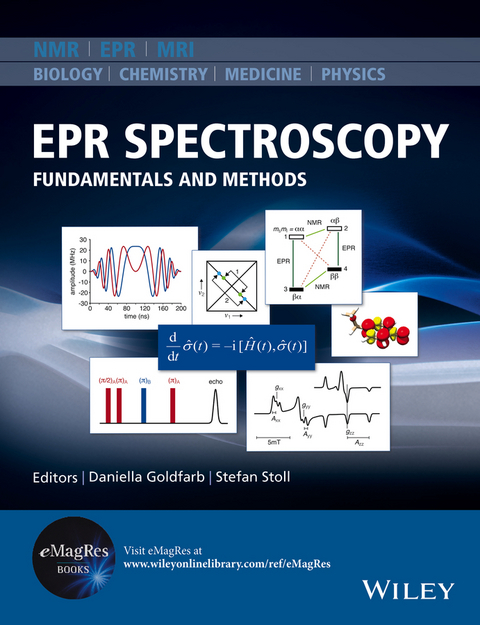
This unique, self-contained resource is the first volume on electron paramagnetic resonance (EPR) spectroscopy in the eMagRes Handbook series. The 27 chapters cover the theoretical principles, the common experimental techniques, and many important application areas of modern EPR spectroscopy. EPR Spectroscopy: Fundamentals and Methods is presented in four major parts: A: Fundamental Theory, B: Basic Techniques and Instrumentation, C: High-Resolution Pulse Techniques, and D: Special Techniques.
The first part of the book gives the reader an introduction to basic continuous-wave (CW) EPR and an overview of the different magnetic interactions that can be determined by EPR spectroscopy, their associated theoretical description, and their information content. The second provides the basics of the various EPR techniques, including pulse EPR, and EPR imaging, along with the associated instrumentation. Parts C and D builds on parts A and B and offer introductory accounts of a wide range of modern advanced EPR techniques, with examples of applications. The last two parts presents most of the new advances that do not appear in most of the classical EPR textbooks that focus on CW EPR.
EPR Spectroscopy: Fundamentals and Methods contains, in concise form, all the material needed to understand state-of-the-art EPR spectroscopy at the graduate school/research level, whilst the editors have ensured that it presents the topic at a level accessible to newcomers to the field and others who want to know its range of application and how to apply it.
Editors
Daniella Goldfarb is Professor in the Department of Chemical Physics at the Weizmann Institute of Science in Rehovot, Israel.
Stefan Stoll is Assistant Professor in the Department of Chemistry at the University of Washington in Seattle, Washington, USA.
This unique, self-contained resource is the first volume on electron paramagnetic resonance (EPR) spectroscopy in the eMagRes Handbook series. The 27 chapters cover the theoretical principles, the common experimental techniques, and many important application areas of modern EPR spectroscopy. EPR Spectroscopy: Fundamentals and Methods is presented in four major parts: A: Fundamental Theory, B: Basic Techniques and Instrumentation, C: High-Resolution Pulse Techniques, and D: Special Techniques. The first part of the book gives the reader an introduction to basic continuous-wave (CW) EPR and an overview of the different magnetic interactions that can be determined by EPR spectroscopy, their associated theoretical description, and their information content. The second provides the basics of the various EPR techniques, including pulse EPR, and EPR imaging, along with the associated instrumentation. Parts C and D builds on parts A and B and offer introductory accounts of a wide range of modern advanced EPR techniques, with examples of applications. The last two parts presents most of the new advances that do not appear in most of the classical EPR textbooks that focus on CW EPR. EPR Spectroscopy: Fundamentals and Methods contains, in concise form, all the material needed to understand state-of-the-art EPR spectroscopy at the graduate school/research level, whilst the editors have ensured that it presents the topic at a level accessible to newcomers to the field and others who want to know its range of application and how to apply it.
Editors Daniella Goldfarb is Professor in the Department of Chemical Physics at the Weizmann Institute of Science in Rehovot, Israel. Stefan Stoll is Assistant Professor in the Department of Chemistry at the University of Washington in Seattle, Washington, USA.
Contributors xi
Series Preface xv
Preface xvii
Part A: Fundamental Theory 1
1 Continuous-Wave EPR 3
Art van der Est
2 EPR Interactions - g-Anisotropy 17
Peter Gast and Edgar J.J. Groenen
3 EPR Interactions - Zero-field Splittings 29
Joshua Telser
4 EPR Interactions - Coupled Spins 63
Eric J.L. McInnes and David Collison
5 EPR Interactions - Hyperfine Couplings 81
Marina Bennati
6 EPR Interactions - Nuclear Quadrupole Couplings 95
Stefan Stoll and Daniella Goldfarb
7 Quantum Chemistry and EPR Parameters 115
Frank Neese
8 Spin Dynamics 143
Akiva Feintuch and Shimon Vega
9 Relaxation Mechanisms 175
Sandra S. Eaton and Gareth R. Eaton
Part B: Basic Techniques and Instrumentation 193
10 Transient EPR 195
Stefan Weber
11 Pulse EPR 215
Stefan Stoll
12 EPR Instrumentation 235
Edward Reijerse and Anton Savitsky
13 EPR Imaging 261
Boris Epel and Howard J. Halpern
14 EPR Spectroscopy of Nitroxide Spin Probes 277
Enrica Bordignon
Part C: High-Resolution Pulse Techniques 303
15 FT-EPR 305
Michael K. Bowman, Hanjiao Chen, and Alexander G. Maryasov
16 Hyperfine Spectroscopy - ENDOR 331
Jeffrey R. Harmer
17 Hyperfine Spectroscopy - ELDOR-detected NMR 359
Daniella Goldfarb
18 Hyperfine Spectroscopy - ESEEM 377
Sabine Van Doorslaer
19 Dipolar Spectroscopy - Double-resonance Methods 401
Gunnar Jeschke
20 Dipolar Spectroscopy - Single-resonance Methods 425
Peter P. Borbat and Jack H. Freed
21 Shaped Pulses in EPR 463
Philipp E. Spindler, Philipp Schöps, Alice M. Bowen, Burkhard Endeward, and Thomas F. Prisner
Part D: Special Techniques 483
22 Pulse Techniques for Quantum Information Processing 485
Gary Wolfowicz and John J.L. Morton
23 Rapid-scan EPR 503
Gareth R. Eaton and Sandra S. Eaton
24 EPR Microscopy 521
Aharon Blank
25 Optically Detected Magnetic Resonance (ODMR) 537
Etienne Goovaerts
26 Electrically Detected Magnetic Resonance (EDMR) Spectroscopy 559
Christoph Boehme and Hans Malissa
27 Very-high-frequency EPR 581
Alexander Schnegg
Index 603
Abbreviations and Acronyms
| 1D | one-dimensional |
| AA | Aharonov–Anandan |
| ADMR | absorption-detected magnetic resonance |
| ADP | adenosine diphosphate |
| AFC | automatic frequency control |
| AFM | atomic force microscopy |
| AFP | adiabatic fast passage |
| AILFT | ab initio ligand-field theory |
| AO | atomic orbital |
| AOM | angular overlap model |
| ARS | Advanced Research Systems |
| ATP | adenosine triphosphate |
| AWG | arbitrary waveform generator |
| BDPA | α,β-bisphenylene-β-phenylallyl-benzolate |
| BEBOP | broadband excitation by optimized pulses |
| BIR4 | $B_1$ insensitive rotation |
| BO | Born–Oppenheimer |
| BP | Breit–Pauli |
| BPP | Bloembergen, Purcell, Pound |
| BW | bandwidth |
| BWO | backward-wave oscillator |
| C-NOT | controlled-NOT |
| C-PHASE | controlled-phase |
| CAP | constant adiabaticity pulse |
| CASPT2 | complete active space second-order perturbation theory |
| CASSCF | complete active space self-consistent field |
| CC | coupled cluster |
| CESR | conduction electron-spin resonance |
| CFT | crystal field theory |
| CIDEP | chemically induced dynamic electron polarization |
| CIDME | chirp-induced dipolar modulation enhancement |
| CLR | cross-loop resonator |
| CP | combination-peak |
| CPMG | Carr–Purcell–Meiboom–Gill |
| CPT | coherence pathway transfer |
| CSR | coherent synchrotron radiation |
| CT | clock transitions |
| CT | coherence transfer |
| CW | continuous wave |
| DAC | digital-to-analog converter |
| DC | direct current |
| DD | dynamical decoupling |
| DDBSQ | 2,5-dichloro-3,6-dihydroxy-1,4-benzosemiquinone |
| DDS | direct digital synthesizer |
| DEER | double electron–electron resonance |
| DEER ESE | deadtime-free ESEEM by nuclear coherence-transfer echoes |
| DFDMR | delayed fluorescence detection of magnetic resonance |
| DFG | Deutsche Forschungsgemeinschaft |
| DFT | density functional theory |
| DKH | Douglas–Kroll–Hess |
| DNP | dynamic nuclear polarization |
| DONUT | double nuclear coherence transfer |
| DPPH | 2,2-diphenyl-1-picrylhydrazyl |
| DQ | double-quantum |
| DQC | double-quantum coherence |
| DQF | DQ filtering |
| DQM | double-quantum modulation |
| DSV | diameter spherical volume |
| EC | electron coherence |
| ED-EPR | echo-detected EPR |
| EDDEER | electrically detected double electron–electron resonance |
| EDMR | electrically detected magnetic resonance |
| EFG | electric field gradient |
| EIK | extended interaction klystron |
| EIO | extended interaction oscillator |
| ELDOR | electron-electron double resonance |
| ELDOR-detected NMR | electon-nuclear double resonance |
| EP | electron polarization |
| EPR | electron paramagnetic resonance |
| EPRI | EPR imaging |
| EPRM | EPR microscopy |
| ESE | electron spin echo |
| ESEEM | electron spin echo envelope modulation |
| ET | electron transfer |
| EZ | electron Zeeman |
| f.w.h.h. | flavin adenine dinucleotide |
| FBP | filtered backprojection |
| FD-EPR | frequency-domain EPR |
| FD-FT THz-EPR | fluorescence detection of magnetic resonance |
| FDMR | frequency-domain magnetic resonance |
| FEL | free-electron laser |
| FFT | fast Fourier transformation |
| FID | free induction decay |
| FJ | field-jump |
| FMR | ferromagnetic resonance |
| FPGA | field-programmable gate array |
| FR | Faraday rotator |
| FRET | fluorescence resonance energy transfer |
| FT | Fourier transform |
| FT | Fourier transformation |
| FWHM | full width at half maximum |
| GGA | generalized gradient approximation |
| GIAOs | gauge-including atomic orbitals |
| GM | Gifford–McMahon |
| HAS | hindered amine stabilizers |
| HF | Hartree–Fock |
| HF | high magnetic field |
| HF | hyperfine |
| HFCs | hyperfine couplings |
| HFEPR | high-frequency and high-field EPR |
| HFHF | high-field high-frequency |
| HFI | hyperfine interaction |
| HFML | High Field Magnet Laboratory |
| HOMO | highest occupied molecular orbital |
| HS | high-spin |
| HTA | high-turning-angle |
| HWHH | half width at half height |
| hwhm | half-width at half maximum |
| HYSCORE | hyperfine sublevel correlation |
| ID | instantaneous diffusion |
| IF | intermediate frequency |
| INS | inelastic neutron scattering |
| IQ | in-phase quadrature |
| IRESE | inversion recovery electron spin-echo |
| ISC | intersystem crossing |
| ISHE | inverse spin Hall effect |
| JB | Jeener–Broekaert |
| KS | Kohn–Sham |
| KSM | Kaplan, Solomon, and Mott |
| LAC | level anticrossing |
| LAN | local area network |
| LCP | left circular polarization |
| LDA | ``local density'' approximation |
| LF-DFT | ligand-field density functional theory |
| LFT | ligand-field theory |
| LGR | loop-gap resonator |
| LHS | left-hand side |
| LiPc | lithium phthalocyanine |
| LMO | localized molecular orbital |
| LNA | low-noise amplifier |
| LO | local oscillator |
| LP | lone-pair |
| LUMO | lowest unoccupied molecular orbital |
| LWHH | linewidth at half height |
| MCD | magnetic circular... |
| Erscheint lt. Verlag | 5.3.2018 |
|---|---|
| Reihe/Serie | eMagRes Books |
| EMR Books | EMR Books |
| Sprache | englisch |
| Themenwelt | Naturwissenschaften ► Chemie ► Analytische Chemie |
| Technik ► Umwelttechnik / Biotechnologie | |
| Schlagworte | Bildgebende Verfahren i. d. Biomedizin • biomedical engineering • Biomedical Imaging • Biomedizintechnik • chemical physics • Chemie • Chemistry • Electron Paramagnetic Resonance • Electron Spin Resonance • Encyclopedia of Magnetic Resonance • Encyclopedia of Magnetic Resonance series • EPR advancements • EPR handbook • EPR spectroscopy • EPR Spectroscopy: Fundamentals and Methods</p> • EPR techniques • ESR • Festkörperphysik • fundamental theory of EPR • <p>EPR • Magnetic Resonance • MRI • NMR • NMR Spectroscopy / MRI / Imaging • NMR-Spektroskopie / MRT / Bildgebende Verfahren • Physics • Physik • Solid state physics |
| ISBN-10 | 1-119-16298-X / 111916298X |
| ISBN-13 | 978-1-119-16298-8 / 9781119162988 |
| Informationen gemäß Produktsicherheitsverordnung (GPSR) | |
| Haben Sie eine Frage zum Produkt? |
 EPUB (Adobe DRM)
Kopierschutz: Adobe-DRM
Adobe-DRM ist ein Kopierschutz, der das eBook vor Mißbrauch schützen soll. Dabei wird das eBook bereits beim Download auf Ihre persönliche Adobe-ID autorisiert. Lesen können Sie das eBook dann nur auf den Geräten, welche ebenfalls auf Ihre Adobe-ID registriert sind.
Details zum Adobe-DRM
Dateiformat: EPUB (Electronic Publication)
EPUB ist ein offener Standard für eBooks und eignet sich besonders zur Darstellung von Belletristik und Sachbüchern. Der Fließtext wird dynamisch an die Display- und Schriftgröße angepasst. Auch für mobile Lesegeräte ist EPUB daher gut geeignet.
Systemvoraussetzungen:
PC/Mac: Mit einem PC oder Mac können Sie dieses eBook lesen. Sie benötigen eine
eReader: Dieses eBook kann mit (fast) allen eBook-Readern gelesen werden. Mit dem amazon-Kindle ist es aber nicht kompatibel.
Smartphone/Tablet: Egal ob Apple oder Android, dieses eBook können Sie lesen. Sie benötigen eine
Geräteliste und zusätzliche Hinweise
Buying eBooks from abroad
For tax law reasons we can sell eBooks just within Germany and Switzerland. Regrettably we cannot fulfill eBook-orders from other countries.
aus dem Bereich