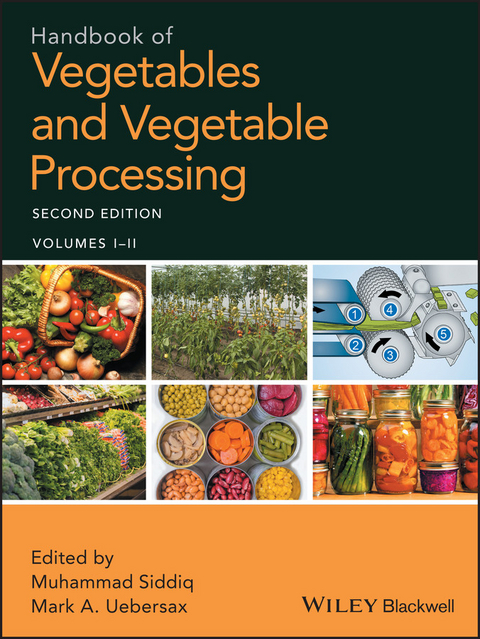
Handbook of Vegetables and Vegetable Processing (eBook)
John Wiley & Sons (Verlag)
978-1-119-09894-2 (ISBN)
Handbook of Vegetables and Vegetable Processing, Second Edition is the most comprehensive guide on vegetable technology for processors, producers, and users of vegetables in food manufacturing.This complete handbook contains 42 chapters across two volumes, contributed by field experts from across the world. It provides contemporary information that brings together current knowledge and practices in the value-chain of vegetables from production through consumption. The book is unique in the sense that it includes coverage of production and postharvest technologies, innovative processing technologies, packaging, and quality management.
Handbook of Vegetables and Vegetable Processing, Second Edition covers recent developments in the areas of vegetable breeding and production, postharvest physiology and storage, packaging and shelf life extension, and traditional and novel processing technologies (high-pressure processing, pulse-electric field, membrane separation, and ohmic heating). It also offers in-depth coverage of processing, packaging, and the nutritional quality of vegetables as well as information on a broader spectrum of vegetable production and processing science and technology.
- Coverage includes biology and classification, physiology, biochemistry, flavor and sensory properties, microbial safety and HACCP principles, nutrient and bioactive properties
- In-depth descriptions of key processes including, minimal processing, freezing, pasteurization and aseptic processing, fermentation, drying, packaging, and application of new technologies
- Entire chapters devoted to important aspects of over 20 major commercial vegetables including avocado, table olives, and textured vegetable proteins
This important book will appeal to anyone studying or involved in food technology, food science, food packaging, applied nutrition, biosystems and agricultural engineering, biotechnology, horticulture, food biochemistry, plant biology, and postharvest physiology.
Muhammad Siddiq, PhD is Associate Professor in the Department of Food Science and Human Nutrition, Michigan State University, East Lansing, USA.
Mark A. Uebersax, PhD is Professor Emeritus in the Department of Food Science and Human Nutrition, Michigan State University, East Lansing, USA.
Handbook of Vegetables and Vegetable Processing, Second Edition is the most comprehensive guide on vegetable technology for processors, producers, and users of vegetables in food manufacturing.This complete handbook contains 42 chapters across two volumes, contributed by field experts from across the world. It provides contemporary information that brings together current knowledge and practices in the value-chain of vegetables from production through consumption. The book is unique in the sense that it includes coverage of production and postharvest technologies, innovative processing technologies, packaging, and quality management. Handbook of Vegetables and Vegetable Processing, Second Edition covers recent developments in the areas of vegetable breeding and production, postharvest physiology and storage, packaging and shelf life extension, and traditional and novel processing technologies (high-pressure processing, pulse-electric field, membrane separation, and ohmic heating). It also offers in-depth coverage of processing, packaging, and the nutritional quality of vegetables as well as information on a broader spectrum of vegetable production and processing science and technology. Coverage includes biology and classification, physiology, biochemistry, flavor and sensory properties, microbial safety and HACCP principles, nutrient and bioactive properties In-depth descriptions of key processes including, minimal processing, freezing, pasteurization and aseptic processing, fermentation, drying, packaging, and application of new technologies Entire chapters devoted to important aspects of over 20 major commercial vegetables including avocado, table olives, and textured vegetable proteins This important book will appeal to anyone studying or involved in food technology, food science, food packaging, applied nutrition, biosystems and agricultural engineering, biotechnology, horticulture, food biochemistry, plant biology, and postharvest physiology.
Muhammad Siddiq, PhD is Associate Professor in the Department of Food Science and Human Nutrition, Michigan State University, East Lansing, USA. Mark A. Uebersax, PhD is Professor Emeritus in the Department of Food Science and Human Nutrition, Michigan State University, East Lansing, USA.
List of Contributors
Jasim Ahmed
Food and Nutrition Program, Environment and Life Sciences Research Center, Kuwait Institute for Scientific Research, Safat, Kuwait
R. Y. Avula
Department of Food Science and Technology, University of Georgia, Athens, USA
A. S. Bawa
Defence Food Research Laboratory, Mysore, India
Bhesh Bhandari
School of Agriculture and Food Sciences, University of Queensland, Brisbane, Australia
Paramita Bhattacharjee
Department of Food Technology and Biochemical Engineering Jadavpur University, Kolkata, India
Elizabeth A. Bihn
Department of Food Science, New York State Agricultural Experiment Station, Cornell University, Geneva, New York, USA
Gokhan Bingol
Department of Chemical and Materials Engineering, University of Auckland, Auckland, New Zealand
David A. Brummell
The New Zealand Institute for Plant & Food Research Limited, Manawatu Mail Centre, Palmerston North, New Zealand
Masood Sadiq Butt
Faculty of Food, Nutrition & Home Sciences, University of Agriculture, Faisalabad, Pakistan
Anoma Chandrasekara
Department of Applied Nutrition, Wyamba University, Makandura, (Gonawila), Sri Lanka
O. P. Chauhan
Defence Food Research Laboratory, Mysore, India
Sudarshan Chellan
Biotechnology Department, Kuwait Institute for Scientific Research, Safat, Kuwait
Linley Chiwona-Karltun
Department of Urban and Rural Development, Swedish University of Agricultural Sciences, Uppsala, Sweden
Y. Onur Devres
Food Engineering Department, Istanbul Technical University, Maslak, Istanbul, Turkey
Esra Dogu-Baykut
Department of Gastronomy and Culinary Arts, Dogus University, Istanbul, Turkey
Saeedeh Ebdali
Research and Development Office, Kalleh Dairy Inc., Amol, Mazandaran, Iran
Evangelos Evangelou
Plant Science Department, Wageningen University, The Netherlands
Sami Ghnimi
Department of Food Science, United Arab Emirates University, Al-Ain, United Arab Emirates
Nejib Guizani
Department of Food Science, United Arab Emirates University, Al-Ain, United Arab Emirates
Gurbuz Gunes
Department of Food Engineering, Istanbul Technical University, Istanbul, Turkey
B. Hounsome
College of Health and Behavioral Sciences, Institute of Medical and Social Care Research, Bangor University, Bangor, Wales, UK
N. Hounsome
College of Health and Behavioral Sciences, Institute of Medical and Social Care Research, Bangor University, Bangor, Wales, UK
Luke R. Howard
Department of Food Science, University of Arkansas, Arkansas, USA
Jose Jackson
African Studies Center, Michigan State University, East Lansing, Michigan, USA
Apostolos Kiritsakis
Alexander Technological Educational Institute of Thessaloniki, Thessaloníki, Greece
Kostas Kiritsakis
Department of Food Science and Technology, Aristotle University of Thessaloniki, Thessaloníki, Greece
Jaheon Koo
Director of Food Safety, Institute of Food Technologists, Washington, DC, USA
W. Krasaekoopt
Faculty of Biotechnology, Assumption University, Hua Mak Campus, Hua Mak, Bangkok, Thailand
Luke F. LaBorde
Department of Food Science, Penn State University, University Park, Pennsylvania, USA
Shao Quan Liu
Food Science and Technology Program, Department of Chemistry National University of Singapore, Singapore
M. G. Lobo
Postharvest & Food Technology Laboratory, Tropical Fruits Department, Instituto Canario de Investigaciones Agrarias, Tenerife, Canary Islands, Spain
Dharmendra K. Mishra
Department of Food Sciences, Purdue University, West Lafayette, Indiana, USA
Ali Motamedzadegan
Department of Food Science and Technology, Sari Agricultural Sciences and Natural Resources University, Sari, Mazandaran, Iran
Kasiviswanathan Muthukumarappan
Department of Agricultural and Biosystems Engineering, South Dakota State University, Brookings, South Dakota
Sadia Naeem
Institute of Home & Food Sciences, GC University, Faisalabad, Pakistan
Peter K. C. Ong
Food Science and Technology Program, Department of Chemistry National University of Singapore, Singapore
Melvin A. Pascall
Department of Food Science & Technology, Ohio State University, Columbus, Ohio, USA
K. V. Pecota
Department of Horticultural Science, North Carolina State University, Raleigh, USA
Edgar Po
Geoinformatics and Precision Agriculture Center, Xavier University, Cagayan de Oro City, Philippines
Lillian G. Po
Department of Food Science, University of Missouri, Columbia, Missouri, USA
Theodore J. K. Radovich
Department of Tropical Plant and Soil Sciences, University of Hawaii at Manoa, Honolulu, USA
P. S. Raju
Defence Food Research Laboratory, Mysore, India
Ramasamy Ravi
Department of Agricultural and Environmental Sciences, Tennessee State University, Nashville, Tennessee, USA
Stephen Reiners
Department of Horticultural Sciences, New York State Agricultural Experiment Station, Cornell University, Geneva, New York, USA
Joe M. Regenstein
Department of Food Science, Cornell University, Ithaca, New York, USA
Elliot T. Ryser
Department of Food Science and Human Nutrition, Michigan State University, East Lansing, Michigan, USA
Nikos Sakellaropoulos
Department of Food Science and Technology, Aristotle University of Thessaloniki, Thessaloníki, Greece
Abdul Sami
National Institute of Food Science and Technology, University of Agriculture, Faisalabad, Pakistan
Fereidoon Shahidi
Department of Biochemistry, Memorial University of Newfoundland, St. John's, Newfoundland, Canada
Tayyab Shahzad
Department of Food Science & Human Nutrition, University of Veterinary and Animal Sciences, Lahore, Pakistan
H. K. Sharma
Department of Food Engineering and Technology, Sant Longowal Institute of Engineering and Technology, Longowal, India
S. C. Shen
Department of Human Development and Family Studies, National Taiwan Normal University, Taipei City, Taiwan
Farihah Siddiq
Food Packaging Associate, East Lansing, Michigan, USA
Muhammad Siddiq
Department of Food Science & Human Nutrition, Michigan State University, East Lansing, Michigan, USA
Jiwan S. Sidhu
Department of Food Science and Nutrition, College of Life Sciences, Kuwait University, Safat, Kuwait
Rekha S. Singhal
Department of Food Engineering, Institute of Chemical Technology, Mumbai, India
Nirmal K. Sinha
Food Science & Technology Consultant, Redmond, Washington, USA
Haley Smolinski
Department of Food Science and Human Nutrition, Michigan State University, East Lansing, Michigan, USA
Dalbir S. Sogi
Department of Food Science & Technology, Guru Nanak Dev University, Amritsar, India
M. Tauseef Sultan
Department of Food Science, Bahauddin Zakariya University, Multan, Pakistan
Fatima Sultana
Institute of Home & Food Sciences, GC University, Faisalabad, Pakistan
Gabriela John Swamy
Department of Food Science, South Dakota State University, Brookings, South Dakota
Hoda Shahiri Tabarestani
Department of Food Science, Gorgan University of Agricultural Sciences and Natural Resources, Golestan, Iran
Brijesh Tiwari
TEAGASC—The Agriculture and Food Development Authority, Division of Food Bioscience, Carlow, County Cork, Ireland
Peter M. A. Toivonen
Postharvest Physiology, Science and Technology Branch, Agriculture and Agri-Food Canada, Summerland, British Columbia, Canada
V. D. Truong
USDA-ARS Food Science Research Unit, Department of Food, Bioprocessing and Nutrition Sciences, North Carolina State University, Raleigh, USA
Mark A. Uebersax
Department of Food Science & Human Nutrition, Michigan State University, East Lansing, Michigan, USA
Brittany L. White
Research and Development Department, Simmons Pet Food; Siloam Springs, Arkansas, USA
Wieslaw Wiczkowski
Institute of Animal Reproduction and Food Research, Polish Academy of Sciences, Olsztyn, Poland
James S. B. Wu
Institute of Food Science and Technology, National Taiwan University, Taipei City, Taiwan
G. C. Yencho
Department of Horticultural Science, North Carolina State University, Raleigh, USA
Sri Yuliani
Indonesian Center for Agricultural Postharvest Research and Development, Bogor, Indonesia
Tasleem Zafar
Department of Food Science and Nutrition, College of Life Sciences Kuwait University, Safat,...
| Erscheint lt. Verlag | 23.2.2018 |
|---|---|
| Sprache | englisch |
| Themenwelt | Naturwissenschaften ► Biologie |
| Technik ► Lebensmitteltechnologie | |
| Weitere Fachgebiete ► Land- / Forstwirtschaft / Fischerei | |
| Schlagworte | Agriculture • applied nutrition • biosystems and agricultural engineering • Biotechnology • botanically vegetables • crops • extending the shelf life of food • Feldfrüchte • Food Biochemistry • Food Packaging • Food Processing • Food Processing, Production & Manufacture • Food Safety • food science • Food Science & Technology • Food Technology • Fruit & Vegetable • Gemüse • Gemüseverarbeitung • Handbook of Vegetables and Vegetable Processing • Herstellung u. Verarbeitung von Lebensmitteln • horticulture • Landwirtschaft • Lebensmittelforschung u. -technologie • Lebensmittelverarbeitung • Nutrition • Obst u. Gemüse • organoleptic vegetables • Plant Biology • postharvest • postharvest physiology • value-chain operations • vegetable breeding and production • vegetable postharvesting • vegetable preservation • vegetable processing • vegetable production • vegetables • vegetable shelf life extension • Vegetable storage |
| ISBN-10 | 1-119-09894-7 / 1119098947 |
| ISBN-13 | 978-1-119-09894-2 / 9781119098942 |
| Informationen gemäß Produktsicherheitsverordnung (GPSR) | |
| Haben Sie eine Frage zum Produkt? |
 EPUB (Adobe DRM)
Kopierschutz: Adobe-DRM
Adobe-DRM ist ein Kopierschutz, der das eBook vor Mißbrauch schützen soll. Dabei wird das eBook bereits beim Download auf Ihre persönliche Adobe-ID autorisiert. Lesen können Sie das eBook dann nur auf den Geräten, welche ebenfalls auf Ihre Adobe-ID registriert sind.
Details zum Adobe-DRM
Dateiformat: EPUB (Electronic Publication)
EPUB ist ein offener Standard für eBooks und eignet sich besonders zur Darstellung von Belletristik und Sachbüchern. Der Fließtext wird dynamisch an die Display- und Schriftgröße angepasst. Auch für mobile Lesegeräte ist EPUB daher gut geeignet.
Systemvoraussetzungen:
PC/Mac: Mit einem PC oder Mac können Sie dieses eBook lesen. Sie benötigen eine
eReader: Dieses eBook kann mit (fast) allen eBook-Readern gelesen werden. Mit dem amazon-Kindle ist es aber nicht kompatibel.
Smartphone/Tablet: Egal ob Apple oder Android, dieses eBook können Sie lesen. Sie benötigen eine
Geräteliste und zusätzliche Hinweise
Buying eBooks from abroad
For tax law reasons we can sell eBooks just within Germany and Switzerland. Regrettably we cannot fulfill eBook-orders from other countries.
aus dem Bereich