


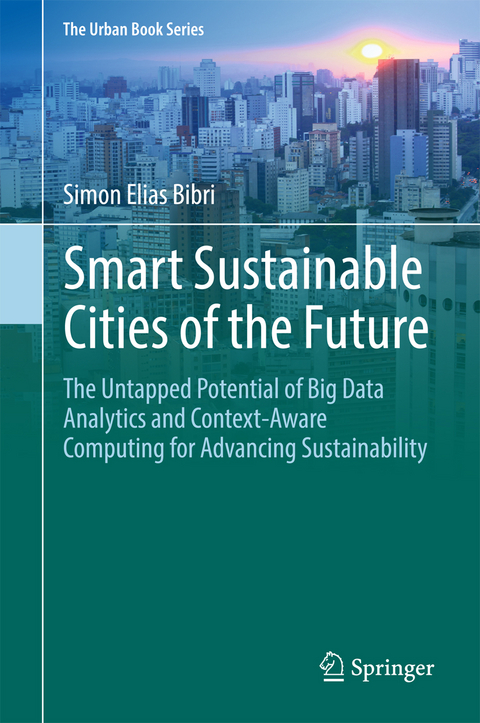
Smart Sustainable Cities of the Future (eBook)
XXIX, 660 Seiten
Springer International Publishing (Verlag)
978-3-319-73981-6 (ISBN)
This book is intended to help explore the field of smart sustainable cities in its complexity, heterogeneity, and breadth, the many faces of a topical subject of major importance for the future that encompasses so much of modern urban life in an increasingly computerized and urbanized world. Indeed, sustainable urban development is currently at the center of debate in light of several ICT visions becoming achievable and deployable computing paradigms, and shaping the way cities will evolve in the future and thus tackle complex challenges.
This book integrates computer science, data science, complexity science, sustainability science, system thinking, and urban planning and design. As such, it contains innovative computer-based and data-analytic research on smart sustainable cities as complex and dynamic systems. It provides applied theoretical contributions fostering a better understanding of such systems and the synergistic relationships between the underlying physical and informational landscapes. It offers contributions pertaining to the ongoing development of computer-based and data science technologies for the processing, analysis, management, modeling, and simulation of big and context data and the associated applicability to urban systems that will advance different aspects of sustainability.
This book seeks to explicitly bring together the smart city and sustainable city endeavors, and to focus on big data analytics and context-aware computing specifically. In doing so, it amalgamates the design concepts and planning principles of sustainable urban forms with the novel applications of ICT of ubiquitous computing to primarily advance sustainability. Its strength lies in combining big data and context-aware technologies and their novel applications for the sheer purpose of harnessing and leveraging the disruptive and synergetic effects of ICT on forms of city planning that are required for future forms of sustainable development. This is because the effects of such technologies reinforce one another as to their efforts for transforming urban life in a sustainable way by integrating data-centric and context-aware solutions for enhancing urban systems and facilitating coordination among urban domains.
This timely and comprehensive book is aimed at a wide audience across science, academia industry, and policymaking. It provides the necessary material to inform relevant research communities of the state-of-the-art research and the latest development in the area of smart sustainable urban development, as well as a valuable reference for planners, designers, strategists, and ICT experts who are working towards the development and implementation of smart sustainable cities based on big data analytics and context-aware computing.
Simon Elias Bibri is a Ph.D scholar in the area of smart sustainable cities of the future and Assistant Professor at the Norwegian University of Science and Technology (NTNU), Department of Computer and Information Science and Department of Urban Design and Planning, Trondheim, Norway. He holds a Bachelor of Science in computer engineering and 10 Masters of Science from different Swedish universities, namely Lund University, West University, Blekinge Institute of Technology, Malmö University, Stockholm University, and Mid Sweden University. He served as a sustainability and ICT strategist, business engineer, researcher, and consultant. His research interests include the following areas: ICT visions of pervasive computing, big data analytics and context-aware computing, sustainable urban planning and development, sustainable cities, smart cities, sustainability transitions, and technological innovation systems. He is the author of two recent books in the field of pervasive computing.
Simon Elias Bibri is a Ph.D scholar in the area of smart sustainable cities of the future and Assistant Professor at the Norwegian University of Science and Technology (NTNU), Department of Computer and Information Science and Department of Urban Design and Planning, Trondheim, Norway. He holds a Bachelor of Science in computer engineering and 10 Masters of Science from different Swedish universities, namely Lund University, West University, Blekinge Institute of Technology, Malmö University, Stockholm University, and Mid Sweden University. He served as a sustainability and ICT strategist, business engineer, researcher, and consultant. His research interests include the following areas: ICT visions of pervasive computing, big data analytics and context–aware computing, sustainable urban planning and development, sustainable cities, smart cities, sustainability transitions, and technological innovation systems. He is the author of two recent books in the field of pervasive computing.
Introduction: The Rise of Sustainability, ICT, and Urbanization and the Materialization of Smart Sustainable Cities.-Conceptual, Theoretical, and Discursive Background: A Multidimensional Framework.- The Core Enabling Technologies of Big Data Analytics and Context–Aware Computing for Smart Sustainable Cities: A Review and Synthesis.- The Next Wave of Urban Analytics in Light of Data Science: Data Mining and Knowledge Discovery in the Domain of Urban Sustainability.- Unprecedented Changes and Innovations in Sustainable Urban Planning in Light of Big Data and Data–Driven Decision–Making.- A Systems Thinking and Complexity Science Approach to Explaining Smart Sustainable Cities and the Prominence of Big Data Analytics, Intelligence Functions, and Simulation Models.- Merging Urban Informational and Physical Landscapes: Conceptual and Analytical Frameworks.- Managing the Complexity of Smart Sustainable Cities: Urban Project, ICT Project and Risk.- Management and Poly–Centric, Participatory and Big Data Governance.- Big Data Analytics and Context–Aware Computing: Characteristics, Commonalities, Differences, Applications, and Challenges.- On the Transition from Smart Cities to Smarter Cities: ICT of Pervasive Computing for Advancing Environmental Sustainability and Mitigating Environmental Risks.
| Erscheint lt. Verlag | 24.2.2018 |
|---|---|
| Reihe/Serie | The Urban Book Series | The Urban Book Series |
| Zusatzinfo | XXIX, 660 p. 13 illus., 10 illus. in color. |
| Verlagsort | Cham |
| Sprache | englisch |
| Themenwelt | Mathematik / Informatik ► Informatik ► Datenbanken |
| Naturwissenschaften ► Geowissenschaften ► Geografie / Kartografie | |
| Technik | |
| Schlagworte | Ambient Intelligence • Big Data Analytics • Context–aware computing • Landscape/Regional and Urban Planning • Sentient Computing • smart cities • Smart sustainable cities • sustainable cities • systems thinking • the Internet of Things • ubiquitous computing |
| ISBN-10 | 3-319-73981-6 / 3319739816 |
| ISBN-13 | 978-3-319-73981-6 / 9783319739816 |
| Informationen gemäß Produktsicherheitsverordnung (GPSR) | |
| Haben Sie eine Frage zum Produkt? |
 PDF (Wasserzeichen)
DRM: Digitales Wasserzeichen
Dieses eBook enthält ein digitales Wasserzeichen und ist damit für Sie personalisiert. Bei einer missbräuchlichen Weitergabe des eBooks an Dritte ist eine Rückverfolgung an die Quelle möglich.
Dateiformat: PDF (Portable Document Format)
Mit einem festen Seitenlayout eignet sich die PDF besonders für Fachbücher mit Spalten, Tabellen und Abbildungen. Eine PDF kann auf fast allen Geräten angezeigt werden, ist aber für kleine Displays (Smartphone, eReader) nur eingeschränkt geeignet.
Systemvoraussetzungen:
PC/Mac: Mit einem PC oder Mac können Sie dieses eBook lesen. Sie benötigen dafür einen PDF-Viewer - z.B. den Adobe Reader oder Adobe Digital Editions.
eReader: Dieses eBook kann mit (fast) allen eBook-Readern gelesen werden. Mit dem amazon-Kindle ist es aber nicht kompatibel.
Smartphone/Tablet: Egal ob Apple oder Android, dieses eBook können Sie lesen. Sie benötigen dafür einen PDF-Viewer - z.B. die kostenlose Adobe Digital Editions-App.
Buying eBooks from abroad
For tax law reasons we can sell eBooks just within Germany and Switzerland. Regrettably we cannot fulfill eBook-orders from other countries.
aus dem Bereich


