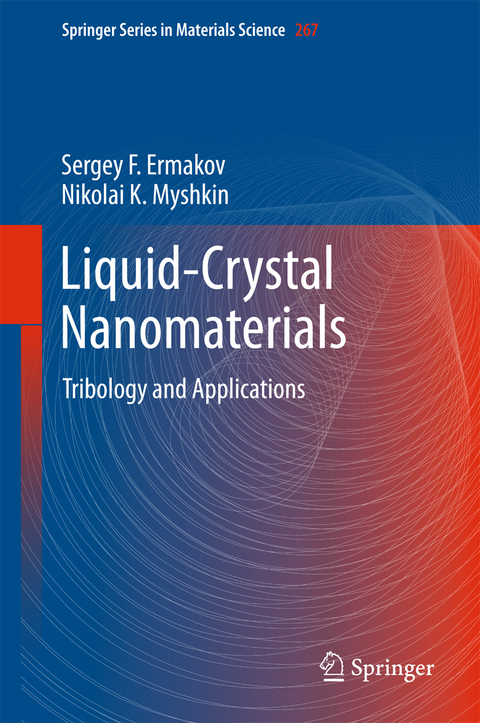
Liquid-Crystal Nanomaterials (eBook)
XVI, 215 Seiten
Springer International Publishing (Verlag)
978-3-319-74769-9 (ISBN)
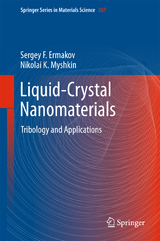
This book discusses the tribological, rheological and optical properties of liquid-crystal nanomaterials as well as lubricant media. It also describes the formation of liquid-crystal materials and the application of cholesteric liquid-crystal compounds in technical friction units and in human and animal joints. Further, it shows the connection between the tribological and other physical properties of liquid-crystal cholesterol compounds and develops a lubricity conceptual model of cholesteric-nematic, liquid-crystalline nanostructures on the basis of physical and energetic interpretations. This general model is valid for all surfaces and friction pairs, including biopolymers, and could lead to applications of cholesteric liquid-crystalline nanomaterials in different friction units and tribosystems as well as in the treatment of joint diseases.
Sergey Ermakov S.F. graduated from Gomel State University, Physics Faculty. He obtained his Ph.D. in 1986, D.Sc. in 2002 and became a professor in 2008. He has been working in V.A. Belyi Metal-Polymer Research Institute of National Academy of Sciences of Belarus since 1979. Prof. Ermakov was head of the laboratory 'Physics and Chemistry of Lubricants' from 2003 to 2005, and head of department 'Tribophysics of Liquid-crystal materials' from 2005 to 2012. He has been chair of the 'Tribophysics of lubricating materials' laboratory since 2012 and a professor at the Department of Microprocessor Technology and Information Management Systems at Belarusian State University of Transport, where he has combined scientific work with teaching since 2003. He received the Award for Best Research at Belarus National Academy of Sciences in 1990 and 2015. In 1998 Prof. Ermakov was awarded the P. Kapitsa Silver Medal for scientific discovery. He has published 7 monographs and more than 300 technical papers and has 22 inventor's certificates and 37 patents in the Republic of Belarus, Russian Federation and the USA. He is a member of the editorial board of the journals 'Friction and Wear' and 'Neftyanik Polesya'.
Professor Nikolai K. Myshkin is the director and head of the Tribology Department at the National Academy of Sciences of Belarus V.A. Belyi Metal-Polymer Research Institute. He received his master's degree in Electromechanical Engineering in 1971, Ph.D. degree from the Institute for Problems in Mechanics at the USSR Academy of Sciences, Moscow in 1977, and the D.Sc. degree in Tribology in 1985. Since 1991 he has been a full professor of materials science. After being a corresponding member of the Belarus National Academy of Sciences, he became a full member in 2009. He received the National Award for young scientists in USSR in 1982, the Award of Russian Government in Science and Technology in 2004, and the Award for Best Research at Belarus National Academy of Sciences in 2003 and 2011. His international activities include: vice-president of the International Tribology Council, deputy editor of the Journal of Friction and Wear, and he is a member of the editorial boards of various national and international journals: Mechanics of Materials, Machines and Mechanisms; Friction and Lubrication in Machines and Mechanisms, Materials, Technologies, and Tools; Applied Mechanics and Engineering; Tribology Letters; and Industrial Lubrication and Tribology. He has co-authored more than 20 monographs, textbooks and chapters in tribology and materials, more than 300 technical papers and 60 patents in Belarus and Russia, the USA, Europe and Asia.
Sergey Ermakov S.F. graduated from Gomel State University, Physics Faculty. He obtained his Ph.D. in 1986, D.Sc. in 2002 and became a professor in 2008. He has been working in V.A. Belyi Metal-Polymer Research Institute of National Academy of Sciences of Belarus since 1979. Prof. Ermakov was head of the laboratory “Physics and Chemistry of Lubricants” from 2003 to 2005, and head of department “Tribophysics of Liquid-crystal materials” from 2005 to 2012. He has been chair of the “Tribophysics of lubricating materials” laboratory since 2012 and a professor at the Department of Microprocessor Technology and Information Management Systems at Belarusian State University of Transport, where he has combined scientific work with teaching since 2003. He received the Award for Best Research at Belarus National Academy of Sciences in 1990 and 2015. In 1998 Prof. Ermakov was awarded the P. Kapitsa Silver Medal for scientific discovery. He has published 7 monographs and more than 300 technical papers and has 22 inventor’s certificates and 37 patents in the Republic of Belarus, Russian Federation and the USA. He is a member of the editorial board of the journals “Friction and Wear” and “Neftyanik Polesya”.Professor Nikolai K. Myshkin is the director and head of the Tribology Department at the National Academy of Sciences of Belarus V.A. Belyi Metal-Polymer Research Institute. He received his master’s degree in Electromechanical Engineering in 1971, Ph.D. degree from the Institute for Problems in Mechanics at the USSR Academy of Sciences, Moscow in 1977, and the D.Sc. degree in Tribology in 1985. Since 1991 he has been a full professor of materials science. After being a corresponding member of the Belarus National Academy of Sciences, he became a full member in 2009. He received the National Award for young scientists in USSR in 1982, the Award of Russian Government in Science and Technology in 2004, and the Award for Best Research at Belarus National Academy of Sciences in 2003 and 2011. His international activities include: vice-president of the International Tribology Council, deputy editor of the Journal of Friction and Wear, and he is a member of the editorial boards of various national and international journals: Mechanics of Materials, Machines and Mechanisms; Friction and Lubrication in Machines and Mechanisms, Materials, Technologies, and Tools; Applied Mechanics and Engineering; Tribology Letters; and Industrial Lubrication and Tribology. He has co-authored more than 20 monographs, textbooks and chapters in tribology and materials, more than 300 technical papers and 60 patents in Belarus and Russia, the USA, Europe and Asia.
Preface 6
About the Book 8
Contents 9
Acronyms and Nomenclature 12
Introduction 14
References 15
1 Structure and Properties of Liquid-Crystal Nanomaterials 16
1.1 Classification and Structure of Liquid-Crystal Nanomaterials 17
1.2 Mesomorphous and Optical Properties of Cholesteric Liquid-Crystal Nanomaterials 22
1.3 Physical Anisotropy and Application of Cholesteric Liquid-Crystal Nanomaterials 31
References 34
2 Tribology and Lubrication of Solids 36
2.1 Modern Antifriction and Antiwear Additives in Tribology (Passive Friction Control) 37
2.2 Present-Day Advances in Control of Antifriction Behavior of Solids (Active Friction Control) 57
2.3 Effect of Lattice-Ordered Lubricant Film on Friction of Solids 65
2.3.1 Structure of Fine Fluid Layers on the Solid Body Contact 66
2.3.2 Surface Forces in Fine Fluid Interlayers 72
2.3.3 Effects Observed During Deformation of Structured Boundary Layers 76
2.3.4 The Concept of the Micropolar Fluid and Related Hydrodynamic Effects 86
2.4 Tribology of Synovial Joints—Unique Natural Rubbing Organs 91
2.4.1 Theories and Hypotheses About Lubrication in the Living Joints 91
2.4.2 Conceptual Approaches to the Explanation of Low Friction in the Joints 98
References 106
3 Engineering and Technique of Experimental Tests of Liquid-Crystal Nanomaterials 115
3.1 Triboengineering Tests 115
3.1.1 Triboengineering Tests on Standard Equipment 115
3.1.2 Integral-Counting Method for Estimation of Small Variations of Oscillation Parameters for High-Precision Tribometry 117
3.1.3 Experimental Setup for the Simulation of Friction Processes in Natural Rubbing Organs–Joints 127
3.1.4 Tribometric Equipment for Precision Tests of Metal- and Biopolymer Coupling 132
3.2 Methods to Determine the Structuring Additives and Their Content in the Basic Compositions 149
3.2.1 Infrared Spectroscopy 149
3.2.2 Determination of the Concentration of the Liquid Crystal Additive in the Base Compositions by Measuring a Rotation Angle of Polarization Plane 150
3.2.3 Development of Methods and Equipment to Control the Mesophase of Cholesteric Liquid-Crystal Nanomaterials and Their Compounds 151
References 153
4 Tribological Properties of Liquid-Crystal Nanomaterials 156
4.1 Influence of Liquid-Crystal Nanomaterials on Friction of Chemically-Inactive Materials 156
4.2 Influence of Liquid-Crystal Nanomaterials on Friction of Metal Tribosystems 160
4.3 Adsorptive Properties of Liquid-Crystal Compounds 172
4.3.1 Interaction of Liquid-Crystal Nanomaterials with Hard Surface in Static Contact 173
4.3.2 Triboinduced Adsorption of Liquid-Crystal Nanomaterials Under Frictional Interaction of Solids 177
4.4 The Role of Liquid-Crystal Additives in Mechanism of Friction, Wear, and Lubrication of Tribosystems 182
4.5 Diagnostics of Liquid-Crystal Cholesterol Compounds in Lubricants by Optical Methods 187
4.6 Lubricity of Cholesteric Liquid-Crystal Nanomaterials and Their Mixtures Depending on Temperature 191
References 196
5 Practical Application of Liquid-Crystal Nanomaterial in Engineering and Medicine 200
5.1 Application of Liquid-Crystal Nanomaterials When Running-In of Internal-Combustion Engines 200
5.2 Liquid-Crystal Nanomaterials as Antiwear Engine Oil Additives 205
5.3 Assessment of Liquid-Crystal Compositions’ Efficiency When Polishing of Diamonds 208
5.4 Artificial Mediums Based on Liquid-Crystal Nanomaterials for Correction of Joint Tribology 210
5.5 Lubricants Based on Vacuum Oil Distillates and Liquid-Crystal Nanomaterials 214
References 219
Conclusions 221
Index 223
| Erscheint lt. Verlag | 6.2.2018 |
|---|---|
| Reihe/Serie | Springer Series in Materials Science | Springer Series in Materials Science |
| Zusatzinfo | XVI, 215 p. 130 illus., 42 illus. in color. |
| Verlagsort | Cham |
| Sprache | englisch |
| Themenwelt | Naturwissenschaften ► Physik / Astronomie |
| Technik ► Maschinenbau | |
| Wirtschaft | |
| Schlagworte | Liquid-Crystal Nanomaterials • Liquid-Crystal Nanomaterials in Medicine • Lubrication of Solids • Triboengineering Tests • Tribology Properties |
| ISBN-10 | 3-319-74769-X / 331974769X |
| ISBN-13 | 978-3-319-74769-9 / 9783319747699 |
| Informationen gemäß Produktsicherheitsverordnung (GPSR) | |
| Haben Sie eine Frage zum Produkt? |
 PDF (Wasserzeichen)
DRM: Digitales Wasserzeichen
Dieses eBook enthält ein digitales Wasserzeichen und ist damit für Sie personalisiert. Bei einer missbräuchlichen Weitergabe des eBooks an Dritte ist eine Rückverfolgung an die Quelle möglich.
Dateiformat: PDF (Portable Document Format)
Mit einem festen Seitenlayout eignet sich die PDF besonders für Fachbücher mit Spalten, Tabellen und Abbildungen. Eine PDF kann auf fast allen Geräten angezeigt werden, ist aber für kleine Displays (Smartphone, eReader) nur eingeschränkt geeignet.
Systemvoraussetzungen:
PC/Mac: Mit einem PC oder Mac können Sie dieses eBook lesen. Sie benötigen dafür einen PDF-Viewer - z.B. den Adobe Reader oder Adobe Digital Editions.
eReader: Dieses eBook kann mit (fast) allen eBook-Readern gelesen werden. Mit dem amazon-Kindle ist es aber nicht kompatibel.
Smartphone/Tablet: Egal ob Apple oder Android, dieses eBook können Sie lesen. Sie benötigen dafür einen PDF-Viewer - z.B. die kostenlose Adobe Digital Editions-App.
Buying eBooks from abroad
For tax law reasons we can sell eBooks just within Germany and Switzerland. Regrettably we cannot fulfill eBook-orders from other countries.
aus dem Bereich