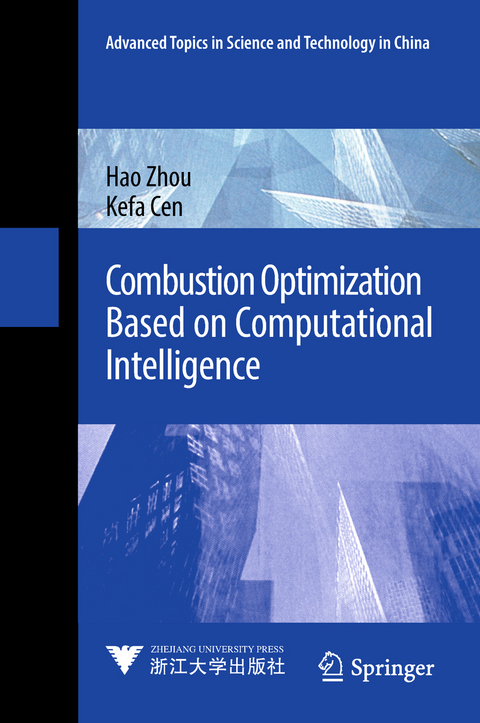
Combustion Optimization Based on Computational Intelligence (eBook)
XXVI, 270 Seiten
Springer Singapore (Verlag)
978-981-10-7875-0 (ISBN)
This book presents the latest findings on the subject of combustion optimization based on computational intelligence. It covers a broad range of topics, including the modeling of coal combustion characteristics based on artificial neural networks and support vector machines. It also describes the optimization of combustion parameters using genetic algorithms or ant colony algorithms, an online coal optimization system, etc. Accordingly, the book offers a unique guide for researchers in the areas of combustion optimization, NOx emission control, energy and power engineering, and chemical engineering.
Professor Hao Zhou received his Ph.D. degree from Zhejiang University in 2004. He is currently Deputy Director of State Key Laboratory of Clean Energy Utilization at Zhejiang University and Director of the Zhejiang University - University of Leeds joint research center for sustainable energy. His research interests include combustion optimization, low pollutant combustion technology for utility boilers, and neural network and support vector machine modeling methods. He has published over 20 academic papers and filed 7 patents in the areas of combustion pollutants control and combustion optimization since 2000.
Professor Kefa Cen is a member of the Chinese Academy of Engineering. He received his Ph.D. degree from Moscow Industrial Technology University and has expertise in clean coal combustion and gasification, poly-generation and comprehensive utilization of energy resources, as well as biomass gasification and bio-oil. He is currently Director of the Institute for Thermal Power Engineering at Zhejiang University and Chairman of the Chinese Society of Power Engineering's International Cooperation & Exchange Committee. He is also Editor-in-Chief of the Journal of Zhejiang University (Engineering Science) and the Journal of Renewable Energy. He has published over 800 academic papers and 15 books.
This book presents the latest findings on the subject of combustion optimization based on computational intelligence. It covers a broad range of topics, including the modeling of coal combustion characteristics based on artificial neural networks and support vector machines. It also describes the optimization of combustion parameters using genetic algorithms or ant colony algorithms, an online coal optimization system, etc. Accordingly, the book offers a unique guide for researchers in the areas of combustion optimization, NOx emission control, energy and power engineering, and chemical engineering.
Professor Hao Zhou received his Ph.D. degree from Zhejiang University in 2004. He is currently Deputy Director of State Key Laboratory of Clean Energy Utilization at Zhejiang University and Director of the Zhejiang University - University of Leeds joint research center for sustainable energy. His research interests include combustion optimization, low pollutant combustion technology for utility boilers, and neural network and support vector machine modeling methods. He has published over 20 academic papers and filed 7 patents in the areas of combustion pollutants control and combustion optimization since 2000. Professor Kefa Cen is a member of the Chinese Academy of Engineering. He received his Ph.D. degree from Moscow Industrial Technology University and has expertise in clean coal combustion and gasification, poly-generation and comprehensive utilization of energy resources, as well as biomass gasification and bio-oil. He is currently Director of the Institute for Thermal Power Engineering at Zhejiang University and Chairman of the Chinese Society of Power Engineering’s International Cooperation & Exchange Committee. He is also Editor-in-Chief of the Journal of Zhejiang University (Engineering Science) and the Journal of Renewable Energy. He has published over 800 academic papers and 15 books.
Preface 6
Contents 7
About the Authors 11
List of Figures 12
List of Tables 24
1 Introduction 26
Abstract 26
1.1 Background 26
1.2 Coal Combustion 27
1.2.1 General Process of Coal Combustion 27
1.2.2 The Duration of Coal Combustion 27
1.2.3 The Characteristic of Coal Combustion 28
1.3 Carbon Burnout 29
1.4 Coal Combustion Optimization 30
1.5 Outline of the Book 30
References 31
2 The Influence of Combustion Parameters on NOx Emissions and Carbon Burnout 32
Abstract 32
2.1 Introduction 32
2.2 Influence of Combustion Parameters on NOx Emissions 33
2.3 Influence of Combustion Parameters on Carbon Burnout 38
References 44
3 Modeling Methods for Combustion Characteristics 45
Abstract 45
3.1 Introduction 45
3.2 Experimental Method 46
3.2.1 Experimental Methods of Coal Combustion Characteristics Study 46
3.2.1.1 Coal Combustion Characteristics 46
3.2.1.2 Experimental Methods 46
3.2.1.3 Test System of Coal Combustion 53
3.2.2 Flame Temperature Measurement 57
3.2.3 Flue Gas Analysis 58
3.2.4 Application Examples 62
3.3 CFD Method 89
3.3.1 Turbulence Model 90
3.3.2 Combustion Model 93
3.3.3 Radiative Heat Transfer Model 94
3.3.4 Discrete Phase Model 94
3.3.5 Reaction Models of Particles 95
3.3.6 Pollutant Formation Model 96
3.3.7 Application Examples 96
3.4 Computational Intelligence Method 156
3.5 Summary 166
References 166
4 Neural Network Modeling of Combustion Characteristics 170
Abstract 170
4.1 Introduction 170
4.1.1 Structural Model of Neuron 170
4.1.2 MP Model 171
4.2 Back Propagation Neural Network Method 172
4.2.1 BPNN Algorithm 172
4.2.2 Learning Methods 173
4.3 General Regression Neural Network Method 174
4.3.1 GRNN Algorithm 175
4.3.2 GRNN Structure 175
4.4 Comparison of BPNN Method and GRNN Method 176
4.4.1 GRNN Advantages 176
4.4.2 Comparison on Example 176
4.5 Summary 177
References 177
5 Classification of the Combustion Characteristics based on Support Vector Machine Modeling 178
Abstract 178
5.1 The Introduction of Support Vector Machine 178
5.2 The Principle of Support Vector Machine 180
5.2.1 Support Vector Classification 180
5.2.2 Support Vector Regression 181
5.2.3 Kernel Function 181
5.3 The Application of Support Vector Machine 182
5.3.1 Coal Identification 182
5.3.2 The Prediction of Ash Fusion Temperature 184
5.3.3 The Prediction of Unburned Carbon in Fly Ash 186
5.3.4 The Prediction of NOx Emission 188
5.4 Summary 192
References 192
6 Combining Neural Network or Support Vector Machine with Optimization Algorithms to Optimize the Combustion 194
Abstract 194
6.1 Introduction of Optimization Algorithms 194
6.1.1 Genetic Algorithms 194
6.1.1.1 Introduction to GA 194
6.1.1.2 The Description of GA 195
6.1.1.3 The Process of GA Approach 195
6.1.2 Ant Colony Algorithms 196
6.1.2.1 Introduction to ACO 196
6.1.2.2 The Description of ACO 196
6.1.2.3 Another Algorithm of ACO 199
6.1.3 Particle Swarm Algorithms 201
6.2 Combining Neural Network and GA to Optimize the Combustion 203
6.2.1 Experiments 203
6.2.2 Result and Discussions 205
6.2.3 Conclusions 210
6.3 Combining SVM and Optimization Algorithms to Optimize the Combustion 210
6.3.1 Modeling NOx Emissions by SVM and ACO with Operating Parameters Optimizing 211
6.3.1.1 Experimental Setup and Data Analysis 211
6.3.1.2 Results 214
6.3.1.3 Prediction Results of ACO–SVR 214
6.3.1.4 Prediction Results of Grid SVR 218
6.3.1.5 Comparison and Discussion 220
6.3.1.6 Conclusions 222
6.3.2 Modeling NOx Emissions by SVM and PSO with Model and Operating Parameters Optimizing 223
6.3.2.1 Experimental Setup 223
6.3.2.2 Optimization Results for the Boiler Load of 288.45 MW 227
6.3.2.3 Comparison with Other Methods 228
6.3.2.4 Conclusions 231
6.3.3 Comparison of Optimization Algorithms for Low NOx Combustion 232
6.3.3.1 Experimental Setup and NOx Emission Data 232
6.3.3.2 Estimation of NOx Emissions by SVR 234
6.3.3.3 Selection of Model Parameters 235
6.3.3.4 NOx Emissions Prediction Results 236
6.3.3.5 Low NOx Emissions by Combining SVR and Optimization Methods 237
6.3.3.6 Parameter Settings for Various Algorithms 239
6.3.3.7 Performance Comparisons 239
6.3.3.8 Convergence Rate 244
6.3.3.9 Conclusions 245
6.4 Multi-objective Optimization of Coal Combustion for Utility Boilers 246
6.4.1 Multi-objective Optimization Algorithm 246
6.4.1.1 The Cellular Genetic Algorithm for Multi-objective Optimization (MOCell) 246
6.4.1.2 AbYSS Algorithm 247
6.4.1.3 OMOPSO Algorithm 247
6.4.1.4 SPEA2 Algorithm 249
6.4.2 Introduction and Experiment Setup 250
6.4.3 Modeling NOx Emissions and Carbon Burnout 251
6.4.4 Performance Metrics of Pareto Solution 253
6.4.4.1 The Ratio of Non-dominated Individuals (RNI) 253
6.4.4.2 Cover Rate 253
6.4.5 Parameter Settings for Various Algorithms 254
6.4.6 Performance Comparisons 254
6.4.7 Conclusion 258
6.5 Summary 258
References 259
7 Online Combustion Optimization System 261
Abstract 261
7.1 Introduction 262
7.1.1 Data Detection Requirements 262
7.1.2 Quickness and Accuracy Requirements 262
7.1.3 Requirements for Different Optimization Goals 263
7.1.4 Requirements Online Self-Learning 263
7.1.5 Parameter Optimization Limit Requirements 263
7.1.6 Fault Tolerance Requirements 263
7.1.7 Alarm Requirements 264
7.1.8 Compatibility of Off-line Data Processing and Optimizing 264
7.2 Instruments or Sensors for Online Combustion Optimization System 264
7.3 Online SVM Algorithm 265
7.3.1 Algorithm Introduction 265
7.3.2 Derivation of the Incremental Relations 268
7.3.3 AOSVR Bookkeeping Procedure 270
7.3.4 Efficiently Updating the R Matrix 271
7.3.5 Initialization of the Incremental Algorithm 272
7.3.6 Decremental Algorithm 273
7.4 Online Combustion Optimization System 273
7.4.1 Online Monitoring and Alarm Function 273
7.4.2 Online Optimization and Self-Learning Function 274
7.4.3 Off-line Modeling and Optimization Function 275
7.5 The Application of Online Combustion Optimization System 280
7.5.1 Train and Prediction 280
7.5.2 Test Purpose 283
7.5.3 Test Condition 283
7.5.4 Test Data 283
7.5.5 Result and Analysis 285
7.6 Summary 285
Reference 286
8 Combustion Optimization Based on Computational Intelligence Applications: Future Prospect 287
Abstract 287
References 288
Index 290
| Erscheint lt. Verlag | 2.2.2018 |
|---|---|
| Reihe/Serie | Advanced Topics in Science and Technology in China | Advanced Topics in Science and Technology in China |
| Zusatzinfo | XXVI, 270 p. 229 illus., 129 illus. in color. |
| Verlagsort | Singapore |
| Sprache | englisch |
| Themenwelt | Informatik ► Theorie / Studium ► Künstliche Intelligenz / Robotik |
| Naturwissenschaften ► Biologie ► Ökologie / Naturschutz | |
| Naturwissenschaften ► Chemie | |
| Naturwissenschaften ► Geowissenschaften | |
| Naturwissenschaften ► Physik / Astronomie | |
| Technik ► Elektrotechnik / Energietechnik | |
| Technik ► Maschinenbau | |
| Schlagworte | ATSTC • Carbon Burnout • Combustion Optimization • Computational Intelligence • NOx Emission • ZJUP |
| ISBN-10 | 981-10-7875-0 / 9811078750 |
| ISBN-13 | 978-981-10-7875-0 / 9789811078750 |
| Informationen gemäß Produktsicherheitsverordnung (GPSR) | |
| Haben Sie eine Frage zum Produkt? |
 PDF (Wasserzeichen)
DRM: Digitales Wasserzeichen
Dieses eBook enthält ein digitales Wasserzeichen und ist damit für Sie personalisiert. Bei einer missbräuchlichen Weitergabe des eBooks an Dritte ist eine Rückverfolgung an die Quelle möglich.
Dateiformat: PDF (Portable Document Format)
Mit einem festen Seitenlayout eignet sich die PDF besonders für Fachbücher mit Spalten, Tabellen und Abbildungen. Eine PDF kann auf fast allen Geräten angezeigt werden, ist aber für kleine Displays (Smartphone, eReader) nur eingeschränkt geeignet.
Systemvoraussetzungen:
PC/Mac: Mit einem PC oder Mac können Sie dieses eBook lesen. Sie benötigen dafür einen PDF-Viewer - z.B. den Adobe Reader oder Adobe Digital Editions.
eReader: Dieses eBook kann mit (fast) allen eBook-Readern gelesen werden. Mit dem amazon-Kindle ist es aber nicht kompatibel.
Smartphone/Tablet: Egal ob Apple oder Android, dieses eBook können Sie lesen. Sie benötigen dafür einen PDF-Viewer - z.B. die kostenlose Adobe Digital Editions-App.
Buying eBooks from abroad
For tax law reasons we can sell eBooks just within Germany and Switzerland. Regrettably we cannot fulfill eBook-orders from other countries.
aus dem Bereich