


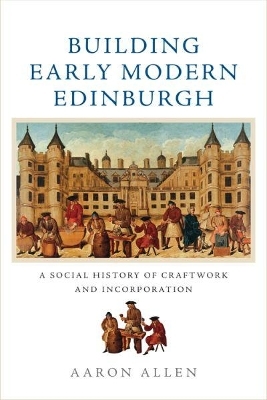
Building Early Modern Edinburgh
A Social History of Craftwork and Incorporation
Seiten
2018
Edinburgh University Press (Verlag)
978-1-4744-4238-1 (ISBN)
Edinburgh University Press (Verlag)
978-1-4744-4238-1 (ISBN)
This volume traces the history of the Edinburgh Incorporation of Mary’s Chapel, which sought to control the capital’s building trades and defend their privileges. By utilising a range of previously missing charters and archival documents, the author offers a new perspective on the prestigious craft guild in its 542 years of existence.
Much like in the present day, building a house in the sixteenth century involved masons, carpenters and glaziers, among others, and in many cities such trades had separate companies to govern their own affairs. In Edinburgh, however, they banded together in a single body – the Edinburgh Incorporation of Mary’s Chapel.
Building Early Modern Edinburgh traces the history of the organisation, which sought to control the capital’s building trades and defend their privileges. By utilising a range of previously missing charters and archival documents, the author offers a new perspective on the prestigious and important craft guild in its 543 years of existence. Developing a crucial theme of ‘composite corporatism’, and using the concepts of ‘family’ and ‘household’ to approach an urban institution, this book is a valuable resource of comparative material for the study of craft guilds and urban history in a global context.
Much like in the present day, building a house in the sixteenth century involved masons, carpenters and glaziers, among others, and in many cities such trades had separate companies to govern their own affairs. In Edinburgh, however, they banded together in a single body – the Edinburgh Incorporation of Mary’s Chapel.
Building Early Modern Edinburgh traces the history of the organisation, which sought to control the capital’s building trades and defend their privileges. By utilising a range of previously missing charters and archival documents, the author offers a new perspective on the prestigious and important craft guild in its 543 years of existence. Developing a crucial theme of ‘composite corporatism’, and using the concepts of ‘family’ and ‘household’ to approach an urban institution, this book is a valuable resource of comparative material for the study of craft guilds and urban history in a global context.
Aaron Allen is currently a Teaching Fellow at the University of Edinburgh. He is the author of The Locksmith Craft in Early Modern Edinburgh (2007) and co-editor, with Cathryn Spence, of Edinburgh Housemails Taxation Book, 1634–1636 (2014).
List of Tables; List of Figures & Plates; List of Abbreviations; Foreword; PrefaceIntroduction: Incorporation and the Corporate Framework1. Headship and Inclusion2. Family, Household and Obligation3. Craft and Kirk: Security, Status and Shelter4. Craft and Burgh: Conflict or Partnership?Conclusions: The Decline of Corporatism and the Rise of the UnfreeAppendices; Glossary; Bibliography; Index
| Erscheinungsdatum | 06.10.2018 |
|---|---|
| Zusatzinfo | 11 black and white illustrations, 8 colour illustrations |
| Verlagsort | Edinburgh |
| Sprache | englisch |
| Maße | 156 x 234 mm |
| Gewicht | 590 g |
| Themenwelt | Sachbuch/Ratgeber ► Geschichte / Politik ► Regional- / Landesgeschichte |
| Geisteswissenschaften ► Geschichte ► Regional- / Ländergeschichte | |
| Sozialwissenschaften ► Soziologie | |
| Technik ► Architektur | |
| ISBN-10 | 1-4744-4238-2 / 1474442382 |
| ISBN-13 | 978-1-4744-4238-1 / 9781474442381 |
| Zustand | Neuware |
| Informationen gemäß Produktsicherheitsverordnung (GPSR) | |
| Haben Sie eine Frage zum Produkt? |
Mehr entdecken
aus dem Bereich

aus dem Bereich
eine Geschichte der Vereinigten Staaten von 1950 bis heute
Buch | Hardcover (2024)
Klett-Cotta (Verlag)
CHF 48,95


