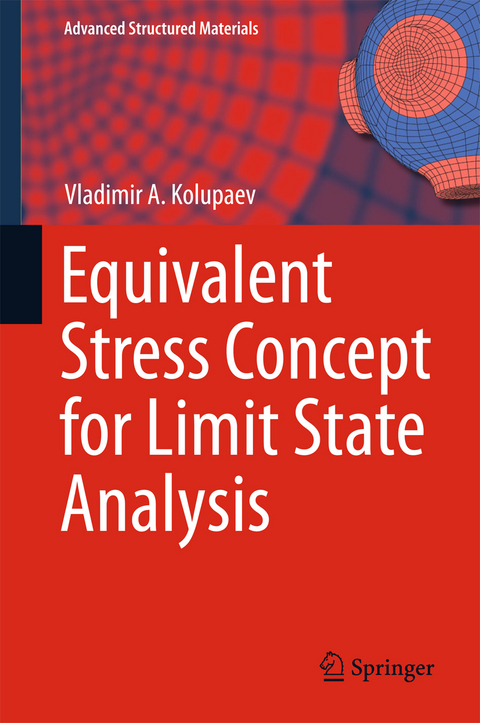
Equivalent Stress Concept for Limit State Analysis (eBook)
XVII, 365 Seiten
Springer International Publishing (Verlag)
978-3-319-73049-3 (ISBN)
This book discusses arbitrary multiaxial stress states using the concept of equivalent stress. It highlights the most useful criteria, which can be applied to various classes of isotropic materials. Due to its simplicity and clarity, this concept is now widely used in component design, and many strength and yield criteria based on the equivalent stress concept have been formulated. Choosing the appropriate criterion for a given material remains the main challenge in applications.
The most useful criteria can be applied best when the plausibility assumptions are known. Accordingly, the book introduces fitting methods based on mathematical, physical, and geometrical objective functions. It also features a wealth of examples that demonstrate the application of different approaches in modeling certain limit behaviors.
Acknowledgements 7
Contents 8
Abbreviations 13
Abstract 15
1 Introduction 16
1.1 Need of Criteria 16
1.2 Equivalent Stress Concept 17
1.3 Invariants of Stress Tensor 18
1.4 Lode Parameter 20
1.5 Formulation of Criteria 21
1.6 Methodology 22
References 23
2 Criteria of Equivalent Stress Concept 27
2.1 Zero-Parameter Criteria 27
2.1.1 Rankine 27
2.1.2 Tresca 29
2.1.3 Maxwell, Huber--von Mises--Hencky 30
2.1.4 Mariotte 32
2.1.5 Schmidt--Ishlinsky, Burzy?ski 32
2.1.6 Ivlev 33
2.1.7 Ko 34
2.1.8 Sokolovsky and Ishlinsky--Ivlev 34
2.1.9 Conclusion 35
2.2 One-Parameter Criteria 36
2.2.1 Mariotte-St. Venant 36
2.2.2 Beltrami 38
2.2.3 Mohr-Coulomb 40
2.2.4 Sandel 41
2.2.5 Burzy?ski--Torre, Balandin 42
2.2.6 Drucker 43
2.2.7 Drucker--Prager, Mirolyubov 45
2.2.8 Sayir 46
2.2.9 Haythornthwaite, Candland 47
2.2.10 Sdobyrev, Pisarenko--Lebedev 49
2.2.11 Capurso 50
2.2.12 Freudenthal--Gou, Cazacu--Barlat 51
2.2.13 Spitzig 52
2.2.14 Edelman--Drucker 53
2.2.15 Maitra, Iyer 54
2.2.16 Dodd--Naruse 55
2.2.17 Hoek--Brown 56
2.2.18 Kolupaev 56
2.3 Two-Parameter Criteria 57
2.3.1 Burzy?ski--Yagn 57
2.3.2 Schleicher 59
2.3.3 Leckie--Hayhurst 60
2.3.4 Podgórski, Bigoni--Piccolroaz 61
2.3.5 Yu 64
2.4 Criteria with More Than Two Parameters 65
2.4.1 Birger 66
2.4.2 Altenbach--Zolochevsky 66
2.4.3 Altenbach--Bolchoun--Kolupaev 68
2.5 Obvious Systematization 69
References 70
3 Visualization Methods 81
3.1 Spatial Representation of the Limit Surface 81
3.2 ?-Plane 86
3.3 Burzy?ski-Plane 88
3.4 Diagram ?I-?II 91
3.5 Diagram ?11-?12 93
3.6 Assessment of the Loading Points 94
References 100
4 Formulations of Classical Strength Hypotheses 103
4.1 Normal Stress Hypothesis 103
4.2 Tresca Hypothesis 106
4.3 vonMises Hypothesis 108
4.4 Schmidt--Ishlinsky Hypothesis 108
4.5 Remarks About Graphical Forms 111
References 112
5 Dimensionless Values for Comparison 114
5.1 Basic Stress States 114
5.2 ?-Plane Values 124
5.3 Elastic Poisson's Ratio 125
5.4 Inelastic Poisson's Ratio 126
References 132
6 Visualization of Standard Criteria 136
6.1 Strain Criterion 136
6.2 Burzy?ski--Yagn Criterion 139
6.3 Linear Combinations of the Classical Hypotheses 141
6.3.1 Mohr--Coulomb Criterion 141
6.3.2 Sdobyrev, Pisarenko--Lebedev Criterion 144
6.4 Comparison of Standard Criteria 146
6.5 Discussion of Standard Criteria 146
References 149
7 Alternative Formulations of Standard Criteria 152
7.1 Hoek--Brown Criterion 152
7.2 Modifications of the Pisarenko--Lebedev Criterion 153
7.2.1 Pisarenko--Lebedev Criteria of Higher Power 153
7.2.2 Reduced Cubic Criterion 154
7.2.3 Leckie--Hayhurst Criterion 155
7.2.4 Sayir's Cone 158
7.3 Modification of Twin-Shear Theory 159
7.4 Simple Generalizations 160
7.5 Discussion 161
References 162
8 Conditions and Assumptions of Strength Criteria 163
8.1 Remarks Concerning the State of the Art of Research 163
8.1.1 Need of a Generalized Criterion 164
8.1.2 Applicability of the Criteria 165
8.2 Formulation of Conditions 166
8.2.1 Necessary Conditions 166
8.2.2 Plausibility Assumptions 166
References 167
9 Generalized Pressure-Insensitive Criteria 171
9.1 Yield Criteria of Trigonal Symmetry 172
9.1.1 Sayir Criterion 172
9.1.2 Capurso Criterion 173
9.1.3 Haythornthwaite Criterion 176
9.1.4 Podgórski, Bigoni–Piccolroaz Criterion 178
9.1.5 Modified Altenbach–Zolochevsky Criterion 178
9.1.6 Capurso–Haythornthwaite Linear Combination 181
9.1.7 Capurso–Haythornthwaite Multiplicative Ansatz 182
9.1.8 Radcig Criterion 183
9.1.9 Cosine Ansatz of Altenbach–Bolchoun–Kolupaev 184
9.1.10 Tri-quadratic Criterion 186
9.2 Yield Criteria of Hexagonal Symmetry 187
9.2.1 Unified Yield Criterion of Yu 188
9.2.2 Bi-cubic Criterion 191
9.2.3 Multiplicative Ansatz Criterion 191
9.2.4 Generalized Criterion of Hexagonal Symmetry 193
9.2.5 Cosine Ansatz of Even Powers 194
9.2.6 Criteria of the Stress Power n=12 194
9.3 Smooth and Polyhedral Criteria 195
9.4 Non-convex Yield Criteria in the ?-Plane 198
9.5 Conclusion 200
References 202
10 Generalized Pressure-Sensitive Criteria 206
10.1 Extension of Yield Criteria 206
10.2 Conical and Pyramidal Criteria 211
10.3 Unified Strength Theory of Yu 215
10.4 Criteria Recommended for Applications 219
10.4.1 Modified Theory of Yu 219
10.4.2 Rotationally Symmetric Criteria 221
10.4.3 Geometrical-Mechanical Criterion 224
10.4.4 Capurso--Haythornthwaite Generalization 225
10.5 Criterion Normalized on Uniaxial Compressive Stress 226
10.6 Conclusion 228
References 230
11 Multi-surface Criteria 233
11.1 Motivation 233
11.2 Systematization of Multi-surface Criteria 234
11.3 Criteria with C0-Transition 236
11.3.1 Davidenkov--Fridman Criterion 240
11.3.2 Modifications of the Normal Stress Hypothesis 240
11.3.3 Modifications of the Strain Criterion 245
11.4 Criteria with C1-Transition 246
11.4.1 Ad hoc Approach According to Berg 246
11.4.2 Huber Criterion 247
11.4.3 Kuhn Criterion 249
11.4.4 Modified Criterion of Huber 250
11.4.5 Combined Geometrical-Mechanical Criterion 252
11.4.6 Sikora Criterion 254
11.4.7 C1-Continuous Surface Varying in the ?-Plane 256
11.5 Conclusion 261
References 263
12 Fitting of Criteria 267
12.1 Mathematical Objective Functions 267
12.2 Physical Objective Functions 268
12.3 Geometry-Motivated Choice of Solution 271
12.4 Requirements on the Parameters of the Criterion 272
12.5 Fitting Features 275
References 278
13 Experiments and Equipment 280
13.1 Discussion of the Necessary Tests 280
13.2 Tests on Hard Foams 282
13.2.1 Specimen Preparation and Density Determination 283
13.2.2 Tubular Specimen 284
13.2.3 Tension, Compression, and Torsion Tests 287
13.2.4 Internal and External Pressure Tests 290
13.2.5 Enlacement Test 294
13.2.6 Biaxial Tensile Test 299
13.2.7 Hydrostatic Compression Test 304
13.2.8 Hydrostatic Tensile Test 308
13.3 Definition of Failure 313
References 317
14 Applications 322
14.1 Measured Data by Naghdi for Aluminum Alloy 322
14.2 Measured Data by Dillenberger for Polyamide 325
14.3 Measured Data by Münch for the Hard Foam EPP 328
14.3.1 Rotationally Symmetric Criteria 328
14.3.2 Geometrical-Mechanical Criterion 335
14.4 Measured Data by DeRuntz for Syntactic Foam 336
14.4.1 Geometrical-Mechanical Criterion 338
14.4.2 C1-Combined Criterion 340
14.5 Measurements on Polymethacrylimide Foam 341
14.5.1 Experimental Results 341
14.5.2 Evaluation of Measurements on PMI Foams 341
14.6 Measured Data by Tasuji for Concrete 355
References 363
15 Summary and Outlook 366
15.1 Summary 366
15.2 Outlook 371
References 372
| Erscheint lt. Verlag | 18.1.2018 |
|---|---|
| Reihe/Serie | Advanced Structured Materials | Advanced Structured Materials |
| Zusatzinfo | XVII, 365 p. 210 illus., 205 illus. in color. |
| Verlagsort | Cham |
| Sprache | englisch |
| Themenwelt | Mathematik / Informatik ► Mathematik ► Statistik |
| Mathematik / Informatik ► Mathematik ► Wahrscheinlichkeit / Kombinatorik | |
| Technik ► Maschinenbau | |
| Schlagworte | arbitrary multiaxial stress • Equivalent Stress Concept • Limit Surfaces • Pressure-Insensitive Criteria • Pressure-Sensitive Criteria • Strength Hypotheses • Yield Criteria |
| ISBN-10 | 3-319-73049-5 / 3319730495 |
| ISBN-13 | 978-3-319-73049-3 / 9783319730493 |
| Informationen gemäß Produktsicherheitsverordnung (GPSR) | |
| Haben Sie eine Frage zum Produkt? |
 PDF (Wasserzeichen)
DRM: Digitales Wasserzeichen
Dieses eBook enthält ein digitales Wasserzeichen und ist damit für Sie personalisiert. Bei einer missbräuchlichen Weitergabe des eBooks an Dritte ist eine Rückverfolgung an die Quelle möglich.
Dateiformat: PDF (Portable Document Format)
Mit einem festen Seitenlayout eignet sich die PDF besonders für Fachbücher mit Spalten, Tabellen und Abbildungen. Eine PDF kann auf fast allen Geräten angezeigt werden, ist aber für kleine Displays (Smartphone, eReader) nur eingeschränkt geeignet.
Systemvoraussetzungen:
PC/Mac: Mit einem PC oder Mac können Sie dieses eBook lesen. Sie benötigen dafür einen PDF-Viewer - z.B. den Adobe Reader oder Adobe Digital Editions.
eReader: Dieses eBook kann mit (fast) allen eBook-Readern gelesen werden. Mit dem amazon-Kindle ist es aber nicht kompatibel.
Smartphone/Tablet: Egal ob Apple oder Android, dieses eBook können Sie lesen. Sie benötigen dafür einen PDF-Viewer - z.B. die kostenlose Adobe Digital Editions-App.
Buying eBooks from abroad
For tax law reasons we can sell eBooks just within Germany and Switzerland. Regrettably we cannot fulfill eBook-orders from other countries.
aus dem Bereich