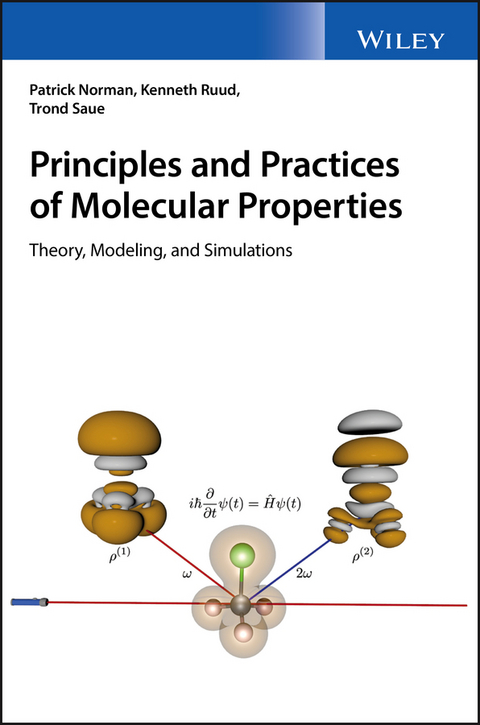
Principles and Practices of Molecular Properties (eBook)
John Wiley & Sons (Verlag)
978-1-118-79483-8 (ISBN)

A comprehensive yet accessible exploration of quantum chemical methods for the determination of molecular properties of spectroscopic relevance
Molecular properties can be probed both through experiment and simulation. This book bridges these two worlds, connecting the experimentalist's macroscopic view of responses of the electromagnetic field to the theoretician's microscopic description of the molecular responses. Comprehensive in scope, it also offers conceptual illustrations of molecular response theory by means of time-dependent simulations of simple systems.
This important resource in physical chemistry offers:
- A journey in electrodynamics from the molecular microscopic perspective to the conventional macroscopic viewpoint
- The construction of Hamiltonians that are appropriate for the quantum mechanical description of molecular properties
- Time- and frequency-domain perspectives of light-matter interactions and molecular responses of both electrons and nuclei
- An introduction to approximate state response theory that serves as an everyday tool for computational chemists
- A unified presentation of prominent molecular properties
Principles and Practices of Molecular Properties: Theory, Modeling and Simulations is written by noted experts in the field. It is a guide for graduate students, postdoctoral researchers and professionals in academia and industry alike, providing a set of keys to the research literature.
Patrick Norman is Professor and Head of Theoretical Chemistry and Biology at KTH Royal Institute of Technology, Stockholm, Sweden. His research interests include response theory for non-resonant and resonant external fields in the UV/vis and X-ray regions. He is a co-author of the Dalton program.
Kenneth Ruud is Professor of Theoretical Chemistry at the University of Tromsø - The Arctic University of Norway. His research interests include linear and nonlinear response theory for mixed electric and magnetic fields as well as vibrational and medium effects. He is a co-author of the Dalton program.
Trond Saue is a directeur de recherché of the French National Center for Scientific Research (CNRS) working at Université Toulouse III-Paul Sabatier in France. His research focuses on relativistic methods in theoretical chemistry. He is a principal author of the DIRAC program.
A comprehensive yet accessible exploration of quantum chemical methods for the determination of molecular properties of spectroscopic relevance Molecular properties can be probed both through experiment and simulation. This book bridges these two worlds, connecting the experimentalist's macroscopic view of responses of the electromagnetic field to the theoretician s microscopic description of the molecular responses. Comprehensive in scope, it also offers conceptual illustrations of molecular response theory by means of time-dependent simulations of simple systems. This important resource in physical chemistry offers: A journey in electrodynamics from the molecular microscopic perspective to the conventional macroscopic viewpoint The construction of Hamiltonians that are appropriate for the quantum mechanical description of molecular properties Time- and frequency-domain perspectives of light matter interactions and molecular responses of both electrons and nuclei An introduction to approximate state response theory that serves as an everyday tool for computational chemists A unified presentation of prominent molecular properties Principles and Practices of Molecular Properties: Theory, Modeling and Simulations is written by noted experts in the field. It is a guide for graduate students, postdoctoral researchers and professionals in academia and industry alike, providing a set of keys to the research literature.
Patrick Norman is Professor and Head of Theoretical Chemistry and Biology at KTH Royal Institute of Technology, Stockholm, Sweden. His research interests include response theory for non-resonant and resonant external fields in the UV/vis and X-ray regions. He is a co-author of the Dalton program. Kenneth Ruud is Professor of Theoretical Chemistry at the University of Tromsø - The Arctic University of Norway. His research interests include linear and nonlinear response theory for mixed electric and magnetic fields as well as vibrational and medium effects. He is a co-author of the Dalton program. Trond Saue is a directeur de recherché of the French National Center for Scientific Research (CNRS) working at Université Toulouse III-Paul Sabatier in France. His research focuses on relativistic methods in theoretical chemistry. He is a principal author of the DIRAC program.
Cover 1
Title Page 5
Copyright 6
Contents 7
Preface 13
Chapter 1 Introduction 15
Chapter 2 Quantum Mechanics 25
2.1 Fundamentals 25
2.1.1 Postulates of Quantum Mechanics 25
2.1.2 Lagrangian and Hamiltonian Formalisms 25
2.1.3 Wave Functions and Operators 32
2.2 Time Evolution of Wave Functions 36
2.3 Time Evolution of Expectation Values 39
2.4 Variational Principle 41
Further Reading 43
Chapter 3 Particles and Fields 45
3.1 Microscopic Maxwell's Equations 46
3.1.1 General Considerations 46
3.1.2 The Stationary Case 48
3.1.3 The General Case 52
3.1.4 Electromagnetic Potentials and Gauge Freedom 53
3.1.5 Electromagnetic Waves and Polarization 55
3.1.6 Electrodynamics: Relativistic and Nonrelativistic Formulations 59
3.2 Particles in Electromagnetic Fields 62
3.2.1 The Classical Mechanical Hamiltonian 62
3.2.2 The Quantum?Mechanical Hamiltonian 66
3.3 Electric and Magnetic Multipoles 71
3.3.1 Multipolar Gauge 71
3.3.2 Multipole Expansions 73
3.3.3 The Electric Dipole Approximation and Beyond 77
3.3.4 Origin Dependence of Electric and Magnetic Multipoles 78
3.3.5 Electric Multipoles 79
3.3.5.1 General Versus Traceless Forms 79
3.3.5.2 What We Can Learn from Symmetry 82
3.3.6 Magnetic Multipoles 83
3.3.7 Electric Dipole Radiation 84
3.4 Macroscopic Maxwell's Equations 86
3.4.1 Spatial Averaging 86
3.4.2 Polarization and Magnetization 87
3.4.3 Maxwell's Equations in Matter 91
3.4.4 Constitutive Relations 93
3.5 Linear Media 95
3.5.1 Boundary Conditions 96
3.5.2 Polarization in Linear Media 100
3.5.3 Electromagnetic Waves in a Linear Medium 106
3.5.4 Frequency Dependence of the Permittivity 110
3.5.4.1 Kramers–Kronig Relations 111
3.5.4.2 Relaxation in the Debye Model 112
3.5.4.3 Resonances in the Lorentz Model 115
3.5.4.4 Refraction and Absorption 119
3.5.5 Rotational Averages 121
3.5.6 A Note About Dimensions, Units, and Magnitudes 124
Further Reading 125
Chapter 4 Symmetry 127
4.1 Fundamentals 127
4.1.1 Symmetry Operations and Groups 127
4.1.2 Group Representation 131
4.2 Time Symmetries 134
4.3 Spatial Symmetries 139
4.3.1 Spatial Inversion 139
4.3.2 Rotations 141
Further Reading 148
Chapter 5 Exact?State Response Theory 149
5.1 Responses in Two?Level System 149
5.2 Molecular Electric Properties 159
5.3 Reference?State Parameterizations 165
5.4 Equations of Motion 170
5.4.1 Time Evolution of Projection Amplitudes 171
5.4.2 Time Evolution of Rotation Amplitudes 173
5.5 Response Functions 177
5.5.1 First?Order Properties 180
5.5.2 Second?Order Properties 180
5.5.3 Third?Order Properties 183
5.5.4 Fourth?Order Properties 188
5.5.5 Higher?Order Properties 193
5.6 Dispersion 193
5.7 Oscillator Strength and Sum Rules 197
5.8 Absorption 199
5.9 Residue Analysis 204
5.10 Relaxation 208
5.10.1 Density Operator 209
5.10.2 Liouville Equation 210
5.10.3 Density Matrix from Perturbation Theory 214
5.10.4 Linear Response Functions from the Density Matrix 215
5.10.5 Nonlinear Response Functions from the Density Matrix 218
5.10.6 Relaxation in Wave Function Theory 218
5.10.7 Absorption Cross Section 221
5.10.8 Einstein Coefficients 224
Further Reading 225
Chapter 6 Electronic and Nuclear Contributions to Molecular Properties 227
6.1 Born–Oppenheimer Approximation 227
6.2 Separation of Response Functions 230
6.3 Molecular Vibrations and Normal Coordinates 235
6.4 Perturbation Theory for Vibrational Wave Functions 239
6.5 Zero?Point Vibrational Contributions to Properties 241
6.5.1 First?Order Anharmonic Contributions 241
6.5.2 Importance of Zero?Point Vibrational Corrections 245
6.5.3 Temperature Effects 248
6.6 Pure Vibrational Contributions to Properties 249
6.6.1 Perturbation Theory Approach 249
6.6.2 Pure Vibrational Effects from an Analysis of the Electric?Field Dependence of the Molecular Geometry 252
6.7 Adiabatic Vibronic Theory for Electronic Excitation Processes 258
6.7.1 Franck–Condon Integrals 262
6.7.2 Vibronic Effects in a Diatomic System 264
6.7.3 Linear Coupling Model 266
6.7.4 Herzberg–Teller Corrections and Vibronically Induced Transitions 266
Further Reading 267
Chapter 7 Approximate Electronic State Response Theory 269
7.1 Reference State Parameterizations 269
7.1.1 Single Determinant 269
7.1.2 Configuration Interaction 277
7.1.3 Multiconfiguration Self?Consistent Field 280
7.1.4 Coupled Cluster 282
7.2 Equations of Motion 285
7.2.1 Ehrenfest Theorem 285
7.2.2 Quasi?Energy Derivatives 289
7.3 Response Functions 290
7.3.1 Single Determinant Approaches 290
7.3.2 Configuration Interaction 295
7.3.3 Multiconfiguration Self?Consistent Field 295
7.3.4 Matrix Structure in the SCF, CI, and MCSCF Approximations 295
7.3.5 Coupled Cluster 299
7.4 Residue Analysis 302
7.5 Relaxation 305
Further Reading 307
Chapter 8 Response Functions and Spectroscopies 309
8.1 Nuclear Interactions 310
8.1.1 Nuclear Charge Distribution 310
8.1.2 Hyperfine Structure 315
8.1.2.1 Nuclear Magnetic Dipole Moment 315
8.1.2.2 Nuclear Electric Quadrupole Moment 319
8.2 Zeeman Interaction and Electron Paramagnetic Resonance 324
8.3 Polarizabilities 331
8.3.1 Linear Polarizability 331
8.3.1.1 Weak Intermolecular Forces 335
8.3.2 Nonlinear Polarizabilities 339
8.4 Magnetizability 340
8.4.1 The Origin Dependence of the Magnetizability 342
8.4.2 Magnetizabilities from Magnetically Induced Currents 345
8.4.3 Isotropic Magnetizabilities and Pascal's Rule 346
8.5 Electronic Absorption and Emission Spectroscopies 349
8.5.1 Visible and Ultraviolet Absorption 352
8.5.2 Fluorescence Spectroscopy 357
8.5.3 Phosphorescence 358
8.5.4 Multiphoton Absorption 361
8.5.4.1 Multiphoton Absorption Cross Sections 362
8.5.4.2 Few?State Models for Two?Photon Absorption Cross Section 364
8.5.4.3 General Multiphoton Absorption Processes 365
8.5.5 X?ray Absorption 368
8.5.5.1 Core?Excited States 369
8.5.5.2 Field Polarization 372
8.5.5.3 Static Exchange Approximation 374
8.5.5.4 Complex or Damped Response Theory 376
8.6 Birefringences and Dichroisms 378
8.6.1 Natural Optical Activity 380
8.6.2 Electronic Circular Dichroism 386
8.6.3 Nonlinear Birefringences 389
8.6.3.1 Magnetic Circular Dichroism 390
8.6.3.2 Electric Field Gradient?Induced Birefringence 393
8.7 Vibrational Spectroscopies 395
8.7.1 Infrared Absorption 395
8.7.1.1 Double?Harmonic Approximation 395
8.7.1.2 Anharmonic Corrections 397
8.7.2 Vibrational Circular Dichroism 398
8.7.3 Raman Scattering 402
8.7.3.1 Raman Scattering from a Classical Point of View 402
8.7.3.2 Raman Scattering from a Quantum Mechanical Point of View 406
8.7.4 Vibrational Raman Optical Activity 416
8.8 Nuclear Magnetic Resonance 422
8.8.1 The NMR Experiment 422
8.8.2 NMR Parameters 427
Further Reading 431
Appendix A Abbreviations 433
Appendix B Units 435
Appendix C Second Quantization 437
C.1 Creation and Annihilation Operators 437
C.2 Fock Space 439
C.3 The Number Operator 440
C.4 The Electronic Hamiltonian on Second?Quantized Form 441
C.5 Spin in Second Quantization 443
Appendix D Fourier Transforms 445
Appendix E Operator Algebra 449
Appendix F Spin Matrix Algebra 453
Appendix G Angular Momentum Algebra 455
Appendix H Variational Perturbation Theory 459
Appendix I Two?Level Atom 465
I.1 Rabi Oscillations 466
I.2 Time?Dependent Perturbation Theory 468
I.3 The Quasi?energy Approach 469
Index 471
EULA 483
| Erscheint lt. Verlag | 11.1.2018 |
|---|---|
| Sprache | englisch |
| Themenwelt | Naturwissenschaften ► Chemie ► Physikalische Chemie |
| Naturwissenschaften ► Physik / Astronomie ► Quantenphysik | |
| Technik ► Maschinenbau | |
| Schlagworte | Absorption • Absorption cross section • Birefringence • CD • Chemie • Chemistry • Circular Dichroism • Computational Chemistry & Molecular Modeling • Computational Chemistry u. Molecular Modeling • Density Matrix • Dichroism • Dispersion • Ehrenfest • electromagnetic potentials and gauge freedom • electromagnetic waves and polarization • Electronic • Electron Paramagnetic Resonance • EPR • frequency dependence of permittivity • hyperpolarizabilities • IR absorption • Kenneth Ruud • Lagrangian and Hamiltonian formalisms • linear media • linear medium • Liouville equation • Maxwell's equations • Modeling and simulations • multipolar gauge • multipole expansions • NMR • Nuclear Magnetic Resonance • optical activity • oscillator strength and sum rules • particles in electromagnetic fields • Patrick Norman • Physical Chemistry • Physics • Physik • Physikalische Chemie • polarizabilities • polarization and magnetization • Postulates of Quantum Mechanics • Principles and Practices of Molecular Properties: Theory • Quantenphysik • Quantenphysik u. Feldtheorie • Quantum Physics & Field Theory • quasi-energy • raman scattering • Relaxation • response functions • Response Theory • rotational averages • Rotations • spatial averaging • spatial symmetries • spectroscopy • time evolution of wave functions • time symmetries • TPA • Trond Saue • Two-Photon Absorption • Variational Principle • Vibrational • wave functions and operators • Zeeman interaction |
| ISBN-10 | 1-118-79483-4 / 1118794834 |
| ISBN-13 | 978-1-118-79483-8 / 9781118794838 |
| Informationen gemäß Produktsicherheitsverordnung (GPSR) | |
| Haben Sie eine Frage zum Produkt? |
 PDF (Adobe DRM)
Kopierschutz: Adobe-DRM
Adobe-DRM ist ein Kopierschutz, der das eBook vor Mißbrauch schützen soll. Dabei wird das eBook bereits beim Download auf Ihre persönliche Adobe-ID autorisiert. Lesen können Sie das eBook dann nur auf den Geräten, welche ebenfalls auf Ihre Adobe-ID registriert sind.
Details zum Adobe-DRM
Dateiformat: PDF (Portable Document Format)
Mit einem festen Seitenlayout eignet sich die PDF besonders für Fachbücher mit Spalten, Tabellen und Abbildungen. Eine PDF kann auf fast allen Geräten angezeigt werden, ist aber für kleine Displays (Smartphone, eReader) nur eingeschränkt geeignet.
Systemvoraussetzungen:
PC/Mac: Mit einem PC oder Mac können Sie dieses eBook lesen. Sie benötigen eine
eReader: Dieses eBook kann mit (fast) allen eBook-Readern gelesen werden. Mit dem amazon-Kindle ist es aber nicht kompatibel.
Smartphone/Tablet: Egal ob Apple oder Android, dieses eBook können Sie lesen. Sie benötigen eine
Geräteliste und zusätzliche Hinweise
Buying eBooks from abroad
For tax law reasons we can sell eBooks just within Germany and Switzerland. Regrettably we cannot fulfill eBook-orders from other countries.
aus dem Bereich