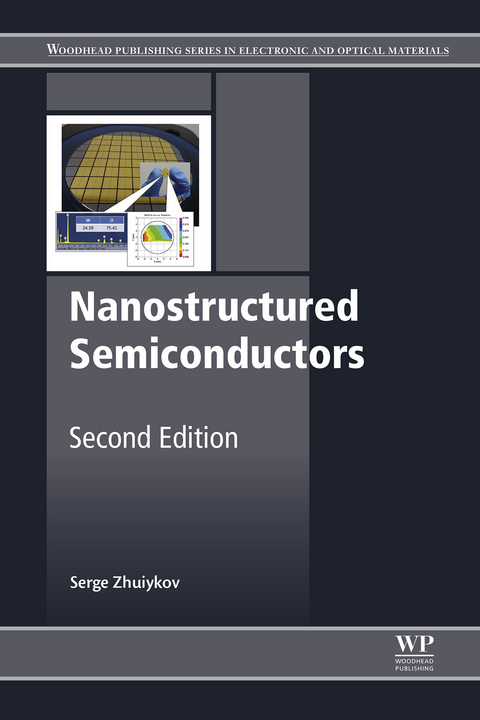
Nanostructured Semiconductors (eBook)
558 Seiten
Elsevier Science (Verlag)
978-0-08-101920-7 (ISBN)
Serge Zhuiykov is a Senior Full Professor at the Department of Applied Analytical & Physical Chemistry of the Gent University Global Campus (GUGC), South Korea. He is also a Director of Centre for Environmental & Energy Research at GUGC, South Korea.
Nanostructured Semiconductors focuses on the development of semiconductor nanocrystals, their technologies and applications, including energy harvesting, solar cells, solid oxide fuel cells, and chemical sensors. Semiconductor oxides are used in electronics, optics, catalysts, sensors, and other functional devices. In their 2D form, the reduction in size confers exceptional properties, useful for creating faster electronics and more efficient catalysts. Since the first edition of the book, there has been significant progress in the development of new functional nanomaterials with unique and sometimes unpredictable quantum-confined properties within the class what it called two-dimensional (2D) semiconductors. These nanocrystals represent extremely thin nano-structures with thickness of just few nano-meters. Since that time, not only were 2D semiconductor oxides further developed, more importantly, 2D metal dichalcogenides, such as MoS2, MoSe2, WS2, WSe2 and others also progressed significantly in their development demonstrating their superior properties compared to their bulk and microstructural counterparts. The book has been expanded to include these advancements. The book begins with the structure and properties of semiconductor nanocrystals (chapter 1), addresses electronic device applications (chapter 2), discusses 2-Dimensional oxides and dichalcogenide semiconductors (chapters 3 through 5), and ends with energy, environment, and bio applications (chapters 6 through 8). - Focuses on the development of semiconductor nanocrystals and their technologies and applications, including energy harvesting, solar cells, solid oxide fuel cells and chemical sensors- Include other 2D materials, such as dichalcogenides to present a comprehensive resource on the latest advancements in nanostructured semiconductors- Reviews the fundamental physics of conductivity and electron arrangement before proceeding to practical applications- Contains a unique chapter dedicated to the new atomic layer deposition (ALD) technique which has the ability to develop 2D nanostructures with great precision
| Erscheint lt. Verlag | 2.1.2018 |
|---|---|
| Sprache | englisch |
| Themenwelt | Technik ► Elektrotechnik / Energietechnik |
| Technik ► Maschinenbau | |
| ISBN-10 | 0-08-101920-3 / 0081019203 |
| ISBN-13 | 978-0-08-101920-7 / 9780081019207 |
| Informationen gemäß Produktsicherheitsverordnung (GPSR) | |
| Haben Sie eine Frage zum Produkt? |
 EPUB (Adobe DRM)
Kopierschutz: Adobe-DRM
Adobe-DRM ist ein Kopierschutz, der das eBook vor Mißbrauch schützen soll. Dabei wird das eBook bereits beim Download auf Ihre persönliche Adobe-ID autorisiert. Lesen können Sie das eBook dann nur auf den Geräten, welche ebenfalls auf Ihre Adobe-ID registriert sind.
Details zum Adobe-DRM
Dateiformat: EPUB (Electronic Publication)
EPUB ist ein offener Standard für eBooks und eignet sich besonders zur Darstellung von Belletristik und Sachbüchern. Der Fließtext wird dynamisch an die Display- und Schriftgröße angepasst. Auch für mobile Lesegeräte ist EPUB daher gut geeignet.
Systemvoraussetzungen:
PC/Mac: Mit einem PC oder Mac können Sie dieses eBook lesen. Sie benötigen eine
eReader: Dieses eBook kann mit (fast) allen eBook-Readern gelesen werden. Mit dem amazon-Kindle ist es aber nicht kompatibel.
Smartphone/Tablet: Egal ob Apple oder Android, dieses eBook können Sie lesen. Sie benötigen eine
Geräteliste und zusätzliche Hinweise
Buying eBooks from abroad
For tax law reasons we can sell eBooks just within Germany and Switzerland. Regrettably we cannot fulfill eBook-orders from other countries.
aus dem Bereich