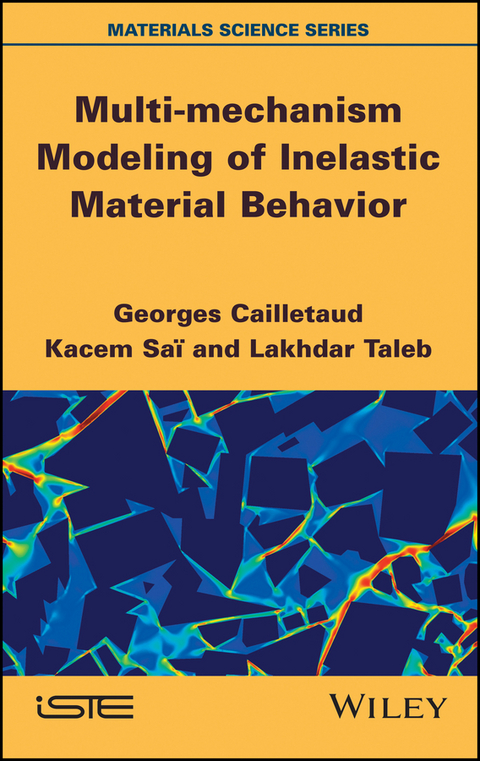
Multi-mechanism Modeling of Inelastic Material Behavior (eBook)
John Wiley & Sons (Verlag)
978-1-118-84512-7 (ISBN)
This book focuses on a particular class of models (namely Multi-Mechanism models) and their applications to extensive experimental data base related to different kind of materials. These models (i) are able to describe the main mechanical effects in plasticity, creep, creep/plasticity interaction, ratcheting extra-hardening under non-proportional loading (ii) provide local information (such us local stress/strain fields, damage, ....). A particular attention is paid to the identification process of material parameters. Moreover, finite element implementation of the Multi-Mechanism models is detailed.
This book focuses on a particular class of models (namely Multi-Mechanism models) and their applications to extensive experimental data base related to different kind of materials. These models (i) are able to describe the main mechanical effects in plasticity, creep, creep/plasticity interaction, ratcheting extra-hardening under non-proportional loading (ii) provide local information (such us local stress/strain fields, damage, .). A particular attention is paid to the identification process of material parameters. Moreover, finite element implementation of the Multi-Mechanism models is detailed.
Georges CAILLETAUD, MINES ParisTech, FranceLakhdar TALEB, INSA Rouen, FranceKacem SAI, ENIS Sfax, France
Introduction
State of the art of the multi-mechanism models
Part I : Theory
Thermodynamical framework
State variables, free energy, plastic potentials, criteria, evolution rules, including thermodynamical consistency
Model with various mechanisms and one criterion
Model with various mechanisms and various criteria
Part II: Model application
Typical stress/strain responses
Creep, plasticity/creep interaction, rate sensitivity, ratcheting, extra hardening under non proportional loading, anisotropy
Damage in multi-mechanism models, continuum damage mechanics theory, Gurson approach
Comparison with experimental data bases (Carbon steel CS1026, Austenitic stainless steel 304 and 316 for a large temperature range, Austenitic stainless steel 304, Inconel 718, N18, 2000 series Al alloy, 35NCD16, Semi-crystalline polymers, Zirconium alloy, 55NiCrMoV7, Mortar rubber aggregate).
Part III: Finite Element implementation
Numerical integration
Finite element simulation
1
State of the Art
The construction of models in the multi-mechanism (MM) family uses a series of generic tools (“building bricks”) that are also introduced in the classical plastic or viscoplastic formulations. They are recalled here, which allows us to define the main notations in the book. Since various MM models can be either seen as purely phenomenological or present a physical background dealing with multiphase models, scale transition rules are also recalled. The models have been applied to a large set of materials, some of them being submitted to large deformation. A simple framework has been used in this case, which is also presented here. The chapter concludes with a brief description of the main steps in the development of MM models. All these elements relate to the mechanical aspects of the models. Nevertheless, some of them are developed with a view to providing a specific material microstructure. This is the reason why the first section of this chapter is devoted to the description of deformation mechanisms at the microscale.
1.1. Motivation from the microstructure
Shear deformation and volume change observed at the macroscale have various origins at the microscale, depending on material microstructure. Metallic alloys usually deform by dislocation slip, climbing and grain boundary sliding, for instance. Each of these deformation sources leads to a type of nonlinearity and a specific shape for the constitutive equations. In the following, the basic mechanisms of plastic deformation are enumerated for (1) single crystals, (2) polycrystals, (3) amorphous polymers and (4) semi-crystalline polymers:
- 1) Single crystals: the plastic deformation of metallic single crystals results from the evolution of the crystal network.
- - Deformation by slip: this mechanism of deformation occurs when dislocations move on certain crystallographic (dense) planes and directions (slip system). According to Schmid’s law, a slip system becomes active provided the resolved shear stress reaches a threshold value called the critical resolved shear stress. Slip produces slip lines, so that the classical models taking into account crystal plasticity represent the average of the deformation produced in a small material element. Dislocation may interact with a number of defects that are present in the material.
- - Mechanical twinning: twinning is a deformation mechanism mainly observed at low temperature. Crystal twinning occurs when a crystal can jump from its initial configuration to a new one, involving the original grain and a twinned part, with an interface compatible with the two crystal networks. The deformation process is time independent, and produces locally both instantaneous shear deformation and eventually volumetric change. Twinning is one of the most active deformation mechanisms in crystals involving a reduced number of slip systems. It is pronounced in HCP crystals, and also observed at low temperature in higher symmetry BCC and FCC crystals.
- 2) Polycrystals: the grains of polycrystalline aggregates do not deform in the same way as single crystals, due to the local plastic flow that generates multiaxial stress states. The behavior is affected by grain boundaries, and by the presence of subgrain boundaries within the grains. Particles may be placed on purpose in the material, in order to produce hardening. The related mechanisms are solid solution strengthening or dislocation–precipitate interaction (Figure 1.1). Hard second-phase particles and ductile phases will change the behavior according to their size, shape, number and spatial distribution. In the classical literature, local fields in the phases are estimated by means of two opposite assumptions, uniform stress or uniform strain. This is a key issue of the MM models and it will be discussed in detail in the next chapters. In addition to the previous effects, grain boundary sliding may become a significant mechanism in specific cases, like the presence of nanograins, at high temperature that promotes diffusion at grain boundaries.
- 3) Amorphous polymers: they are polymers whose molecular structure lacks a definite repeating form, shape or structure. In some glassy polymers, the tensile stress–strain curve can be separated into three regimes: (i) initially, the deformation is linear until the yield stress is reached, (ii) the stress decreases due to softening associated with the formation of a neck and (iii) molecular orientation provides a mechanism for hardening that predominates at large strains (Figure 1.2).
- 4) Semi-crystalline polymers: semi-crystalline polymers (SCP) belong to a family of materials that combine a crystalline molecular structure and amorphous regions. Their microstructure can then be seen as a two-phase composite material consisting of crystalline and amorphous phases. Spherulites are spherical regions inside non-branched linear polymers. They are composed of highly ordered lamellae. The macroscopically homogeneous deformation results from various deformation mechanisms in the heterogeneous microstructure (Figure 1.3). The main deformation mechanisms responsible for the plastic deformation of SCP are crystallographic in nature. For small levels of deformation, the crystals are distorted but the crystalline lamellae are not damaged, whereas, under large plastic deformation, the distortion in the spherulitic region creates a strong preferential orientation. The elastic and viscoplastic behavior of SCP is mainly affected by the degree of crystallinity, the initial microstructure and the evolution in this microstructure during the deformation process.
Figure 1.1. N18 alloy: stress relaxation at 650°C for two levels of initial plastic strain [SAÏ 04]
Figure 1.2. Typical stress–strain curve for glassy polymers
Figure 1.3. SEM observation of the spherulitic microstructure of a semi-crystalline polymer, polyamide 6 (PA6) [REG 09b]
Depending on the application, the MM models presented later in this book can be seen as multi-mechanism, multi-phase or multi-potential. The corresponding terminology can be characterized as follows:
- – “Multi-phase” is used when different phases can be distinguished in a material such as the SCP.
- – “Multi-mechanism” is used when different regimes can be observed in a material. These behaviors may be linked to different strain or stress ranges or different temperatures. The term “multi-mechanism” can also be used if nonlinearities on the macroscale come from different sources of deformation at the crystal level.
- – “Multi-potential” refers to potentials in the thermodynamic formalism.
Beside the mechanisms related to metallic materials and polymers enumerated above, phase transformation is a source of deformation that deserves to be included in the MM modeling. “Phase transformation” refers to solid–solid metallurgical transformations that change the volume fraction of crystallographic phases. According to experimental observations, the transformation can be classified into (i) diffusional transformations, (ii) displacive transformations and (iii) hybrid transformations:
- –In diffusional transformations, the diffusion of one or several species allows the creation of a new balance between several phases (like austenite–ferrite in steels) or to change the morphology of precipitates (like gamma prime in Ni-base alloys). The resulting microstructure will minimize the energy of the full system.
- – The martensitic transformation is a time-independent phase transformation that occurs in some metals, resulting in the formation of martensite. The martensite is generally formed as thin plates with a predefined orientation with respect to the parent phase.
- – Hybrid transformations incorporate characteristics related to both diffusional and displacive transformations. The ferrous bainitic transformation is a typical example because of its morphology, kinetics and mechanism of growth.
All these transformations are regulated by thermodynamic considerations. The driving forces for the transformation depend on temperature and deformation. Twinning-induced plasticity (TWIP) is an example where the phase change is produced by deformation (Figure 1.4). The well-known TWIP steels are increasingly used due to their high strength and good ductility.
Figure 1.4. The optical microstructures of an experimental alloy: (a) as-received dual-phase TWIP steel, (b) 40% cold-rolled steel and (c) 70% cold-rolled steel [TOR 11]. For a color version of the figure, see www.iste.co.uk/cailletaud/multi-mechanism.zip
1.2. Building bricks
This section provides an analytical presentation of the various numerical tools that will be used in any model development. Having these elements in hand, the plastic and viscoplastic models can be constructed by assembling various blocks. What is needed is the definition of:
- – the initial yield surface, defined by a plasticity criterion;
- – the way in which this surface will change during inelastic flow, defined by hardening rules. Classical models introduce isotropic and/or kinematic hardening. Specific models are able to reproduce surface distortions;
- – the flow direction and intensity. They come directly...
| Erscheint lt. Verlag | 27.12.2017 |
|---|---|
| Sprache | englisch |
| Themenwelt | Naturwissenschaften ► Chemie |
| Technik ► Maschinenbau | |
| Schlagworte | Anisotropic Materials • Corrosion • Creep Behavior • creep plasticity interaction • cyclic responses • Geomaterials • isotropic materials • Korrosion • Materials Science • Materialverhalten • Materialwissenschaften • mechanical engineering • metals • Multi-mechanism models • Plasticity • Polymers |
| ISBN-10 | 1-118-84512-9 / 1118845129 |
| ISBN-13 | 978-1-118-84512-7 / 9781118845127 |
| Informationen gemäß Produktsicherheitsverordnung (GPSR) | |
| Haben Sie eine Frage zum Produkt? |
 EPUB (Adobe DRM)
Kopierschutz: Adobe-DRM
Adobe-DRM ist ein Kopierschutz, der das eBook vor Mißbrauch schützen soll. Dabei wird das eBook bereits beim Download auf Ihre persönliche Adobe-ID autorisiert. Lesen können Sie das eBook dann nur auf den Geräten, welche ebenfalls auf Ihre Adobe-ID registriert sind.
Details zum Adobe-DRM
Dateiformat: EPUB (Electronic Publication)
EPUB ist ein offener Standard für eBooks und eignet sich besonders zur Darstellung von Belletristik und Sachbüchern. Der Fließtext wird dynamisch an die Display- und Schriftgröße angepasst. Auch für mobile Lesegeräte ist EPUB daher gut geeignet.
Systemvoraussetzungen:
PC/Mac: Mit einem PC oder Mac können Sie dieses eBook lesen. Sie benötigen eine
eReader: Dieses eBook kann mit (fast) allen eBook-Readern gelesen werden. Mit dem amazon-Kindle ist es aber nicht kompatibel.
Smartphone/Tablet: Egal ob Apple oder Android, dieses eBook können Sie lesen. Sie benötigen eine
Geräteliste und zusätzliche Hinweise
Buying eBooks from abroad
For tax law reasons we can sell eBooks just within Germany and Switzerland. Regrettably we cannot fulfill eBook-orders from other countries.
aus dem Bereich