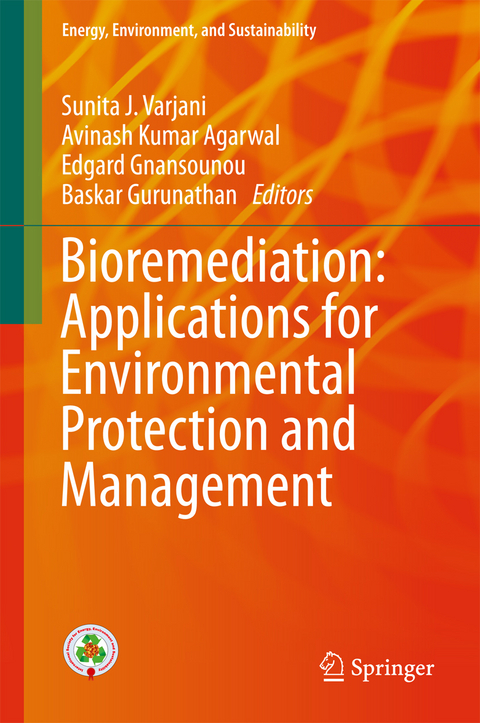
Bioremediation: Applications for Environmental Protection and Management (eBook)
411 Seiten
Springer Singapore (Verlag)
978-981-10-7485-1 (ISBN)
This book examines bioremediation technologies as a tool for environmental protection and management. It provides global perspectives on recent advances in the bioremediation of various environmental pollutants. Topics covered include comparative analysis of bio-gas electrification from anaerobic digesters, mathematical modeling in bioremediation, the evaluation of next-generation sequencing technologies for environmental monitoring in wastewater abatement; and the impact of diverse wastewater remediation techniques such as the use of nanofibers, microbes and genetically modified organisms; bioelectrochemical treatment; phytoremediation; and biosorption strategies. The book is targeted at scientists and researchers working in the field of bioremediation.
Dr. Sunita Varjani is a Scientific Officer at the Gujarat Pollution Control Board, India. She holds an M.Sc. degree in Microbiology (2009) and a Ph.D. in Biotechnology (2014). Her major areas of research are Industrial and Environmental Microbiology/Biotechnology and Molecular Biology. Dr. Varjani has authored 35 publications, including one book, 19 book chapters/reviews and 15 original research papers. She has received several awards and honours, including the Young Scientist Award at the AFRO-ASIAN Congress on Microbes for Human and Environmental Health, New Delhi (2014) and Best Paper Awards for oral presentations at national and international conferences in 2008, 2012 and 2013. Further, she serves on the editorial board of the Journal of Energy and Environmental Sustainability.
Prof. Avinash K. Agarwal joined the IIT Kanpur in 2001. His areas of interest are IC engines, combustion, alternative fuels, conventional fuels, optical diagnostics, laser ignition, HCCI, emission and particulate control, and large-bore engines. He has published 230+ international journal and conference papers. Prof. Agarwal is a Fellow of the SAE (2012), ASME (2013), ISEES (2015) and INAE (2015). He has received several awards such as the prestigious Shanti Swarup Bhatnagar Award in Engineering Sciences-2016; Rajib Goyal prize-2015; NASI-Reliance Industries Platinum Jubilee Award-2012; and INAE Silver Jubilee Young Engineer Award-2012.
Dr. Edgard Gnansounou is a Professor of Modelling and Planning of Energy Systems at the Swiss Federal Institute of Technology Lausanne (EPFL), Switzerland, where he is the Director of the Bioenergy and Energy Planning Research Group. His current research work focuses on techno-economic and environmental assessment of bio-refinery schemes based on the conversion of agricultural residues. He is leading research projects in this field in several countries including Brazil, Colombia and South Africa. In addition to publishing numerous papers in high-impact scientific journals, Dr. Gnansounou is a member of the editorial board of Bioresource Technology. He graduated with an M.S. in Civil Engineering and a Ph.D. in Energy Systems at the Swiss Federal Institute of Technology Lausanne. He has been a visiting researcher in the USA, France and India.
Dr. G. Baskar is currently working as a Professor of Biotechnology at St. Joseph's College of Engineering, Chennai, India. He has published more than 100 papers in national and international forums, as well as five book chapters. His current research focus is on biofuels, therapeutic proteins, microbial enzymes, nanomedicine and nanocatalysis. The International Bioprocessing Association (International Forum on Industrial Bioprocesses) conferred Dr. Baskar its Young Scientist Award (2015) in recognition of his contributions in the area of Bioprocess Technology. He also received the Indian Society for Technical Education's ISTE-Sayed Sajid Ali National Award (2016) for his outstanding research work on Renewable Energy.
This book examines bioremediation technologies as a tool for environmental protection and management. It provides global perspectives on recent advances in the bioremediation of various environmental pollutants. Topics covered include comparative analysis of bio-gas electrification from anaerobic digesters, mathematical modeling in bioremediation, the evaluation of next-generation sequencing technologies for environmental monitoring in wastewater abatement; and the impact of diverse wastewater remediation techniques such as the use of nanofibers, microbes and genetically modified organisms; bioelectrochemical treatment; phytoremediation; and biosorption strategies. The book is targeted at scientists and researchers working in the field of bioremediation.
Dr. Sunita Varjani is a Scientific Officer at the Gujarat Pollution Control Board, India. She holds an M.Sc. degree in Microbiology (2009) and a Ph.D. in Biotechnology (2014). Her major areas of research are Industrial and Environmental Microbiology/Biotechnology and Molecular Biology. Dr. Varjani has authored 35 publications, including one book, 19 book chapters/reviews and 15 original research papers. She has received several awards and honours, including the Young Scientist Award at the AFRO-ASIAN Congress on Microbes for Human and Environmental Health, New Delhi (2014) and Best Paper Awards for oral presentations at national and international conferences in 2008, 2012 and 2013. Further, she serves on the editorial board of the Journal of Energy and Environmental Sustainability. Prof. Avinash K. Agarwal joined the IIT Kanpur in 2001. His areas of interest are IC engines, combustion, alternative fuels, conventional fuels, optical diagnostics, laser ignition, HCCI, emission and particulate control, and large-bore engines. He has published 230+ international journal and conference papers. Prof. Agarwal is a Fellow of the SAE (2012), ASME (2013), ISEES (2015) and INAE (2015). He has received several awards such as the prestigious Shanti Swarup Bhatnagar Award in Engineering Sciences-2016; Rajib Goyal prize-2015; NASI-Reliance Industries Platinum Jubilee Award-2012; and INAE Silver Jubilee Young Engineer Award-2012. Dr. Edgard Gnansounou is a Professor of Modelling and Planning of Energy Systems at the Swiss Federal Institute of Technology Lausanne (EPFL), Switzerland, where he is the Director of the Bioenergy and Energy Planning Research Group. His current research work focuses on techno-economic and environmental assessment of bio-refinery schemes based on the conversion of agricultural residues. He is leading research projects in this field in several countries including Brazil, Colombia and South Africa. In addition to publishing numerous papers in high-impact scientific journals, Dr. Gnansounou is a member of the editorial board of Bioresource Technology. He graduated with an M.S. in Civil Engineering and a Ph.D. in Energy Systems at the Swiss Federal Institute of Technology Lausanne. He has been a visiting researcher in the USA, France and India. Dr. G. Baskar is currently working as a Professor of Biotechnology at St. Joseph’s College of Engineering, Chennai, India. He has published more than 100 papers in national and international forums, as well as five book chapters. His current research focus is on biofuels, therapeutic proteins, microbial enzymes, nanomedicine and nanocatalysis. The International Bioprocessing Association (International Forum on Industrial Bioprocesses) conferred Dr. Baskar its Young Scientist Award (2015) in recognition of his contributions in the area of Bioprocess Technology. He also received the Indian Society for Technical Education’s ISTE-Sayed Sajid Ali National Award (2016) for his outstanding research work on Renewable Energy.
Preface 6
Contents 9
Editors and Contributors 11
1 Introduction to Environmental Protection and Management 17
Abstract 17
2 Mathematical Modeling in Bioremediation 23
2.1 Basics of Flow of Groundwater and Transport of Contaminants 24
2.1.1 Introduction 24
2.1.2 Concepts of Groundwater 26
2.1.3 Concepts of Contaminant Transport Processes 31
2.1.4 Other Terminologies 35
2.2 Model Equations for Bioremediation 35
2.2.1 Theory 35
2.2.2 Analytical Models 38
2.3 Recent Advances in Mathematical Modeling in Bioremediation 39
References 42
3 Evaluation of Next-Generation Sequencing Technologies for Environmental Monitoring in Wastewater Abatement 44
Abstract 44
3.1 Introduction 45
3.2 Wastewater Treatment Mechanism 47
3.2.1 Biological Wastewater Treatment 48
3.2.2 Types of Microbes in Wastewater Treatment Plant 48
3.2.3 Water Quality Analysis 50
3.3 Infrastructure of Wastewater Treatment Plant 51
3.3.1 Drinking Water Distribution System 51
3.3.2 Types of Water Sampling 52
3.3.2.1 Bulk Water Sampling 52
3.3.2.2 Biofilm Water Sampling 53
3.4 Microbiological Techniques 53
3.4.1 Microbial Detection and Enumeration 54
3.4.1.1 Culture-Dependent Techniques 54
3.4.1.2 Culture-Independent Techniques 55
3.4.1.3 Fluorescent in situ Hybridization (FISH) 55
3.4.1.4 Flow Cytometry (FC) 56
3.4.1.5 PCR-Based Methods 57
3.4.2 Microbial Community Composition 58
3.4.2.1 Phospholipid Fatty Acids 58
3.4.2.2 Bioinformatic Tools 58
3.4.2.3 Fingerprinting Techniques 59
3.4.2.4 Terminal Restriction Fragment Length Polymorphism (TeRFLP) 60
3.4.2.5 Amplified Ribosomal DNA Restriction Analysis (ARDRA) 60
3.4.2.6 Automated Ribosomal Intergenic Spacer Analysis (ARISA) 60
3.4.3 Sequencing-Based Approaches 60
3.5 Next-Generation Sequencing 61
3.5.1 Stable Isotope Probing (SIP) Technique 62
3.5.2 Challenges in NGS 63
3.5.3 NGS Technologies and Analysis Methods 63
3.5.4 Limitations in NGS 64
3.5.5 Application of NGS in Water Quality Analysis 64
3.5.6 Microbial Safety of Drinking Water 65
References 66
4 Genetically Modified Organisms and Its Impact on the Enhancement of Bioremediation 68
Abstract 68
4.1 Introduction 69
4.1.1 Bioremediation 69
4.1.2 Types of Bioremediation 70
4.1.2.1 In Situ Bioremediation 70
4.1.2.2 Intrinsic In Situ Bioremediation 70
4.1.2.3 Ex Situ Bioremediation 71
4.2 Genetically Modified Microorganisms and Its Application in Bioremediation 72
4.2.1 Factors Influencing Genetically Engineered Microorganisms 75
4.2.2 Strategies to Control GEMs Transfer 77
4.2.2.1 Mini-transposon-mediated GEM Transfer Control 77
4.2.2.2 Suicide Genes-mediated GEM Transfer Control 77
4.2.2.3 gef Gene Expression and GEM Transfer Control 77
4.2.2.4 Composting and GEM Transfer Control 78
4.2.3 Techniques to Identify Genetically Modified Microbes 78
4.2.3.1 PCR-based Techniques 78
4.2.3.2 Fluorescent-based DNA Hybridization Technique 78
4.2.3.3 Bioluminescence-mediated Technique 79
4.2.3.4 DNA Microarray Technique 79
4.3 Molecular Tools for Construction of Genetic Engineering of Microbes for Bioremediation 79
4.3.1 Molecular Cloning 79
4.3.2 Electroporation 80
4.3.3 Protoplast Transformation 80
4.3.4 Biolistic Transformation 82
4.4 Genetically Modified Microorganisms for Bioremediation Purposes 82
4.4.1 GMOs in Removal of Toxic Heavy Metals 82
4.4.2 GMOs in Phytoremediation 83
4.5 Pros and Cons of Genetically Engineering Organisms 84
4.5.1 The Pros 84
4.5.2 The Cons 85
4.6 Ethical Issues and Risk Assessments in Usage of GMOs in Bioremediation 85
4.7 Conclusion 88
References 88
5 Integration of Lignin Removal from Black Liquor and Biotransformation Process 92
Abstract 92
5.1 Introduction 93
5.2 Structure of Lignin 93
5.3 Lignin Isolation Processes 96
5.3.1 Kraft Lignin 96
5.3.2 Lignosulfonate Lignin 97
5.3.3 Soda Lignin 97
5.3.4 Organosolv Lignin 98
5.3.5 Steam Explosion Lignin 98
5.3.6 Ionic Liquid Lignin 99
5.4 Physicochemical Properties of Lignin 99
5.5 Lignin: Recent Advances Applications 100
5.5.1 Lignin for Power-Fuel Gas Production 100
5.5.2 Lignin for Macromolecule Synthesis 100
5.5.3 Fine Chemical Synthesis 101
5.6 Lignin Removal in Paper and Pulp Industry 102
5.6.1 Lignin Removal by Coagulation Process 102
5.6.2 Lignin Precipitation by Acidification Process 103
5.6.3 Electrocoagulation Process 103
5.7 Biodegradation and Bioremediation of Lignin 105
5.7.1 Bacteria 106
5.7.2 Algae 107
5.7.3 Soft-Rot Fungi 108
5.7.4 Microfungi or Molds 108
5.7.4.1 Brown-Rot and White-Rot Basidiomycetes 108
References 109
6 Role of Nanofibers in Bioremediation 113
Abstract 113
6.1 Introduction 113
6.2 Nanofibers 115
6.3 Electrospinning 115
6.4 Biohybrid Nanofibers 116
6.5 Immobilization 117
6.6 Types of Microorganism Immobilizations 118
6.6.1 Adsorption 118
6.6.2 Covalent Binding/Cross-Linking 119
6.6.3 Entrapment 119
6.6.4 Encapsulation 119
6.7 Fabrication of Biohybrid Nanofibers 120
6.7.1 Monolithic Nanofibers 120
6.7.2 Core–Shell Nanofibers 121
6.8 Biohybrid Nanofibers for Bioremedial Applications 122
6.8.1 Nanofibers on Dye Removal 122
6.8.2 Nanofibers on Atrazine Removal 123
6.8.3 Nanofibers on Chromium Removal 124
6.8.4 Nanofibers on Nitrate and Ammonium Removal 124
6.8.5 Nanofibers on Heavy Metal Removal 125
6.9 Analysis of Advantages–Disadvantages 125
6.10 Conclusion 126
References 126
7 Bioremediation of Industrial Wastewater Using Bioelectrochemical Treatment 129
Abstract 129
7.1 Introduction 129
7.2 Organic Matter Removal Using Different System 130
7.3 Metal Removal Using Bioelectrochemical System 131
7.3.1 Metal Ions Using Abiotic Cathode System in MFC 133
7.3.2 Metal Removal Using Abiotic Cathode in MEC 134
7.3.3 Metal Ion Removal and Recovery Using Biocathode MFC System 135
7.3.4 Metal Ion Removal and Recovery Using Biocathode MEC System 136
7.4 Conclusion 137
References 137
8 Biosorption Strategies in the Remediation of Toxic Pollutants from Contaminated Water Bodies 141
Abstract 141
8.1 Introduction 142
8.2 Potential of Biosorption 145
8.3 Biosorption and the Pollutants 147
8.3.1 Biosorption and Heavy Metal 147
8.3.2 Biosorption and Dyes 152
8.3.3 Biosorption and Phenol 153
8.3.4 Biosorption and Radioactive Waste 154
8.4 Factors Consideration in Biosorption Process 154
8.4.1 Cost of Biosorbents 154
8.4.2 Biosorbent Regeneration 155
8.4.3 Biosorbent Immobilization 155
8.4.4 Charge of Biomass 156
8.4.5 Biosorption Process Design 157
8.5 Biomass Types 157
8.5.1 Biosorption Using Algae 161
8.5.2 Biosorption Using Bacteria 163
8.5.3 Biosorption Using Fungi 163
8.5.4 Biosorbents from Agricultural Waste 165
8.5.5 Biosorption from Industrial Waste 166
8.6 Application of Biosorbents 166
8.7 Conclusion 167
References 167
9 Bioremediation of Heavy Metals 178
Abstract 178
9.1 Introduction 179
9.2 Heavy Metal-Polluted Environments 179
9.2.1 Types of Heavy Metals and Their Toxicity 181
9.2.1.1 Arsenic 181
9.2.1.2 Lead 181
9.2.1.3 Zinc 182
9.2.1.4 Cadmium 182
9.2.1.5 Copper 182
9.2.1.6 Chromium 183
9.2.1.7 Mercury 184
9.2.1.8 Silver 184
9.2.1.9 Gold 185
9.2.1.10 Nickel 185
9.2.1.11 Selenium 186
9.2.1.12 Uranium 186
9.3 Bioremediation 187
9.3.1 Principle of Bioremediation 187
9.3.2 Types of Bioremediation 188
9.3.2.1 In Situ Bioremediation 188
Types of In Situ Bioremediation 188
Advantages and Disadvantages of In Situ Bioremediation 190
9.3.2.2 Ex Situ Bioremediation 190
Type of Ex Situ Bioremediation 190
Advantages and Disadvantages of Ex Situ Bioremediation 192
9.3.3 Factor Affecting Bioremediation 192
9.3.3.1 Microbial Populations for Bioremediation 192
9.3.3.2 Chemical Factors 193
Bioavailability of Pollutants 193
Biodegradability of Pollutants 193
9.3.3.3 Environmental Factors 193
Temperature 193
pH 194
Nutrients 194
Moisture Content and Water Availability 194
9.3.4 Bioremediation of Heavy Metals by Microorganism 194
9.3.4.1 Mechanisms 196
9.3.5 Bioremediation of Heavy Metals by Plants 197
9.3.5.1 Mechanisms of Bioremediation by Plants 197
Phytoextraction 197
Phytostabilization 199
Rhizofiltration 199
Phytovolatilization 200
9.3.6 Bioremediation of Heavy Metals by Algae 200
9.3.6.1 Mechanisms 201
9.3.7 Bioreactors 201
9.3.7.1 Stirred Tank Bioreactor (STRs) 202
9.3.7.2 Fluidized Bed Bioreactor (FBRs) 202
9.3.7.3 Airlift Reactors (ALRs) 202
9.3.7.4 Fixed-Bed Bioreactors (FXRs) 202
9.3.7.5 Rotating Biological Bioreactor (RBC) 203
9.4 Recent Trends 203
9.4.1 Application of Genetic Engineering 203
9.4.1.1 Genetically Modified Microorganisms 203
9.4.1.2 Genetically Modified Plants 204
9.4.2 Rhizosphere Engineering 204
9.4.3 Application of Nanotechnology 205
9.4.4 Effect of Plant–Microbe Symbiosis 206
9.5 Conclusion 206
References 206
10 Pesticides Bioremediation 209
Abstract 209
10.1 Introduction and General Overview 210
10.2 Pesticides 211
10.3 Different Categories of Pesticides 212
10.3.1 Organochlorine Pesticides 212
10.3.1.1 DDT 214
10.3.1.2 Lindane 214
10.3.1.3 Chlordane 215
10.3.1.4 Endosulfan 215
10.3.2 Organophosphate Pesticides 216
10.3.2.1 Chlorpyrifos 216
10.3.2.2 Methyl Parathion 217
10.3.3 Carbamates 217
10.3.3.1 Carbaryl 218
10.4 Risk Correlated with Pesticides 218
10.4.1 Threats to Human Health 219
10.4.2 Threats to Plants 220
10.4.3 Threats to Aquatic System 220
10.4.4 Threats to Soil 221
10.5 Bioremediation History 221
10.6 Classes of Bioremediation 222
10.6.1 In Situ Process 222
10.6.2 Ex Situ Process 222
10.7 Bioremediation of Pesticides 223
10.8 Upside of Bioremediation 223
10.9 Downside of Bioremediation 224
10.10 Strategies of Pesticides Bioremediation 224
10.10.1 Involvement of Microbes in Bioremediation of Pesticides 224
10.10.1.1 Bacterial Bioremediation 225
10.10.1.2 Mycoremediation 227
10.10.1.3 Phycoremediation 228
10.10.2 Phytoremediation of Pesticides 229
10.11 Future Recommendations 230
10.12 Conclusion 231
References 231
11 Application of Microbes in Remediation of Hazardous Wastes: A Review 235
Abstract 235
11.1 Introduction 236
11.2 Remediation Methods 238
11.2.1 Physicochemical Methods 238
11.2.2 Biological Methods 239
11.3 Bioremediation Processes: Two Main Categories 239
11.3.1 In situ Bioremediation 239
11.3.2 Ex situ Bioremediation 239
11.4 Microbial Application for the Bioremediation of Hazardous Wastes 240
11.4.1 Bacterial Treatment of Wastes 240
11.4.2 Algal Treatment of Hazardous Wastes 240
11.4.3 Fungal Treatment of Hazardous Wastes 241
11.5 Degradation of Hazardous Waste Using Microbial Consortia 243
11.6 Mechanism of Bioremediation 243
11.7 Factors Affecting Bioremediation 244
11.8 Waste Valorization 246
11.9 Advantages and Disadvantages of Bioremediation 247
11.10 Hazardous Waste Management 248
11.11 Conclusion 249
Acknowledgements 249
References 249
12 Phytoremediation Techniques for the Removal of Dye in Wastewater 254
Abstract 254
12.1 Introduction 255
12.1.1 Phytoremediation 256
12.2 Mechanisms of Phytoremediation 257
12.3 Phytoremediation Process 257
12.3.1 Selection of Plants for Remediation of Textile Dyes 258
12.3.2 Phytoremediation of Textile Dyes 259
12.4 Removal of Azo Dyes 261
12.5 Advantages of Phytoremediation 261
References 261
13 Phenol Degradation from Industrial Wastewater by Engineered Microbes 264
Abstract 264
13.1 Introduction 264
13.2 Manifestation of Phenol Pollution 269
13.2.1 Aromatic Alcohol 270
13.3 Phenolic Compounds Toxicity Data 271
13.3.1 Deleterious Effects on Ecosystem 272
13.3.2 Impact and Fate of Phenolic Compounds on Humans 274
13.4 Biodegradation of Phenols 275
13.4.1 Genetic Engineering in Biodegradation 277
13.5 Engineered Plasmids for Phenol Treatment 280
13.6 Risk Assessment in Genetic Engineering 282
13.7 Regulatory Affairs 283
13.8 Conclusions 283
References 284
14 Insect Gut Bacteria and Their Potential Application in Degradation of Lignocellulosic Biomass: A Review 288
Abstract 288
14.1 Introduction 288
14.2 Insect Gut Environment 290
14.3 Microbial Colonization Within Insect Gut 291
14.4 Insect Gut Microbial Composition 291
14.4.1 According to Diet 293
14.4.2 Role in Partner Selection 294
14.4.3 Genome Evolution 295
14.5 Lignocellulose as a Component: Physiological Property 296
14.6 Enzymatic Breakdown of Lignocellulose 297
14.7 Cellulosomes Complex 298
14.8 Biotechnological Application of Cellulase Enzyme 299
14.8.1 In Waste Management 300
14.8.2 Food and Brewage Industry 300
14.8.3 Ethanol Production from Lignocellulosic Biomasses 300
14.8.4 Pulp and Paper Industry 302
14.8.5 Textile Industry 302
14.9 Conclusion 303
Acknowledgements 303
References 303
15 Bioremediation of Volatile Organic Compounds in Biofilters 311
Abstract 311
15.1 Introduction 312
15.1.1 Air Pollution 312
15.1.2 Effect of Volatile Organic Compounds 314
15.1.3 Environmental and Health Hazards 314
15.1.4 VOCs Removal Techniques by Non-biological and Biological Methods 318
15.2 Degradation of VOCs Using Microorganisms 322
15.2.1 Biodegradation of VOCs Using Pure Culture 323
15.2.1.1 Biodegradation of VOCs Using Bacteria 323
15.2.1.2 Biodegradation of VOCs Using Fungi 324
15.2.2 Biodegradation of VOCs Using Mixed Culture 327
15.3 Biofilters 327
15.3.1 Type of Bioreactors Employed for Toluene Removal 331
15.3.1.1 Biotrickling Bioreactor (BTBR) 332
15.3.1.2 Bioscrubber Bioreactor (BSBR) 333
15.3.1.3 Two-Phase Partitioning Bioreactor (TPPB) 334
15.3.1.4 Fluidized Bed Bioreactor (FBR) 334
15.3.1.5 Fixed Film Bioreactor (FFBR) 335
15.3.1.6 Upflow Packed Bed Reactor (UFPBR) 335
15.3.1.7 Foam Emulsion Bioreactor (FEBR) 335
15.3.1.8 Membrane Bioreactor (MBR) 336
15.3.2 Packing Materials 336
15.3.3 Suggestions and Future Scope of Work 337
15.4 Summary 337
References 338
16 Bioremediation of Industrial and Municipal Wastewater Using Microalgae 341
Abstract 341
16.1 Introduction 342
16.2 Bioremediation 343
16.3 Phycoremediation 344
16.4 Microalgae in Wastewater Treatment 346
16.5 Methodology 347
16.5.1 Microalgae Wastewater Treatment in Waste Stabilization Ponds (WSP) 347
16.5.2 Facultative Ponds 348
16.5.3 High-Rate Algal Ponds (HRAPs) 349
16.5.4 Cell Immobilization 350
16.5.5 Use of Strains with Special Attributes 351
16.6 Bioreactor Design 352
16.6.1 Open Raceway Ponds 352
16.6.2 Photobioreactor 353
16.6.3 Activated Sludge Process 354
16.7 Harvesting Strategy 355
16.8 Advantage—Dual Role of Microalgae 356
16.9 Nonfuel Applications 356
16.10 Fuel-Based Applications 356
16.11 Applications 357
16.11.1 Treating Municipal Wastewater 357
16.11.2 Treating Food Processing Industrial Wastewater 358
16.11.3 Treating Paper Industrial Wastewater 359
16.11.4 Treating Agro-Industrial Wastes 359
16.12 Cost Analysis 360
16.13 Additional Features 361
16.14 Challenges 361
16.15 Summary 363
References 364
17 Phytoremediation of Textile Dye Effluents 368
Abstract 368
17.1 Introduction 369
17.2 Characterization of Textile Effluents (Source and its Characterization) 369
17.2.1 Textile Effluents 369
17.2.2 Characteristics of Textile Effluents 370
17.2.3 Adsorption 370
17.2.4 Flocculation 371
17.2.5 Microbial Treatment 371
17.2.5.1 Factors Affecting Color Removal Using Microbes 372
17.3 Phytoremediation 373
17.4 Mechanisms of Phytoremediation 373
17.4.1 Phytoextraction 373
17.4.2 Phytostabilisation 375
17.4.3 Rhizofiltration 375
17.4.4 Phytovolatilization 375
17.4.5 Phytodegradation or Phytotransformation 376
17.4.6 Rhizodegradation/Phytostimulation 376
17.4.7 Biotransformation of Pollutants by Plants 377
17.5 Factors Affecting the uptake Mechanisms of Contaminants in Phytoremediation 377
17.6 Characterization of the Textiles Dyes and Effluents After Phytoremediation 378
17.7 Toxicity Analysis of Dye Products in Dye Effluents (Kabra et al. 2013) 379
17.8 Various Physiochemical Factors Affecting the Phytoremediation of Textile Dyes and Effluents (Pilon-Smits 2005) 379
17.9 Advantages Of Phytoremediation 379
17.10 Disadvantages of Phytoremediation 380
17.11 Conclusions 380
18 Role of Biosurfactants in Enhancing the Microbial Degradation of Pyrene 383
Abstract 383
18.1 Introduction 383
18.2 Occurrence and Physical Properties of Pyrene 384
18.3 Toxic Effects Caused Due to Pyrene Exposure 385
18.4 Pyrene Degradation by Single Microbial Species and Microbial Consortium 386
18.5 Pyrene Degradation Pathway by Microbes 389
18.6 Surfactant-Enhanced Degradation of Pyrene 389
18.7 Conclusions and Future Scope 391
References 391
19 Bioremediation of Nitrate-Contaminated Wastewater and Soil 395
Abstract 395
19.1 Introduction 396
19.2 Sources of Nitrate-Contaminated Wastewater 396
19.3 Environmental and Health Concerns Due to Nitrate Contamination 397
19.4 Technologies Available for Nitrate Removal 397
19.5 Biological Denitrification 398
19.6 Heterotrophic and Autotrophic Denitrification 400
19.7 Suspended Growth Process and Fixed Film Process 401
19.8 Denitrification Microbiology 402
19.9 Organic Compounds for Denitrification 402
19.10 Factors Affecting Nitrate Removal Efficiency 404
19.10.1 Effect of Hydraulic Residence Time (HRT) 404
19.10.2 Effect of Temperature 404
19.10.3 Effect of Grain Size 405
19.10.4 Effect of Dissolved Oxygen (DO) 405
19.10.5 Effect of Initial Nitrate Concentration (C0) 406
19.10.6 Effect of Salinity 406
19.10.7 Effect of PH 407
19.10.8 Effect of Other Trace Elements 407
19.10.9 Effect of Free Ammonia Concentration 407
19.11 Reactors for Denitrification 407
19.12 Limitations of Denitrification 411
19.13 Denitrification in Soil 412
19.14 Future Scope 413
19.15 Summary 414
References 414
Author Index 418
| Erscheint lt. Verlag | 11.12.2017 |
|---|---|
| Reihe/Serie | Energy, Environment, and Sustainability | Energy, Environment, and Sustainability |
| Zusatzinfo | XVI, 411 p. 52 illus., 34 illus. in color. |
| Verlagsort | Singapore |
| Sprache | englisch |
| Themenwelt | Naturwissenschaften ► Biologie ► Genetik / Molekularbiologie |
| Naturwissenschaften ► Biologie ► Ökologie / Naturschutz | |
| Naturwissenschaften ► Chemie | |
| Naturwissenschaften ► Geowissenschaften ► Hydrologie / Ozeanografie | |
| Technik ► Umwelttechnik / Biotechnologie | |
| Schlagworte | biochemical engineering • Bioelectrochemical treatment • Biosorption • Engineering in Bioremediation • hazardous waste • leachate • microalgae • Organic Pollutants • Phytoremediation • Waste water remediation • Water Quality and Water Pollution |
| ISBN-10 | 981-10-7485-2 / 9811074852 |
| ISBN-13 | 978-981-10-7485-1 / 9789811074851 |
| Informationen gemäß Produktsicherheitsverordnung (GPSR) | |
| Haben Sie eine Frage zum Produkt? |
 PDF (Wasserzeichen)
DRM: Digitales Wasserzeichen
Dieses eBook enthält ein digitales Wasserzeichen und ist damit für Sie personalisiert. Bei einer missbräuchlichen Weitergabe des eBooks an Dritte ist eine Rückverfolgung an die Quelle möglich.
Dateiformat: PDF (Portable Document Format)
Mit einem festen Seitenlayout eignet sich die PDF besonders für Fachbücher mit Spalten, Tabellen und Abbildungen. Eine PDF kann auf fast allen Geräten angezeigt werden, ist aber für kleine Displays (Smartphone, eReader) nur eingeschränkt geeignet.
Systemvoraussetzungen:
PC/Mac: Mit einem PC oder Mac können Sie dieses eBook lesen. Sie benötigen dafür einen PDF-Viewer - z.B. den Adobe Reader oder Adobe Digital Editions.
eReader: Dieses eBook kann mit (fast) allen eBook-Readern gelesen werden. Mit dem amazon-Kindle ist es aber nicht kompatibel.
Smartphone/Tablet: Egal ob Apple oder Android, dieses eBook können Sie lesen. Sie benötigen dafür einen PDF-Viewer - z.B. die kostenlose Adobe Digital Editions-App.
Buying eBooks from abroad
For tax law reasons we can sell eBooks just within Germany and Switzerland. Regrettably we cannot fulfill eBook-orders from other countries.
aus dem Bereich