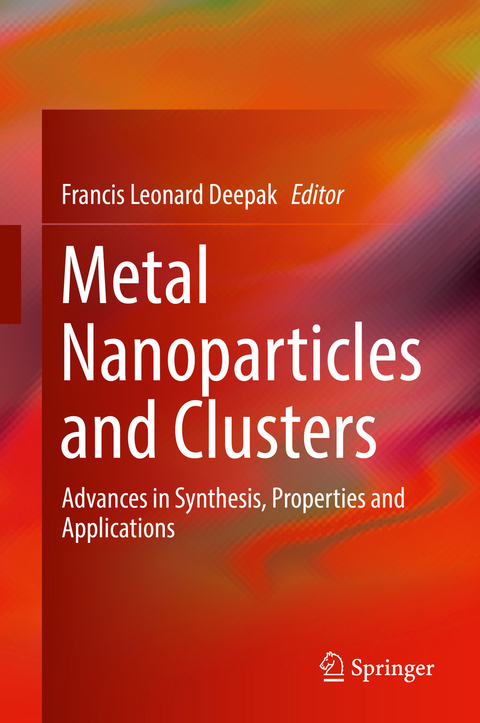
Metal Nanoparticles and Clusters (eBook)
XII, 426 Seiten
Springer International Publishing (Verlag)
978-3-319-68053-8 (ISBN)
This book covers the continually expanding field of metal nanoparticles and clusters, in particular their size-dependent properties and quantum phenomena. The approaches to the organization of atoms that form clusters and nanoparticles have been advancing rapidly in recent times. These advancements are described through a combination of experimental and computational approaches and are covered in detail by the authors. Recent highlights of the various emerging properties and applications ranging from plasmonics to catalysis are showcased.
Dr. Francis Leonard Deepak is a Group Leader in the Department of Advanced Electron Microscopy, Imaging and Spectroscopy at the International Iberian Nanotechnology Laboratory, Braga, Portugal. He received his PhD at the Jawaharlal Nehru Center for Advanced Scientific Research in Bangalore, India. His broad area of research is focused on the use of advanced electron microscopic techniques for the study of materials/nanomaterials for various applications, as well as in the study of fundamental physical phenomena and dynamics at the nanoscale.
Dr. Francis Leonard Deepak is a Group Leader in the Department of Advanced Electron Microscopy, Imaging and Spectroscopy at the International Iberian Nanotechnology Laboratory, Braga, Portugal. He received his PhD at the Jawaharlal Nehru Center for Advanced Scientific Research in Bangalore, India. His broad area of research is focused on the use of advanced electron microscopic techniques for the study of materials/nanomaterials for various applications, as well as in the study of fundamental physical phenomena and dynamics at the nanoscale.
Foreword 5
Preface 7
Contents 10
1 From Nano- to Angstrom Technology 12
1.1 Introduction: Industrial Revolutions, from Metals to Semiconductors and Backwards 12
1.2 The Basic Physics Behind Two Size Ranges: Scaling Laws of Surface Phenomena in NPs and Quantum Confinement in AQCs 14
1.2.1 Surface Phenomena in NPs 14
1.2.2 Strong Quantum Confinement in Small AQCs and Jellium Model Electronic Shells 16
1.2.2.1 Basic Spherical Symmetric Potential-Based Jellium Model 16
1.2.2.2 Extensions to Ligand-Protected Clusters 19
1.2.3 Competing Geometric Growth Stability and Electronic Shell Structures in Large AQCs 19
1.3 Physical Consequences of Size-Induced Transitions from Metal NPs to AQCs 21
1.3.1 Metal to Non-metal Transition in AQCs 22
1.3.2 Opening of HOMO-LUMO Gap-Dependent Optical Properties in NPs and AQCs 24
1.3.3 Towards Bulk Crystallinity Formation and Structure-Dependent Magnetic Properties 27
1.4 Catalytic Activity in Metal Clusters 28
1.5 Relevant Characterization Techniques for AQCs 33
1.5.1 HRSTEM 33
1.5.2 AFM/STM 34
1.5.3 Mass Spectrometry 35
1.5.4 Fluorescence 37
1.6 Voltammetry 37
References 37
2 Advances in Synthesis of Metal Nanocrystals 42
2.1 Introduction 42
2.1.1 Nanocrystals in Liquids 43
2.2 Synthesis of Nanocrystals in the Aqueous Phase 44
2.2.1 Sodium Citrate and Related Reducing Agents 44
2.2.2 Borohydride Reduction 45
2.2.3 Photochemical Synthesis 45
2.2.4 Tetrakis(hydroxymethyl)phosphonium Chloride 46
2.2.4.1 Role of THPC in Reductions 47
2.3 Metal Nanocrystals in Nonaqueous Medium 49
2.3.1 Brust Method 50
2.3.2 Thermolysis Routes 50
2.3.2.1 Bimetallic and Other Systems 51
2.4 Digestive Ripening 52
2.5 Nanostructures with Structural Anisotropy and High-Energy Facets 54
2.5.1 Silver Nanowires Synthesised by the Polyol Process 56
2.6 Conclusions 59
References 59
3 Spectroscopic and Computational Studies on Ligand-Capped Metal Nanoparticles and Clusters 66
3.1 Introduction 66
3.2 Metal Nanoparticles 67
3.2.1 SERS Effect 67
3.2.2 SERS/DFT Investigation of Ligand-Capped Silver, Gold, and Copper Nanoparticles 69
3.2.3 Solvation and Chemisorption of Ligand Molecules in Metal Colloidal Suspensions 82
3.2.4 Concluding Remarks 84
3.2.5 Computational Details 86
3.3 Metal Clusters 87
3.3.1 Ligand-Capped Nanoclusters 87
3.3.2 Relation Between Structures and Optical Properties in Metal Nanoclusters 88
3.3.3 Computational Details 94
3.4 Conclusions 95
References 95
4 Surface-Enhanced Raman Spectroscopy: Principles, Substrates, and Applications 99
4.1 Introduction 99
4.2 Brief Introduction on Raman Scattering 102
4.3 Enhancement Mechanisms in SERS 104
4.3.1 Electromagnetic Enhancement 104
4.3.1.1 Local Field Enhancement 105
4.3.1.2 The Radiation Enhancement 107
4.3.1.3 Similarities Between Local Field and Radiation Enhancement 108
4.3.1.4 Derivation of SERS Enhancement Factor for a Single Molecule 111
4.3.1.5 "026A30C E"026A30C 4 Approximation and Its Zero Stokes Shift Limit 112
4.3.2 Chemical Enhancement 114
4.3.2.1 Contribution of the Plasmonic, Charge-Transfer, and Molecular Resonances 116
4.3.2.2 The Surface Selection Rules 117
4.3.2.3 Comparison with the Electromagnetic Enhancement 119
4.4 Distance Dependence 119
4.5 Definition and Properties of Hot Spots 122
4.5.1 Definition 122
4.5.2 Extinction and Enhancement as a Function of the Gap Size 122
4.5.3 SERS Enhancement Distribution on a Substrate 124
4.6 Near- Versus Far-Field Properties 125
4.7 Materials for SERS 128
4.8 Fabrication of SERS Substrates 132
4.8.1 Bottom-Up Methods 133
4.8.1.1 Electrochemical Roughening 133
4.8.1.2 Assembly of Nanostructures on a Surface 134
4.8.1.3 Laser Direct Writing 136
4.8.2 Template Methods 136
4.8.2.1 Anodic Aluminum Oxide Template 136
4.8.2.2 Nanosphere Lithography 137
4.8.3 Top-Down Methods 139
4.8.3.1 Electron Beam Lithography 139
4.8.3.2 Extreme Ultraviolet Interference Lithography 141
4.8.3.3 Soft Lithography 142
4.9 Applications 144
4.9.1 Chemical Warfare Agents and Explosives 146
4.9.2 Environmental Analysis of Pollutants 147
4.9.3 Art Preservation 148
4.9.4 Food Contaminants 148
4.9.5 Biomolecules 151
4.9.5.1 Oligonucleotides 151
4.9.5.2 Proteins 152
4.9.5.3 Viruses and Bacteria 153
4.9.6 Medical Applications 154
4.9.7 Therapeutic Drugs 155
4.9.8 Forensic Science and Illicit Drugs 155
4.9.9 Novel Applications 157
4.10 Conclusions 158
References 159
5 Model Nanoparticles in Catalysis 175
5.1 Introduction 175
5.2 Morphology-Controlled Nanoparticles and Its Applications 177
5.3 Surface Structure 177
5.3.1 Low-Index Faceted Nanoparticle System 178
5.3.2 High-Index Faceted Nanoparticles 179
5.4 Determination of High-Index Facets 180
5.4.1 Microfacet Notation for Denoting Stepped Surfaces 180
5.4.2 Projection Angle Method for the Identification of High-Index Facets 180
5.5 Different Types of High-Index Faceted Nanostructures 180
5.5.1 "4266308 hk0"5267309 Facets 180
5.5.2 "4266308 hhl"5267309 Facets 183
5.5.3 "4266308 hkk"5267309 Facets 183
5.5.4 "4266308 hkl"5267309 Facets 183
5.6 Morphology-Dependent Geometric and Electronic Factors of a Nanoparticle Surface 184
5.6.1 Crystallographic Surface-Dependent d-Band Center and Its Correlation with Surface Adsorption Energy 185
5.7 Mechanism of Growth of Morphology-Controlled Nanoparticles 185
5.7.1 Nucleation and Seed Formation 185
5.8 Shape-Controlled Nanoparticles for Catalytic Applications 187
5.8.1 Oxidation Reactions 187
5.8.2 Hydrogenation Reactions 189
5.8.3 Coupling Reactions 193
5.9 Bimetallic Systems and Their Development as Catalytic Materials 194
5.9.1 Bimetallic Synergism: Geometric and Electronic Effects 195
5.9.2 Designed Architectures and Synthesis of Bimetallic Nanoparticles 196
5.9.3 Catalytic Applications of Bimetallic Nanoparticles 199
5.10 Summary and Future Outlook 206
References 206
6 Catalytic Efficiency in Metallic Nanoparticles: A Computational Approach 210
6.1 Introduction 210
6.2 Ab Initio Calculations 212
6.2.1 Electrocatalysis 212
6.2.1.1 Description of Different Electrochemical Reactions 213
6.2.2 Future Directions 213
6.3 Monte Carlo 214
6.3.1 KMC Approach in Catalysis 215
6.3.1.1 CO Oxidation 215
6.3.1.2 NO Reduction and Oxidation 216
6.3.1.3 Ethylene Hydrogenation 216
6.3.2 KMC Simulations for Catalysis in Nanoparticles 217
6.3.3 Future Directions 217
6.4 Molecular Dynamics 217
6.4.1 Metallic Nanoparticles for Catalytic Applications 218
6.4.2 Nucleation Process of Catalytic Nanoparticles 219
6.4.2.1 Classification of Surface Defects 220
6.4.2.2 Catalytic Activity in Pt Nanoparticles 221
6.5 Conclusions 223
References 224
7 Advanced Electron Microscopy Techniques Toward the Understanding of Metal Nanoparticles and Clusters 227
7.1 Introduction 227
7.2 Characterization Techniques 230
7.2.1 Transmission Electron Microscopy (TEM) 230
7.2.1.1 Diffraction 233
7.2.1.2 Image 234
7.2.2 Scanning Transmission Electron Microscopy (STEM) 237
7.2.3 Aberration-Corrected TEM/STEM 239
7.2.4 Spectroscopic Techniques 240
7.2.4.1 Energy-Dispersive X-Ray Spectroscopy (EDX/XEDS) 240
7.2.4.2 Electron Energy Loss Spectroscopy (EELS) 241
7.2.5 Energy-Filtered Transmission Electron Microscopy (EFTEM) 242
7.2.6 Electron Tomography 245
7.2.7 Holography 246
7.3 Monometallic Nanoparticles: Shape, Size, and Morphology Control 248
7.3.1 TEM/STEM Characterization of Monometallic Nanoparticles 249
7.3.2 TEM/STEM Characterization of Supported Metal Nanoparticles 254
7.4 TEM/STEM Characterization of Bimetallic Nanoparticles 259
7.5 TEM/STEM Characterization of Trimetallic Nanoparticles 264
7.6 TEM/STEM Characterization of Clusters 265
7.6.1 Atomic Clusters 267
7.6.1.1 STEM Characterization of Metal Clusters 268
7.6.1.2 The Interpretation of Three-Dimensional Structure of Metal Clusters 271
7.6.2 Protected Clusters 271
7.6.2.1 Metal Clusters Stabilized with Capping Agents 272
7.6.2.2 Metal Clusters Confined Within Nanopores 274
7.6.3 Supported Metal Clusters 275
7.6.3.1 Oxide-Supported Metal Clusters 275
7.6.3.2 Metal Clusters Supported on Carbon 277
7.6.3.3 Supported Bimetallic Clusters 277
7.7 In Situ Electron Microscopy 278
7.8 Conclusions 284
References 285
8 Simulation of Metal Clusters and Nanostructures 296
8.1 Introduction 296
8.2 Common Potentials for Metallic Systems 297
8.3 Global Search of Minima in Metallic Clusters 299
8.4 Global Search of Minima in Bimetallic Clusters 302
8.5 Melting and Sintering of Metal Nanoparticles 303
8.6 Phase Diagrams of Metal Nanoparticles 313
8.7 Phase Diagrams of Bimetallic Nanoparticles 314
8.8 Supported and Confined Nanoparticles 315
8.9 Core-Shell Nanoparticles 319
8.10 STEM Simulation of Clusters and Particles 321
8.11 Tensile Strain in Metal Nanowires 325
8.12 Conclusions 329
References 329
9 Gold and Silver Fluorescent Nanomaterials as Emerging Probes for Toxic and Biochemical Sensors 334
Abbreviations 334
9.1 Introduction 336
9.2 Synthetic Methods of Gold and Silver Nanoclusters 339
9.3 Bio- and Toxic Chemical Sensing by Luminescent Au/Ag Nanomaterials 339
9.3.1 Detection of Cations and Anions 340
9.3.2 Detection of Biomolecules 354
9.3.2.1 Nonenzymatic Detection of Biomolecules 358
9.3.2.2 Enzymatic Detection of Biomolecules 362
9.3.3 Detection of Drugs and Small Molecules 369
9.3.4 Detection of Toxic Chemicals 373
9.3.5 Detection of Bacteria 375
9.4 Conclusions and Trends 382
References 383
10 NIR Light-Sensitive Plasmonic Gold Nanomaterials for Cancer Photothermal and Chemotherapy Applications 391
Abbreviations 391
10.1 Introduction 392
10.2 NIR Light-Sensitive Plasmonic Gold Nanomaterial-Based Cancer Therapy 394
10.2.1 Au Nanoshells for PTT and Chemotherapy Applications 395
10.2.2 Gold Nanorods for PTT and Chemotherapy Applications 401
10.2.3 Gold Nanocages for PTT and Chemotherapy Applications 406
10.2.4 Hollow Gold Nanospheres for PTT and Chemotherapy Applications 409
10.2.5 Gold Nanostars for PTT and Chemotherapy Applications 410
10.2.6 Gold Nanocluster for Bioimaging and Drug Delivery Applications 413
10.3 Conclusions and Trends 417
References 417
Index 422
| Erscheint lt. Verlag | 17.11.2017 |
|---|---|
| Zusatzinfo | XII, 426 p. 196 illus., 169 illus. in color. |
| Verlagsort | Cham |
| Sprache | englisch |
| Themenwelt | Technik ► Maschinenbau |
| Schlagworte | Metal Cluster Synthesis • Metal nanocharacterization • metal nanocrystals • Morphology controlled Nanosurfaces • Nanoalloys • Nanocatalysis • Noble Metal Nanoparticles • plasmonic nanostructures • Sub-nanometer clusters |
| ISBN-10 | 3-319-68053-6 / 3319680536 |
| ISBN-13 | 978-3-319-68053-8 / 9783319680538 |
| Informationen gemäß Produktsicherheitsverordnung (GPSR) | |
| Haben Sie eine Frage zum Produkt? |
 PDF (Wasserzeichen)
DRM: Digitales Wasserzeichen
Dieses eBook enthält ein digitales Wasserzeichen und ist damit für Sie personalisiert. Bei einer missbräuchlichen Weitergabe des eBooks an Dritte ist eine Rückverfolgung an die Quelle möglich.
Dateiformat: PDF (Portable Document Format)
Mit einem festen Seitenlayout eignet sich die PDF besonders für Fachbücher mit Spalten, Tabellen und Abbildungen. Eine PDF kann auf fast allen Geräten angezeigt werden, ist aber für kleine Displays (Smartphone, eReader) nur eingeschränkt geeignet.
Systemvoraussetzungen:
PC/Mac: Mit einem PC oder Mac können Sie dieses eBook lesen. Sie benötigen dafür einen PDF-Viewer - z.B. den Adobe Reader oder Adobe Digital Editions.
eReader: Dieses eBook kann mit (fast) allen eBook-Readern gelesen werden. Mit dem amazon-Kindle ist es aber nicht kompatibel.
Smartphone/Tablet: Egal ob Apple oder Android, dieses eBook können Sie lesen. Sie benötigen dafür einen PDF-Viewer - z.B. die kostenlose Adobe Digital Editions-App.
Buying eBooks from abroad
For tax law reasons we can sell eBooks just within Germany and Switzerland. Regrettably we cannot fulfill eBook-orders from other countries.
aus dem Bereich