


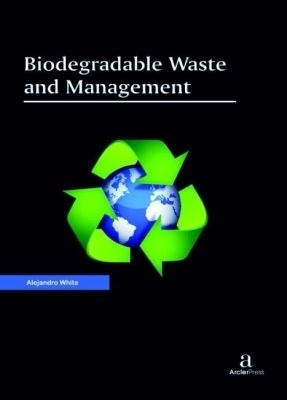
Biodegradable Waste and Management
Seiten
2016
Arcler Education Inc (Verlag)
978-1-68094-615-4 (ISBN)
Arcler Education Inc (Verlag)
978-1-68094-615-4 (ISBN)
- Titel z.Zt. nicht lieferbar
- Versandkostenfrei
- Auch auf Rechnung
- Artikel merken
Biodegradable waste is a type of waste, typically originating from plant or animal sources, which may be degraded by other living organisms. This book provides an introduction to the management of biodegradable waste.
Biodegradable waste is a type of waste, typically originating from plant or animal sources, which may be degraded by other living organisms. Waste that cannot be broken down by other living organisms are called non-biodegradable. Biodegradable waste can be commonly found in municipal solid waste (sometimes called biodegradable municipal waste, or BMW) as green waste, food waste, paper waste, and biodegradable plastics. Other biodegradable wastes include human waste, manure, sewage, slaughterhouse waste. In the absence of oxygen much of this waste will decay to methane by anaerobic digestion. The main environmental threat from biodegradable waste is the production of methane in landfills. Unquestionably, landfilling is the worst waste management option for bio-waste. However, for the management of biodegradable waste diverted from landfills, there seems to be several environmentally favorable options. While the waste management hierarchy also applies to the management of bio-waste, in specific cases it may be justified to depart from it as the environmental balance of the various options available for the management of this waste depends on a number of local factors, inter alia collection systems, waste composition and quality, climatic conditions, the potential of use of various waste-derived products such as electricity, heat, methane-rich gas or compost. Therefore, national strategies for the management of this waste should be determined in a transparent manner and be based on a structured and comprehensive approach such as Life Cycle Thinking (LCT). Biodegradable waste can often be used for composting which turns the waste into humus. It can also be used as a resource for heat, electricity and fuel in future, by using anaerobic digestion. This produces additional Biogas and still delivers usable nutrients that can be implemented to the soil. Especially animal-based kitchen scraps are best disposed this way. The leftover human food can also be used as fodder to flightless birds, goats, pigs, sheep, or alternatively can be fed to birds, and other wildlife.
Biodegradable waste is a type of waste, typically originating from plant or animal sources, which may be degraded by other living organisms. Waste that cannot be broken down by other living organisms are called non-biodegradable. Biodegradable waste can be commonly found in municipal solid waste (sometimes called biodegradable municipal waste, or BMW) as green waste, food waste, paper waste, and biodegradable plastics. Other biodegradable wastes include human waste, manure, sewage, slaughterhouse waste. In the absence of oxygen much of this waste will decay to methane by anaerobic digestion. The main environmental threat from biodegradable waste is the production of methane in landfills. Unquestionably, landfilling is the worst waste management option for bio-waste. However, for the management of biodegradable waste diverted from landfills, there seems to be several environmentally favorable options. While the waste management hierarchy also applies to the management of bio-waste, in specific cases it may be justified to depart from it as the environmental balance of the various options available for the management of this waste depends on a number of local factors, inter alia collection systems, waste composition and quality, climatic conditions, the potential of use of various waste-derived products such as electricity, heat, methane-rich gas or compost. Therefore, national strategies for the management of this waste should be determined in a transparent manner and be based on a structured and comprehensive approach such as Life Cycle Thinking (LCT). Biodegradable waste can often be used for composting which turns the waste into humus. It can also be used as a resource for heat, electricity and fuel in future, by using anaerobic digestion. This produces additional Biogas and still delivers usable nutrients that can be implemented to the soil. Especially animal-based kitchen scraps are best disposed this way. The leftover human food can also be used as fodder to flightless birds, goats, pigs, sheep, or alternatively can be fed to birds, and other wildlife.
Alejandro White is an Environmental Engineering BSc. from Universidad de los Andes, Colombia. His background and experience include areas like air quality and pollution, purification and waste water treatment and solid waste management. His interests span from sustainable architecture to renewable energies. Currently he is settled in the Philippines working for an international non-governmental organization after his passage from the private sector working in Coca Cola FEMSA.
| Erscheinungsdatum | 20.03.2018 |
|---|---|
| Sprache | englisch |
| Maße | 152 x 229 mm |
| Gewicht | 820 g |
| Themenwelt | Technik ► Umwelttechnik / Biotechnologie |
| ISBN-10 | 1-68094-615-3 / 1680946153 |
| ISBN-13 | 978-1-68094-615-4 / 9781680946154 |
| Zustand | Neuware |
| Informationen gemäß Produktsicherheitsverordnung (GPSR) | |
| Haben Sie eine Frage zum Produkt? |
Mehr entdecken
aus dem Bereich
aus dem Bereich
Senses and Movement
Buch | Softcover (2023)
De Gruyter (Verlag)
CHF 132,90
Kommentar der DIN 15905-5, LärmVibrationsArbSchV und …
Buch | Softcover (2023)
DIN Media (Verlag)
CHF 79,95
Buch | Softcover (2023)
DIN Media (Verlag)
CHF 105,55


