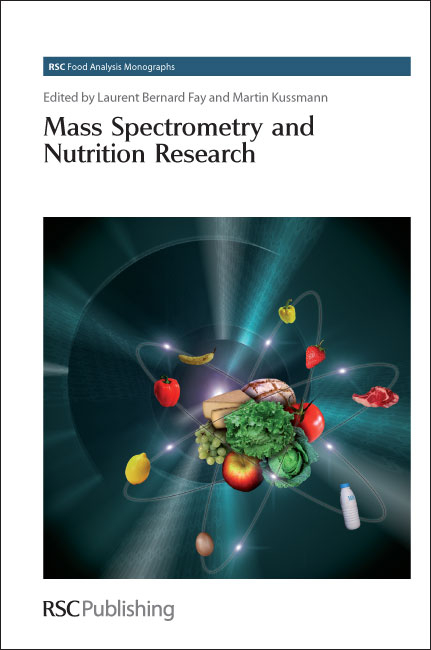
Mass spectrometry has developed into a platform for the assessment of health, sensory, quality and safety aspects of food. Current nutrition research focuses on unravelling the link between acute or chronic dietary and nutrient intake and the physiological effects at cellular, tissue and whole body level. The bioavailability and bioefficacy of food constituents and dose-effect correlations are key to understanding the impact of food on defined health outcomes. To generate this information, appropriate analytical tools are required to identify and quantify minute amounts of individual compounds in highly complex matrices (such as food or biological fluids) and to monitor molecular changes in the body in a highly specific and sensitive manner. Mass spectrometry has become the method of choice for such work and now has broad applications throughout all areas of nutrition research. This book focuses the contribution of mass spectrometry to the advancement of nutrition research. Aimed at students, teachers and researchers, it provides a link between nutrition and analytical biochemistry. It guides nutritionists to the appropriate techniques for their work and introduces analytical biochemists to new fields of application in nutrition and health. The first part of the book is dedicated to the assessment of macro- and micro-nutrient status with a view to making dietary recommendations for the treatment of diet-related diseases. The second part shows how mass spectrometry has changed nutrition research in fields like energy metabolism, body composition, protein turnover, immune modulation and cardiovascular health.
Dr. Laurent B. Fay is currently the Head of the Nutrition and Health Department at the NestlÚ Research Center in Switzerland. After a Master in Nutrition in 1981 he completed his PhD in Biochemistry at Dijon University in 1985, and joined NestlÚ in 1989 after three years in the pharmaceutical industry. Dr. FayÆs current research aims at developing nutritional approaches that promote health and wellness throughout life. His research team focuses on providing practical food and beverage solutions for optimal physical and cognitive performance, growth and development, protection, and weight management. Composed of nutritionists and biologists from diverse fields including microbiology, molecular biology, immunology, allergy, gut physiology and cognitive science, they apply the scientific advances of today to meet the nutrition needs of tomorrow. Dr. Fay is the author of more than 160 peer-reviewed publications. He is honorary member of the Swiss Group for Mass Spectrometry. Prof. Dr. Martin Kussmann leads the Functional Genomics Group at the NestlÚ Research Centre and is Honorary Professor at Aarhus University, Denmark. His team at NestlÚ is responsible for Nutrigenomics and Nutrigenetics. They develop and integrate gene and protein expression profiling with bioinformatics and computational molecular science. Major application fields are immunology, diabesity, and physical performance. Being educated as an analytical biochemist, Prof. Kussmann has acquired research experience in the pharmaceutical, biotechnological and nutritional industry. Prof. Kussmann holds a M.Sc. and a Ph.D. in Chemistry, obtained at the Universities of Aachen and Konstanz, Germany, and at the University of California, San Francisco, USA. During his doctorate and post-doctorate, he has specialised in analytical biochemistry, proteomics and genomics.
Chapter 1: Mass Spectrometry Technologies; Chapter 2: Mass Spectrometry for Food Analysis: The Example of Fat Soluble Vitamins A and K; Chapter 3: Mass Spectrometry for the Analysis of Milk Oligosaccharides; Chapter 4: Mass Spectrometry in Protein, Peptide and Amino Acid Analysis; Chapter 5: Lipidomics and Metabolomics of Dietary Lipid Peroxidation; Chapter 6: Mass Spectrometry in Phytonutrient Research; Chapter 7: Addressing Health Beneficial Aspects of Nutrition - The Example of the Obesity Epidemic; Chapter 8: Mass Spectrometry, Diet and Cardiovascular Disease: What Will They Mean for Food?; Chapter 9: Nutrition and Immunity; Chapter 10: Mass Spectrometry, Nutrition and Protein Turnover; Chapter 11: Conclusion
| Erscheint lt. Verlag | 1.7.2010 |
|---|---|
| Reihe/Serie | ISSN |
| ISSN | RSC Food Analysis Monographs |
| Co-Autor | Arnis Kuksis, Gregory Dolnikowski, Jean - Luc Wolfender, Dwight Matthews, Matej Oresic, Bruce German, Claudio Corradini, Nicole Packer, Michael Affolter |
| Verlagsort | Cambridge |
| Sprache | englisch |
| Themenwelt | Naturwissenschaften ► Chemie ► Analytische Chemie |
| Technik ► Lebensmitteltechnologie | |
| Schlagworte | Mass • Nutrition • Research • Spectrometry |
| ISBN-10 | 1-84973-092-X / 184973092X |
| ISBN-13 | 978-1-84973-092-1 / 9781849730921 |
| Informationen gemäß Produktsicherheitsverordnung (GPSR) | |
| Haben Sie eine Frage zum Produkt? |
 PDF (Adobe DRM)
Kopierschutz: Adobe-DRM
Adobe-DRM ist ein Kopierschutz, der das eBook vor Mißbrauch schützen soll. Dabei wird das eBook bereits beim Download auf Ihre persönliche Adobe-ID autorisiert. Lesen können Sie das eBook dann nur auf den Geräten, welche ebenfalls auf Ihre Adobe-ID registriert sind.
Details zum Adobe-DRM
Dateiformat: PDF (Portable Document Format)
Mit einem festen Seitenlayout eignet sich die PDF besonders für Fachbücher mit Spalten, Tabellen und Abbildungen. Eine PDF kann auf fast allen Geräten angezeigt werden, ist aber für kleine Displays (Smartphone, eReader) nur eingeschränkt geeignet.
Systemvoraussetzungen:
PC/Mac: Mit einem PC oder Mac können Sie dieses eBook lesen. Sie benötigen eine
eReader: Dieses eBook kann mit (fast) allen eBook-Readern gelesen werden. Mit dem amazon-Kindle ist es aber nicht kompatibel.
Smartphone/Tablet: Egal ob Apple oder Android, dieses eBook können Sie lesen. Sie benötigen eine
Geräteliste und zusätzliche Hinweise
Buying eBooks from abroad
For tax law reasons we can sell eBooks just within Germany and Switzerland. Regrettably we cannot fulfill eBook-orders from other countries.
aus dem Bereich