


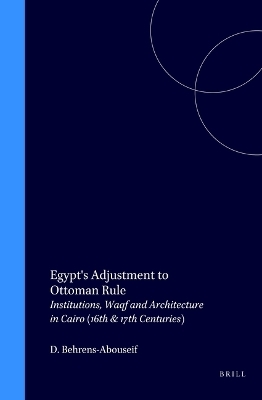
Egypt's Adjustment to Ottoman Rule
Institutions, Waqf and Architecture in Cairo (16th & 17th Centuries)
Seiten
1994
Brill (Verlag)
978-90-04-09927-2 (ISBN)
Brill (Verlag)
978-90-04-09927-2 (ISBN)
- Keine Verlagsinformationen verfügbar
- Artikel merken
This book deals with the transition of Egypt from Mamluk to Ottoman rule, a subject that has not been investigated before; Waqf documents are a major source for this study which also treats urban and architectural development as an aspect of the history of the period.
Egypt's Adjustment to Ottoman Rule deals with the impact of the Ottoman conquest of Egypt on its political, religious and social institutions, their transition from the Mamluk to the Ottoman regime and further development up to the 17th century.
The relationship between the Ottoman ruling establishment, the local religious groups and the military aristocracy is discussed in the first part of the volume. Waqf documents are a major source for this study which, in the second part, analyzes and compares the endowments of the Ottoman governors and those of the military aristocracy and their respective impact on the urban development and architecture of Cairo in this period. The architecture is documented with 70 photographs and figures.
By integrating architecture and urbanism in the historical analysis of the period under study, this book is important for historians and art historians of Egypt.
Egypt's Adjustment to Ottoman Rule deals with the impact of the Ottoman conquest of Egypt on its political, religious and social institutions, their transition from the Mamluk to the Ottoman regime and further development up to the 17th century.
The relationship between the Ottoman ruling establishment, the local religious groups and the military aristocracy is discussed in the first part of the volume. Waqf documents are a major source for this study which, in the second part, analyzes and compares the endowments of the Ottoman governors and those of the military aristocracy and their respective impact on the urban development and architecture of Cairo in this period. The architecture is documented with 70 photographs and figures.
By integrating architecture and urbanism in the historical analysis of the period under study, this book is important for historians and art historians of Egypt.
Doris Behrens-Abouseif, M.A. in Islamic Art at the American University in Cairo, Ph.D. at the University of Hamburg, Habilitation in Islamic History at the University of Freiburg. She is Privatdozent at the University of Freiburg and has many publications on social, urban and art history.
| Erscheint lt. Verlag | 1.3.1994 |
|---|---|
| Reihe/Serie | Islamic History and Civilization ; 7 |
| Verlagsort | Leiden |
| Sprache | englisch |
| Maße | 155 x 235 mm |
| Gewicht | 820 g |
| Einbandart | Leinen |
| Themenwelt | Kunst / Musik / Theater ► Kunstgeschichte / Kunststile |
| Geschichte ► Allgemeine Geschichte ► Neuzeit (bis 1918) | |
| Geisteswissenschaften ► Geschichte ► Regional- / Ländergeschichte | |
| Technik ► Architektur | |
| ISBN-10 | 90-04-09927-1 / 9004099271 |
| ISBN-13 | 978-90-04-09927-2 / 9789004099272 |
| Zustand | Neuware |
| Informationen gemäß Produktsicherheitsverordnung (GPSR) | |
| Haben Sie eine Frage zum Produkt? |
Mehr entdecken
aus dem Bereich

aus dem Bereich
Geschichte einer wilden Handlung
Buch | Hardcover (2024)
C.H.Beck (Verlag)
CHF 47,60


