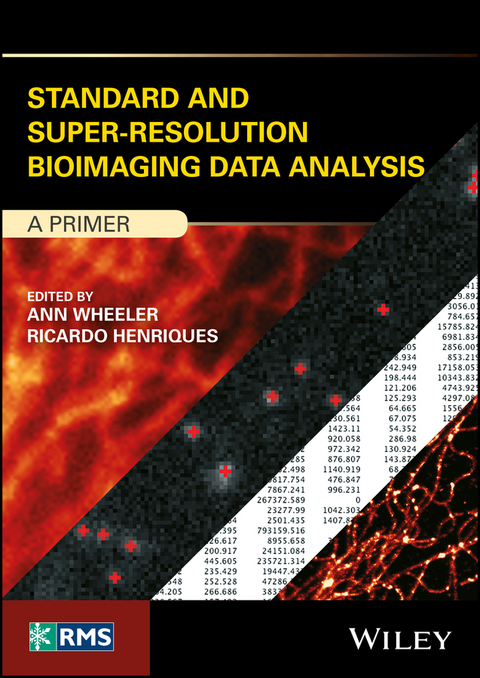
Standard and Super-Resolution Bioimaging Data Analysis (eBook)
John Wiley & Sons (Verlag)
978-1-119-09692-4 (ISBN)
A comprehensive guide to the art and science of bioimaging data acquisition, processing and analysis
Standard and Super-Resolution Bioimaging Data Analysis gets newcomers to bioimage data analysis quickly up to speed on the mathematics, statistics, computing hardware and acquisition technologies required to correctly process and document data.
The past quarter century has seen remarkable progress in the field of light microscopy for biomedical science, with new imaging technologies coming on the market at an almost annual basis. Most of the data generated by these systems is image-based, and there is a significant increase in the content and throughput of these imaging systems. This, in turn, has resulted in a shift in the literature on biomedical research from descriptive to highly-quantitative. Standard and Super-Resolution Bioimaging Data Analysis satisfies the demand among students and research scientists for introductory guides to the tools for parsing and processing image data. Extremely well illustrated and including numerous examples, it clearly and accessibly explains what image data is and how to process and document it, as well as the current resources and standards in the field.
- A comprehensive guide to the tools for parsing and processing image data and the resources and industry standards for the biological and biomedical sciences
- Takes a practical approach to image analysis to assist scientists in ensuring scientific data are robust and reliable
- Covers fundamental principles in such a way as to give beginners a sound scientific base upon which to build
- Ideally suited for advanced students having only limited knowledge of the mathematics, statistics and computing required for image data analysis
An entry-level text written for students and practitioners in the bioscience community, Standard and Super-Resolution Bioimaging Data Analysis de-mythologises the vast array of image analysis modalities which have come online over the past decade while schooling beginners in bioimaging principles, mathematics, technologies and standards.
ANN WHEELER, PhD, is Head of the Advanced Imaging Resource at the MRC Institute of Genetics and Molecular Medicine, University of Edinburgh, UK.
RICARDO HENRIQUES, PhD, is Head of the Quantitative Imaging and NanoBioPhysics research group at the MRC Laboratory for Molecular Cell Biology, University College London, UK.
A comprehensive guide to the art and science of bioimaging data acquisition, processing and analysis Standard and Super-Resolution Bioimaging Data Analysis gets newcomers to bioimage data analysis quickly up to speed on the mathematics, statistics, computing hardware and acquisition technologies required to correctly process and document data. The past quarter century has seen remarkable progress in the field of light microscopy for biomedical science, with new imaging technologies coming on the market at an almost annual basis. Most of the data generated by these systems is image-based, and there is a significant increase in the content and throughput of these imaging systems. This, in turn, has resulted in a shift in the literature on biomedical research from descriptive to highly-quantitative. Standard and Super-Resolution Bioimaging Data Analysis satisfies the demand among students and research scientists for introductory guides to the tools for parsing and processing image data. Extremely well illustrated and including numerous examples, it clearly and accessibly explains what image data is and how to process and document it, as well as the current resources and standards in the field. A comprehensive guide to the tools for parsing and processing image data and the resources and industry standards for the biological and biomedical sciences Takes a practical approach to image analysis to assist scientists in ensuring scientific data are robust and reliable Covers fundamental principles in such a way as to give beginners a sound scientific base upon which to build Ideally suited for advanced students having only limited knowledge of the mathematics, statistics and computing required for image data analysis An entry-level text written for students and practitioners in the bioscience community, Standard and Super-Resolution Bioimaging Data Analysis de-mythologises the vast array of image analysis modalities which have come online over the past decade while schooling beginners in bioimaging principles, mathematics, technologies and standards.
ANN WHEELER, PhD, is Head of the Advanced Imaging Resource at the MRC Institute of Genetics and Molecular Medicine, University of Edinburgh, UK. RICARDO HENRIQUES, PhD, is Head of the Quantitative Imaging and NanoBioPhysics research group at the MRC Laboratory for Molecular Cell Biology, University College London, UK.
Title Page 5
Copyright Page 6
Contents 7
List of Contributors 13
Foreword 15
Chapter 1 Digital Microscopy: Nature to Numbers 17
1.1 Acquisition 20
1.1.1 First Principles: How Can Images Be Quantified? 20
1.1.2 Representing Images as a Numerical Matrix Using a Scientific Camera 22
1.1.3 Controlling Pixel Size in Cameras 24
1.2 Initialisation 27
1.2.1 The Sample 28
1.2.2 Pre-Processing 28
1.2.3 Denoising 28
1.2.4 Filtering Images 30
1.2.5 Deconvolution 32
1.2.6 Registration and Calibration 35
1.3 Measurement 37
1.4 Interpretation 39
1.5 References 45
Chapter 2 Quantification of Image Data 47
2.1 Making Sense of Images 47
2.1.1 The Magritte Pipe 47
2.1.2 Quantification of Image Data Via Computers 49
2.2 Quantifiable Information 51
2.2.1 Measuring and Comparing Intensities 51
2.2.2 Quantifying Shape 52
2.2.3 Spatial Arrangement of Objects 57
2.3 Wrapping Up 61
2.4 References 62
Chapter 3 Segmentation in Bioimaging 63
3.1 Segmentation and Information Condensation 63
3.1.1 A Priori Knowledge 64
3.1.2 An Intuitive Approach 65
3.1.3 A Strategic Approach 67
3.2 Extracting Objects 68
3.2.1 Detecting and Counting Objects 68
3.2.2 Automated Segmentation of Objects 76
3.3 Wrapping Up 90
3.4 References 95
Chapter 4 Measuring Molecular Dynamics and Interactions by Förster Resonance Energy Transfer (FRET) 99
4.1 FRET-based techniques 99
4.1.1 Ratiometric Imaging 100
4.1.2 Acceptor Photobleaching 101
4.1.3 Other FRET Measurement Techniques 101
4.1.4 Alternative Methods to Measure Interactions 103
4.2 Experimental Design 105
4.2.1 Ratiometric Imaging of FRET-Based Sensors 106
4.2.2 Acceptor Photobleaching 107
4.3 FRET Data Analysis 108
4.3.1 Ratiometric Imaging 108
4.3.2 Acceptor Photobleaching 109
4.3.3 Data Averaging and Statistical Analysis 109
4.4 Computational Aspects of Data Processing 110
4.4.1 Software Tools 110
4.4.2 FRET Data Analysis with Fiji 110
4.5 Concluding Remarks 111
4.6 References 112
Chapter 5 FRAP and Other Photoperturbation Techniques 115
5.1 Photoperturbation Techniques in Cell Biology 115
5.1.1 Scientific Principles Underpinning FRAP 116
5.1.2 Other Photoperturbation Techniques 119
5.2 FRAP Experiments 122
5.2.1 Selecting Fluorescent Tags 123
5.2.2 Optimisation of FRAP Experiments 123
5.2.3 Storage of Experimental Data 125
5.3 FRAP Data Analysis 125
5.3.1 Quantification of FRAP Intensities 128
5.3.2 Normalisation 129
5.3.3 In Silico Modelling of FRAP Data 131
5.3.4 Fitting Recovery Curves 136
5.3.5 Evaluating the Quality of FRAP Data and Analysis Results 137
5.3.6 Data Averaging and Statistical Analysis 138
5.3.7 Software for FRAP Data Processing 139
5.4 Procedures for Quantitative FRAP Analysis with Freeware Software Tools 143
5.4.1 Quantification of Intensity Traces with Fiji 143
5.4.2 Processing FRAP Recovery Curves with FRAP Analyser 144
5.5 Notes 146
5.6 Concluding Remarks 147
5.7?References 148
5A Case Study: Analysing COPII Turnover During ER Exit 151
5A.1 Quantitative FRAP Analysis of ER-Exit Sites 151
5A.2 Mechanistic Insight into COPII Coat Kinetics with FRAP 154
5A.3 Automated FRAP at ERESs 156
5A.4 References 157
Chapter 6 Co-Localisation and Correlation in Fluorescence Microscopy Data 159
6.1 Introduction 159
6.2 Co-Localisation for Conventional Microscopy Images 161
6.2.1 Co-Localisation in Super-Resolution Localisation Microscopy 167
6.2.2 Fluorescence Correlation Spectroscopy 172
6.2.3 Image Correlation Spectroscopy 177
6.3 Conclusion 180
6.4 Acknowledgments 181
6.5 References 181
Chapter 7 Live Cell Imaging: Tracking Cell Movement 189
7.1 Introduction 189
7.2 Setting up a Movie for Time-Lapse Imaging 190
7.3 Overview of Automated and Manual Cell Tracking Software 191
7.3.1 Automatic Tracking 192
7.3.2 Manual Tracking 196
7.3.3 Comparison Between Automated and Manual Tracking 197
7.4 Instructions for Using ImageJ Tracking 200
7.5 Post-Tracking Analysis Using the Dunn Mathematica Software 205
7.6 Summary and Future Direction 214
7.7 References 214
Chapter 8 Super-Resolution Data Analysis 217
8.1 Introduction to Super-Resolution Microscopy 217
8.2 Processing Structured Illumination Microscopy Data 218
8.2.1 SIM Reconstruction Theory 219
8.2.2 Parameter Fitting and Corrections 220
8.2.3 SIM Quality Control 221
8.2.4 Checking System Calibration 221
8.2.5 Checking Raw Data 221
8.2.6 Checking Reconstructed Data 224
8.2.7 SIM Data Analysis 224
8.3 Quantifying Single Molecule Localisation Microscopy Data 226
8.3.1 SMLMS Pre-Processing 226
8.3.2 Localisation: Finding Molecule Positions 226
8.3.3 Fitting Molecules 226
8.3.4 Problem of Multiple Emissions Per Molecule 228
8.3.5 Sieving and Quality Control and Drift Correction 229
8.3.6 How Far Can I Trust the SMLM Data? 234
8.4 Reconstruction Summary 236
8.5 Image Analysis on Localisation Data 236
8.5.1 Cluster Analysis 237
8.5.2 Stoichiometry and Counting 238
8.5.3 Fitting and Particle Averaging 239
8.5.4 Tracing 239
8.6 Summary and Available Tools 239
8.7 References 240
Chapter 9 Big Data and Bio-Image Informatics: A Review of Software Technologies Available for Quantifying Large Datasets in Light-Microscopy 243
9.1 Introduction 243
9.2 What is Big Data Anyway? 244
9.3 The Open-Source Bioimage Informatics Community 247
9.3.1 ImageJ for Small-Scale Projects 247
9.3.2 CellProfiler, Large-Scale Projects and the Need for Complex Infrastructure 251
9.3.3 Technical Notes – Setting Up CellProfiler for Use on a Linux HPC 254
9.3.4 Icy, Towards Reproducible Image Informatics 258
9.4 Commercial Solutions for Bioimage Informatics 259
9.4.1 Imaris Bitplane 259
9.4.2 Definiens and Using Machine?Learning on Complex Datasets 260
9.5 Summary 263
9.6 Acknowledgments 263
9.7 References 264
Chapter 10 Presenting and storing data for publication 265
10.1 How to Make Scientific Figures 265
10.1.1 General Guidelines for Making Any Microscopy Figure 266
10.1.2 Do’s and Don’ts: Preparation of Figures for Publication 267
10.1.3 Restoration, Revelation or Manipulation 269
10.2 Presenting, Documenting and Storing Bioimage Data 272
10.2.1 Metadata Matters 273
10.2.2 The Open Microscopy Project 274
10.2.3 OME and Bio-Formats, Supporting Interoperability in Bioimaging Data 275
10.2.4 Long-Term Data Storage 276
10.2.5 USB Drives Friend or Foe? 278
10.2.6 Beyond the (USB) Drive Limit 278
10.2.7 Servers and Storage Area Networks 279
10.2.8 OMERO Scalable Data Management for Biologists 281
10.3 Summary 283
10.4 References 284
Chapter 11 Epilogue: A Framework for Bioimage Analysis 285
11.1 Workflows for Bioimage Analysis 286
11.1.1 Components 286
11.1.2 Workflows 288
11.1.3 Types of Workflows 289
11.1.4 Types of Component 292
11.2 Resources for Designing Workflows and Supporting Bioimage Analysis 293
11.2.1 A Brief History 294
11.2.2 A Network for Bioimage Analysis 295
11.2.3 Additional Textbooks 295
11.2.4 Training Schools 296
11.2.5 Database of Components and Workflows 296
11.2.6 Benchmarking Platform 298
11.3 Conclusion 298
11.4 References 299
Index 301
EULA 310
| Erscheint lt. Verlag | 12.10.2017 |
|---|---|
| Reihe/Serie | RMS - Royal Microscopical Society |
| RMS - Royal Microscopical Society | RMS - Royal Microscopical Society |
| Sprache | englisch |
| Themenwelt | Medizin / Pharmazie ► Gesundheitsfachberufe |
| Medizin / Pharmazie ► Medizinische Fachgebiete ► Radiologie / Bildgebende Verfahren | |
| Medizin / Pharmazie ► Physiotherapie / Ergotherapie ► Orthopädie | |
| Naturwissenschaften ► Biologie | |
| Naturwissenschaften ► Chemie | |
| Technik ► Maschinenbau | |
| Technik ► Medizintechnik | |
| Schlagworte | 3-d digital color microscopy for the biosciences • bioimage filtering • Bioimaging • bioimaging data documentation • bioimaging data parsing • bioimaging data processing • bioimaging hardware • bioimaging software • bioimaging technology • Biomedical Imaging • biomedical imaging data analysis • Biowissenschaften • Cell & Molecular Biology • Chemie • Chemistry • digital light microscopy in the biosciences • digital microscopy • digital microscopy hardware reviews • digital microscopy software reviews • image restoration of 2-dimensional microscopy • Imaging • imaging analysis • imaging data in biosciences • Life Sciences • Light microscopy • light microscopy image analysis • light microscopy imaging analysis • live cell imaging techniques • materials characterization • Materials Science • Materialwissenschaften • microscopes • Microscopy • Mikroskopie • Molekularbiologie • quantification of bioimaging data • quantifying data sets in microscopy • segmentation of bioimaging data • super-resolution bioimaging • super-resolution bioimaging data analysis • super-resolution image data processing • super-resolution imaging in biosciences • Werkstoffprüfung • Zell- u. Molekularbiologie |
| ISBN-10 | 1-119-09692-8 / 1119096928 |
| ISBN-13 | 978-1-119-09692-4 / 9781119096924 |
| Informationen gemäß Produktsicherheitsverordnung (GPSR) | |
| Haben Sie eine Frage zum Produkt? |
 PDF (Adobe DRM)
Kopierschutz: Adobe-DRM
Adobe-DRM ist ein Kopierschutz, der das eBook vor Mißbrauch schützen soll. Dabei wird das eBook bereits beim Download auf Ihre persönliche Adobe-ID autorisiert. Lesen können Sie das eBook dann nur auf den Geräten, welche ebenfalls auf Ihre Adobe-ID registriert sind.
Details zum Adobe-DRM
Dateiformat: PDF (Portable Document Format)
Mit einem festen Seitenlayout eignet sich die PDF besonders für Fachbücher mit Spalten, Tabellen und Abbildungen. Eine PDF kann auf fast allen Geräten angezeigt werden, ist aber für kleine Displays (Smartphone, eReader) nur eingeschränkt geeignet.
Systemvoraussetzungen:
PC/Mac: Mit einem PC oder Mac können Sie dieses eBook lesen. Sie benötigen eine
eReader: Dieses eBook kann mit (fast) allen eBook-Readern gelesen werden. Mit dem amazon-Kindle ist es aber nicht kompatibel.
Smartphone/Tablet: Egal ob Apple oder Android, dieses eBook können Sie lesen. Sie benötigen eine
Geräteliste und zusätzliche Hinweise
Buying eBooks from abroad
For tax law reasons we can sell eBooks just within Germany and Switzerland. Regrettably we cannot fulfill eBook-orders from other countries.
aus dem Bereich