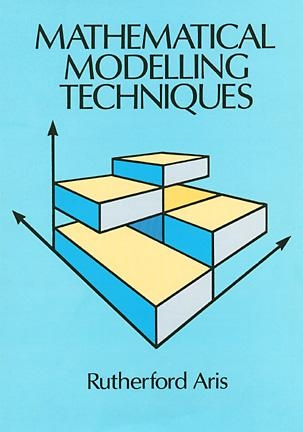
Mathematical Modelling Techniques (eBook)
288 Seiten
Dover Publications (Verlag)
9780486138893 (ISBN)
"e;Engaging, elegantly written."e; — Applied Mathematical ModellingMathematical modelling is a highly useful methodology designed to enable mathematicians, physicists and other scientists to formulate equations from a given nonmathematical situation. In this elegantly written volume, a distinguished theoretical chemist and engineer sets down helpful rules not only for setting up models but also for solving the mathematical problems they pose and for evaluating models.The author begins with a discussion of the term "e;model,"e; followed by clearly presented examples of the different types of models (finite, statistical, stochastic, etc.). He then goes on to discuss the formulation of a model and how to manipulate it into its most responsive form. Along the way Dr. Aris develops a delightful list of useful maxims for would-be modellers. In the final chapter he deals not only with the empirical validation of models but also with the comparison of models among themselves, as well as with the extension of a model beyond its original "e;domain of validity."e;Filled with numerous examples, this book includes three appendices offering further examples treated in more detail. These concern longitudinal diffusion in a packed bed, the coated tube chromatograph with Taylor diffusion and the stirred tank reactor. Six journal articles, a useful list of references and subject and name indexes complete this indispensable, well-written guide."e;A most useful, readable-and stimulating-book, to be read both for pleasure and for enlightenment."e; — Bulletin of the Institute of Mathematics and Its Applications
1. What is a model? 1.1 The idea of a mathematical model and its relation to other uses of the word 1.2 Relations between models with respect to origins 1.3 Relations between models with respect to purpose and conditions 1.4 How should a model be judged?2. The Different types of model 2.1 Verbal models and mechanical analogies 2.2 Finite models 2.3 Fuzzy subsets 2.4 Statistical models 2.5 Difference and differential equations 2.6 Stochastic models3. How to formulate a model 3.1 Laws and conservation principles 3.2 Constitutive relations 3.3 Discrete and continuous models4. How should a model be manipulated into its most responsive form? 4.1 Introductory suggestions 4.2 Natural languages and notations 4.3 Rendering the variables and parameters dismensionless 4.4 Reducing the number of equations and simplifying them 4.5 Getting partial insights into the form of the solution 4.5.1 The phase plane and competing populations 4.5.2 Coarse numerical methods and their uses 4.5.3 The interaction of easier and more difficult problems5. How should a model be evaluated? 5.1 Effective presentation of a model 5.2 Extension of models 5.3 Observable quantities 5.4 Comparison of models and prototypes and of models among themselves Appendices A. Longitudinal diffusion in a packed bed B. The coated tube chromatograph and Taylor diffusion C. The stirred tank reactor References Subject index Name idex Appendices to the Dover Edition I. "Re, k and p: A Conversation on Some Aspects of Mathematical Modelling" II. The Jail of Shape III. The Mere Notion of a Model IV. "Ut Simulacrum, Poesis" V. Manners Makyth Modellers VI. How to Get the Most Out of an Equation without Really Trying
| Erscheint lt. Verlag | 29.6.2012 |
|---|---|
| Reihe/Serie | Dover Books on Computer Science |
| Sprache | englisch |
| Maße | 170 x 170 mm |
| Gewicht | 422 g |
| Themenwelt | Mathematik / Informatik ► Mathematik |
| Technik ► Maschinenbau | |
| ISBN-13 | 9780486138893 / 9780486138893 |
| Informationen gemäß Produktsicherheitsverordnung (GPSR) | |
| Haben Sie eine Frage zum Produkt? |
 EPUB (Adobe DRM)
Kopierschutz: Adobe-DRM
Adobe-DRM ist ein Kopierschutz, der das eBook vor Mißbrauch schützen soll. Dabei wird das eBook bereits beim Download auf Ihre persönliche Adobe-ID autorisiert. Lesen können Sie das eBook dann nur auf den Geräten, welche ebenfalls auf Ihre Adobe-ID registriert sind.
Details zum Adobe-DRM
Dateiformat: EPUB (Electronic Publication)
EPUB ist ein offener Standard für eBooks und eignet sich besonders zur Darstellung von Belletristik und Sachbüchern. Der Fließtext wird dynamisch an die Display- und Schriftgröße angepasst. Auch für mobile Lesegeräte ist EPUB daher gut geeignet.
Systemvoraussetzungen:
PC/Mac: Mit einem PC oder Mac können Sie dieses eBook lesen. Sie benötigen eine
eReader: Dieses eBook kann mit (fast) allen eBook-Readern gelesen werden. Mit dem amazon-Kindle ist es aber nicht kompatibel.
Smartphone/Tablet: Egal ob Apple oder Android, dieses eBook können Sie lesen. Sie benötigen eine
Geräteliste und zusätzliche Hinweise
Buying eBooks from abroad
For tax law reasons we can sell eBooks just within Germany and Switzerland. Regrettably we cannot fulfill eBook-orders from other countries.
aus dem Bereich