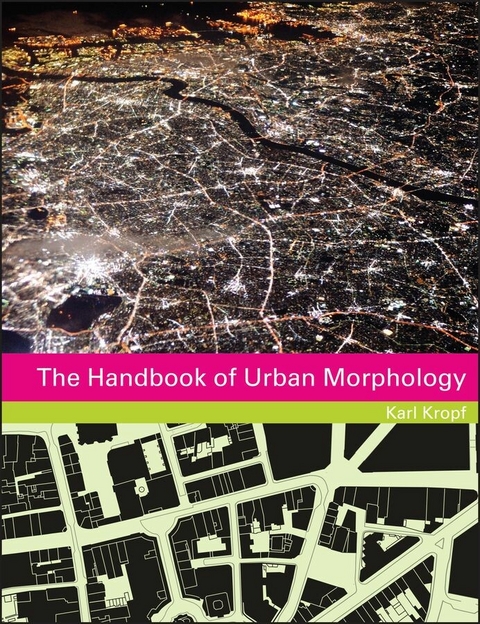
The Handbook of Urban Morphology (eBook)
John Wiley & Sons (Verlag)
978-1-118-74782-7 (ISBN)
Karl Kropf is Director of urban design consultancy Built Form Resource and Senior Lecturer at Oxford Brookes University. He has more than thirty years of experience in the fields of urban design, landscape architecture, architecture and historic conservation, working in the UK, France and US. He combines academic research in urban morphology and practice in urban design with the aim of using insights from one to improve the other.
The Handbook of Urban Morphology Karl Kropf Urban morphology is a core discipline for both academic research and professional practice in a range of fields including urban design, architecture, planning, geography, archaeology and anthropology. It plays a central role in improving our understanding of the built environment as a diverse, complex structure that is the product of ongoing social processes and serves as our own habitat. Conceived as a practical manual of morphological analysis, The Handbook of Urban Morphology brings together in one place the core concepts and principles of the discipline; specific, up-to-date guidance on analytical methods with clear step-by-step instructions and case studies demonstrating specific applications in research and professional practice. Illustrative material includes examples from Iran, China, Turkey, Brazil, France, Italy, the UK and the US, with case studies covering applications in theoretical morphology, environmental performance, historical characterisation, socio-cultural investigations, planning and design. The result lays the foundation for taking forward and reconciling what might seem to be different views of urban form. It provides a common basis for seeing the built environment as a quasi-natural, emergent phenomenon, the material and medium of urban design, a repository of embodied ideas and the cultural expression of the societies that produce it.
Karl Kropf is Director of urban design consultancy Built Form Resource and Senior Lecturer at Oxford Brookes University. He has more than thirty years of experience in the fields of urban design, landscape architecture, architecture and historic conservation, working in the UK, France and US. He combines academic research in urban morphology and practice in urban design with the aim of using insights from one to improve the other.
Introduction 2
Slowing down the normative impulse
Part 1 - Principles 12
1 Core Concepts 14
2 Origins and Approaches 16
3 Aspects of Urban Form 20
4 Minimum Elements 38
Part 2 - Methods 48
5 The General Process of Analysis 50
6 Desktop Analysis 58
7 Field Survey 116
8 Synthesis 132
Part 3 - Applications 174
9 Case Studies 176
Conclusion 230
Appendix 232
Further Reading 234
Illustration Credits 236
Index 237
Introduction
Slowing down the normative impulse
Cities exert an enormous pull on our imagination. We invest in them in innumerable ways, mentally, physically and financially. We expend great energy on them, and they are part of us as a species, essential to our very survival. Yet they also seem to grow and change by themselves, ‘out of our control’. One way or another, we tend to demonstrate a strong sense of territory and drive to create places for our own needs. This is revealed in the rich diversity of places that reflect the different ways people choose to create environments conducive to life (figures 0.1–0.4).
Figure 0.1 The Atago district, Minato, Tokyo
Figure 0.2 The Gros-Caillou quartier, Paris
Figure 0.3 A typical street in the Yanaka district, Tokyo
Figure 0.4 View down Rue Budé, Île Saint-Louis, Paris
One of the consequences of the deep-rooted connection we have with the places where we live is a normative impulse in our perceptions and interpretations of buildings and cities. When we talk about places, we tend to start with preferences and social judgements: beautiful, ugly, fascinating, good neighbourhood, bad neighbourhood, ‘not the sort of place you'd want to live’.1 Professionals are paid to have preferences, to say what is good or bad and whether or not it is worth investing in building.
At a broader level, the normative impulse is an expression of the fundamentally political nature of creating and changing the built environment and is rooted in our territoriality. Occupying land and putting up buildings (and tearing them down) are political acts, whether by an external power or an internal group (figures 0.5 and 0.6). The preferences of those in control are the ones that are acted upon and expressed.
Figure 0.5 Ruins of a Roman villa in Carthage, the Phoenician city destroyed and then reoccupied by the Romans only to be destroyed again in the Umayyad conquest. The site of Carthage is now a wealthy suburb of Tunis.
Figure 0.6 Aerial view of the West End of Boston, Massachusetts, after demolitions in 1958–9 as part of the city-led redevelopment project. Redevelopment of this kind in the US prompted Jane Jacobs to write The Death and Life of Great American Cities.
So if there is this almost irresistible, headlong rush toward the normative, how do we deal with the sense that cities appear out of our control, as if they have a mind of ‘their’ own? How do we work out who is in control if some things emerge not because of deliberate choice, but as a consequence of a number of individuals' choices about something else?
At the heart of this book is a desire to understand this apparent paradox. Underlying the desire to understand is the conviction that the normative impulse, while ultimately irresistible, can at least be slowed down. We can, with effort and the right tools, temporarily suspend the impulse long enough to examine what is really going on in the built environment. Yes, it is political, but it is not only political.
There are three general sets of tools that provide the basis for suspending the impulse. The first is really just a simple single principle: all places are worthy of our attention. To fully understand what is going on, we have to remain open-minded (figures 0.7 and 0.8). If we exercise our preferences first, we preclude the opportunity to learn, and it is often the places that look the least promising that have the most to offer. We never know what problem we may face in the future and where we might find the most effective solutions.
Figure 0.7 A view of the city of Bath from the south on Beechen Cliff
Figure 0.8 The Périphérique, the multi-lane ring road around the centre of Paris
The second set of tools is the sequence: analysis, comparison, synthesis. Comparison is fundamental to the way the brain works and overcomes the limitations of our isolation behind the veil of our senses. The strength of the methods of morphology that lie at the heart of this book is to make deliberate use of the comparative nature of our cognitive capacities to arrive at a richer understanding. That is, analysis on its own is not enough. We need to compare the results and collate them from different points of view.
The third set of tools is the sequence: description, evaluation, design. These represent a continuum between ‘looking’ and ’making'. Looking is not entirely passive but infused with values. A start, as a designer working with the built environment, is to see it as a ‘material’ or ‘medium’ for design with technical characteristics. We should be able to investigate and speak about the characteristics of different places in a non-normative way and then move on to why we think the places do or do not work – for particular purposes in particular circumstances. The question of whether or not you like a place should not determine your ability to understand how it is put together and works. Even if our interest is prompted initially by a qualitative judgement, however vague, we should be capable of taking a step back to work out what is going on and why the place generates that reaction in us. Once we understand how a place works and why we like it, we are then in a better position to use that knowledge and experience in design, and get better results.
The aim of the material set out in the three parts of this book is to show how to put these tools into practice. Part one of the book explores the core principles that define urban morphology as a field and the different approaches taken in developing and applying those principles. It breaks down the phenomenon of urban form into different aspects for the purposes of investigation – a precursor to comparison and synthesis.
Part two brings together and explains the range of different specific methods used in urban morphological investigations. While the emphasis is on the practical techniques of desktop analysis, field survey and synthesis, these are necessarily tied back into the theoretical considerations that inform the methods and techniques.
Part three gives a survey of different applications of urban morphology, both to illustrate the ways it can be put to use and to shed further light on the ideas and techniques. Applications range from theoretical explorations of possible form and investigation of environmental performance to formulation of planning policy, development control and generation of designs.
Together the three parts can help in slowing down the normative impulse so that we can not only learn from our experience but learn to improve the way that we learn.
DEFINITION OF URBAN MORPHOLOGY AND AIM OF THIS BOOK
Urban morphology is the study of human settlements, their structure and the process of their formation and transformation. It is a specialist but wide-ranging interdisciplinary field contributing to both academic research and professional practice in the built environment. It is concerned with the form and structure of cities, towns and villages, the way that they grow and change and their characteristics as our habitat. Urban morphology provides a range of concepts and tools that articulate the different aspects and elements of urban form, the relations between them and our role as the agents who create, use and transform them. The aim of urban morphological research is to contribute to our understanding of the built environment as a complex physical object, a cultural artefact and quasi-natural phenomenon similar to language.
This book is intended as a practical manual of urban morphological analysis. It provides a guide to methods and techniques of analysis, working definitions, terms and concepts, and approaches to interpretation. It also sets out a number of brief case studies of specific applications to illustrate how urban morphology is used in practice.
At its most basic, urban morphology provides a consistent and rigorous descriptive language of the built environment. It is a set of tools that helps us to ‘read’ urban form and in turn to tell the story of individual cities, towns and villages. It helps us to understand what makes every city unique and sheds light on the diversity of human culture as expressed through the specific local forms of different human environments, both across the globe and historically. At the same time, urban morphology facilitates rigorous comparison of different places in order to see what they have in common and identify the regularities in the processes by which they emerge and evolve as human habitat and human creations. The information accumulated through morphological analysis lays the foundation for identifying and understanding the common features and regularities of the built environment.
In combination with a range of associated methods and techniques, urban morphology provides tools for investigating and assessing the performance of urban environments as a habitat and the suitability of different forms for different purposes and conditions. Urban morphological concepts provide a rigorous frame of reference for studies into aspects such as energy...
| Erscheint lt. Verlag | 5.10.2017 |
|---|---|
| Reihe/Serie | The Urban Handbook series |
| The Urban Handbook series | The Urban Handbook series |
| Sprache | englisch |
| Themenwelt | Technik ► Architektur |
| Schlagworte | academic • Architecture • Architektur • built • Central • Complex • Concepts • Core • Discipline • Diverse • Environment • Fields • Habitat • Handbook • Including • Manual • Morphological • Morphology • Place • Practical • Practice • Product • Professional • Range • Role • social processes • Stadtentwicklung • Stadtmorphologie • Urban • Urban Development |
| ISBN-10 | 1-118-74782-8 / 1118747828 |
| ISBN-13 | 978-1-118-74782-7 / 9781118747827 |
| Informationen gemäß Produktsicherheitsverordnung (GPSR) | |
| Haben Sie eine Frage zum Produkt? |
 EPUB (Adobe DRM)
Kopierschutz: Adobe-DRM
Adobe-DRM ist ein Kopierschutz, der das eBook vor Mißbrauch schützen soll. Dabei wird das eBook bereits beim Download auf Ihre persönliche Adobe-ID autorisiert. Lesen können Sie das eBook dann nur auf den Geräten, welche ebenfalls auf Ihre Adobe-ID registriert sind.
Details zum Adobe-DRM
Dateiformat: EPUB (Electronic Publication)
EPUB ist ein offener Standard für eBooks und eignet sich besonders zur Darstellung von Belletristik und Sachbüchern. Der Fließtext wird dynamisch an die Display- und Schriftgröße angepasst. Auch für mobile Lesegeräte ist EPUB daher gut geeignet.
Systemvoraussetzungen:
PC/Mac: Mit einem PC oder Mac können Sie dieses eBook lesen. Sie benötigen eine
eReader: Dieses eBook kann mit (fast) allen eBook-Readern gelesen werden. Mit dem amazon-Kindle ist es aber nicht kompatibel.
Smartphone/Tablet: Egal ob Apple oder Android, dieses eBook können Sie lesen. Sie benötigen eine
Geräteliste und zusätzliche Hinweise
Buying eBooks from abroad
For tax law reasons we can sell eBooks just within Germany and Switzerland. Regrettably we cannot fulfill eBook-orders from other countries.
aus dem Bereich