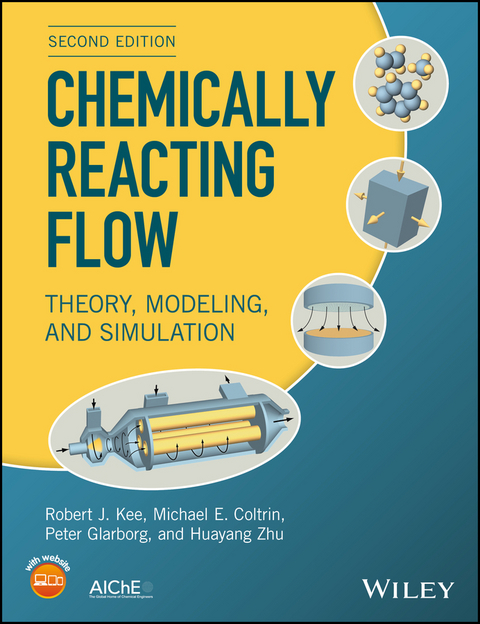
Chemically Reacting Flow (eBook)
John Wiley & Sons (Verlag)
978-1-119-18629-8 (ISBN)
A guide to the theoretical underpinnings and practical applications of chemically reacting flow
Chemically Reacting Flow: Theory, Modeling, and Simulation, Second Edition combines fundamental concepts in fluid mechanics and physical chemistry while helping students and professionals to develop the analytical and simulation skills needed to solve real-world engineering problems. The authors clearly explain the theoretical and computational building blocks enabling readers to extend the approaches described to related or entirely new applications. New to this Second Edition are substantially revised and reorganized coverage of topics treated in the first edition. New material in the book includes two important areas of active research: reactive porous-media flows and electrochemical kinetics. These topics create bridges between traditional fluid-flow simulation approaches and transport within porous-media electrochemical systems.
The first half of the book is devoted to multicomponent fluid-mechanical fundamentals. In the second half the authors provide the necessary fundamental background needed to couple reaction chemistry into complex reacting-flow models. Coverage of such topics is presented in self-contained chapters, allowing a great deal of flexibility in course curriculum design.
• Features new chapters on reactive porous-media flow, electrochemistry, chemical thermodynamics, transport properties, and solving differential equations in MATLAB
• Provides the theoretical underpinnings and practical applications of chemically reacting flow
• Emphasizes fundamentals, allowing the analyst to understand fundamental theory underlying reacting-flow simulations
• Helps readers to acquire greater facility in the derivation and solution of conservation equations in new or unusual circumstances
• Reorganized to facilitate use as a class text and now including a solutions manual for academic adopters
Computer simulation of reactive systems is highly efficient and cost-effective in the development, enhancement, and optimization of chemical processes. Chemically Reacting Flow: Theory, Modeling, and Simulation, Second Edition helps prepare graduate students in mechanical or chemical engineering, as well as research professionals in those fields take utmost advantage of that powerful capability.
Robert J. Kee, PhD, is the George R. Brown Distinguished Professor of Engineering at the Colorado School of Mines in Golden, Colorado.
Michael E. Coltrin, PhD, is a Distinguished Member of the Technical Staff at Sandia National Laboratories, Albuquerque, New Mexico.
Peter Glarborg, PhD, is a Professor of Chemical Engineering at the Technical University of Denmark in Lyngby, Denmark.
Huayang Zhu, PhD, is a Research Professor of Mechanical Engineering at the Colorado School of Mines, Golden, Colorado.
Robert J. Kee, PhD, is the George R. Brown Distinguished Professor of Engineering at the Colorado School of Mines in Golden, Colorado. Michael E. Coltrin, PhD, is a Distinguished Member of the Technical Staff at Sandia National Laboratories, Albuquerque, New Mexico. Peter Glarborg, PhD, is a Professor of Chemical Engineering at the Technical University of Denmark in Lyngby, Denmark. Huayang Zhu, PhD, is a Research Professor of Mechanical Engineering at the Colorado School of Mines, Golden, Colorado.
Preface xxi
Acknowledgments xxv
1 Introduction 1
References 17
2 Fluid properties 21
viii CONTENTS
References 42
3 Fluid Kinematics 43
4 The Conservation Equations 89
CONTENTS ix
x CONTENTS
References 147
5 Parallel Flows 149
References 191
6 Similarity and Local Similarity 193
CONTENTS xi
References 222
7 Stagnation Flows 223
xii CONTENTS
References 284
8 Boundary-Layer Channel Flow 287
References 316
9 Low-Dimensional Reactors 319
CONTENTS xiii
References 342
10 Thermochemical Properties 343
References 366
11 Molecular Transport 367
xiv CONTENTS
References 412
12 Mass-Action Kinetics 413
CONTENTS xv
References 438
13 Reaction Rate Theories 439
References 475
14 Reaction Mechanisms 477
References 515
xvi CONTENTS
15 Laminar Flames 519
References 543
16 Heterogeneous Chemistry 547
CONTENTS xvii
References 586
17 Reactive Porous Media 587
References 607
18 Electrochemistry 611
xviii CONTENTS
References 647
A Vector and Tensor Operations 649
B Navier-Stokes Equations 669
CONTENTS xix
C Example in General Curvilinear Coordinates 679
D Small Parameter Expansion 685
E Boundary-Layer Asymptotic Behavior 689
F Computational Algorithms 695
References 718
G Matlab Examples 721
xx CONTENTS
Index 739
ACKNOWLEDGMENTS
During the 13 years since the first edition was published, the authors have all been actively engaged in directly relevant research. Bob Kee has used the book as the basis for his graduate class on viscous flow and boundary-layer behavior. The second edition benefits greatly from the combination of these experiences.
Bob Kee and Huayang Zhu are grateful for over 15 years of close collaboration with Prof. David Goodwin (1957-2012) at Caltech. Dave played a particularly important and enduring role in the development of new ideas and approaches for understanding electrochemistry. Our initial collaborations in electrochemistry focused on understanding and modeling solid-oxide fuel cells, but the concepts are being extended and applied to ongoing research in rechargeable batteries and ion-conducting membranes. The book's new chapter on Electrochemistry builds on the foundation of extensive and fruitful collaborations with Dave. Among Dave's many contributions, his innovative design and implementation of the CANTERA software is increasingly prominent in the modeling and simulation of chemically reacting flow.
Bob Kee and Huayang Zhu gratefully acknowledge Dr. Michele Anderson (Office of Naval Research) for her valuable direction, feedback, and sustained long-term support of our research. The fundamental and applied research that she supports is generally in the area of electrochemical power systems, spanning a range of topics from hydrocarbon-fueled fuel-cell systems to the development and control of secondary batteries. Results from these efforts can be found throughout the second edition of this book.
Since the publication of the book's first edition, we have several new colleagues at the Colorado School of Mines. Prof. Canan Karakaya has made important contributions in the development of heterogeneous reactions mechanisms, especially in heterogeneous catalysis. The material in this book is influenced significantly by day-to-day technical interactions with Profs. Greg Bogin, Rob Braun, Tony Dean, Steven DeCaluwe, Greg Jackson, Ryan O'Hayre, Jason Porter, Sandrine Ricote, Neal Sullivan, Nils Tilton, and Tyrone Vincent. Close interaction with Dr. Grover Coors has played an important role in developing our capabilities in understanding electrochemical ceramics.
Mike Coltrin has continued to develop techniques and understanding of heterogeneous chemistry and transport with application to semiconductor materials processing. He gratefully acknowledges the valuable and long-term collaborations in this research with colleagues Randy Creighton, Jeff Tsao, Dan Koleske, Bob Kaplar (all at Sandia National Laboratories), and Jung Han (Yale University). This body of work, primarily on the III-nitride materials with applications to energy efficiency, has been funded by the US Department of Energy Office of Basic Energy Sciences and the Office of Energy Efficiency and Renewable Energy (related to solid-state lighting, SSL), and by Sandia's Laboratory Directed Research and Development Program (related to SSL and power electronics).
First Edition Acknowledgements
With this book we seek to document the experience we have gained over some 20 years of research and applications in chemically reacting fluid flow. An important aspect of the experience has been the development and application of the CHEMKIN software that implements much of the theory discussed in this text.
Beginning in the late 1970s, Jim Miller and Bob Kee began to collaborate on modeling combustion chemical kinetics and flame structure at Sandia National Laboratories in Livermore, California. Even as a freshly graduated Ph.D., Jim brought an extraordinarily deep understanding of fluid mechanics, thermodynamics, and chemistry together with a keen vision on how combustion modeling should proceed and what it could accomplish in the following decades. That theoretical foundation and vision set the course for much of what is presented in this text.
Modeling and simulation, of course, rests on physically based mathematical models and the numerical mathematics tools to solve them computationally. We are fortunate to have collaborated with a group of outstanding numerical mathematicians who were at Sandia in the 1980s. They served as a primary force in shaping the mathematical formalisms and writing the software implementations. This group includes Tom Manteuffel (University of Colorado), Tom Jefferson (Sandia National Laboratories), Linda Petzold (University of California, Santa Barbara), Mitch Smooke (Yale University), and Joe Grcar (Lawrence Berkeley National Laboratory). Linda Petzold must be especially acknowledged, as our collaborations have continued for nearly two decades.
In the early 1980s, Bob Kee and Jim Miller began to collaborate with Mike Coltrin on modeling chemical-vapor-deposition processes, which required specific attention to heterogeneous chemistry. Greg Evans (Sandia National Laboratories) was also instrumental in this effort, bringing a capability to model the Navier-Stokes equations in complex reactor configurations and including complex chemistry. As this effort grew, Bill Breiland, Pauline Ho, and Harry Moffat (all at Sandia National Laboratories) were instrumental in developing reaction chemistries and experimental validations.
Once the basic CHEMKIN philosophy and software were established in 1980, we had a framework into which new models could be integrated. Thus, we could expand the integrated modeling tools efficiently to meet the needs of increasingly challenging applications. Over the years, more than 20 individuals have contributed to aspects of CHEMKIN. Major contributors include Fran Rupley (Reaction Design, Inc.), Ellen Meeks (Reaction Design, Inc.), Rich Larson (Sandia National Laboratories), and Andy Lutz (Sandia National Laboratories).
Active international collaborations played a critical role in developing modeling capabilities. The frequent interactions with Jürgen Warnatz (University of Heidelberg) and his group over two decades have had a substantial influence on the course of our modeling philosophy. Collaborations with Graham Dixon-Lewis (University of Leeds) and Jürgen Warnatz led directly to the molecular-transport formulations and CHEMKIN implementations. The original stirred-reactor software grew out of collaborations with Peter Glarborg (Technical University of Denmark), who has continued collaboration with Jim Miller on nitrogen-cycle chemistry. Our understanding of fluid-mechanical similarity in various combustion situations has benefited greatly from long-standing interactions with Tadao Takeno (Meijo University, Japan).
We have benefited greatly from collaboration with Dave Goodwin (California Institute of Technology), who has developed a vision for the future course of chemically reacting flow modeling. In particular, he is concerned with the theoretical and software tools to couple individual models that bridge highly disparate time and length scales. He is also implementing models, including some of those discussed herein, with modern high-level programming and scripting languages, in a software suite called CANTERA.
We are grateful to the Department of Energy (DOE), Office of Basic Energy Sciences, Division of Materials Sciences, for the long-term fundingof the Chemical Vapor Deposition Sciences program at Sandia. We are also grateful to DOE's Division of Chemical Sciences, which, through the Combustion Research Facility, has supported much of the CHEMKIN development.
We gratefully acknowledge the long-term support from Bill Barker (ITN Energy Systems, Inc.), who as a DARPA program manager significantly influenced the direction of materials processing application software. He was one of the first to recognize that the physically based modeling of complex chemical chemically reacting flow could have a direct and beneficial impact on the design and optimization of practical materials processing. We are also grateful to Sematech for support of thin-film processing applications and to the Gas Research Institute (GRI) for support combustion research.
Bob Kee joined the engineering faculty at the Colorado School of Mines in 1996, creating the need for pedagogically oriented documentation. Close collaboration with Laxmi-narayan Raja was extraordinarily valuable in the early stages of this writing. There is a growing group of faculty at the Colorado School of Mines who are principally concerned with chemically reacting flow: Mark Linne, Terry Parker, Tom McKinnon, Colin Wolden, Jean-Pierre Delplanque, Huayang Zhu, and Tony Dean. The day-to-day interactions with these colleagues, on both research and teaching, provided valuable and stimulating experiences that have influenced the course of this text. Dr. Huayang Zhu, especially, as well as graduate students Wenhua Yang, Mark Pavol, and Kevin Walters have also contributed to formulating and solving several of the homework exercises.
Peter Glarborg gratefully acknowledges his long-term and fruitful interaction with Jim Miller in the field of high-temperature gas-phase chemistry, and with colleagues Anker Jensen, Jan Johnsson, and Kim Dam-Johansen at the Technical University of Denmark in the field of chemical reaction engineering. Furthermore, collaboration in kinetics research with a number of scientists, including Per Gravers Kristensen, Maria Alzueta, and Martin Skov Skjøth-Rasmussen, has been very valuable. Peter Glarborg would also like to acknowledge John Kramlich, Jerry Cole, and Irv Glassman for inspiration in some of the homework problems. He would also like to thank the long-term funding provided by the Danish Ministry of Energy, the Nordic Gas Technology Centre, the Gas Research Institute (United States), and the CHEC...
| Erscheint lt. Verlag | 27.9.2017 |
|---|---|
| Sprache | englisch |
| Themenwelt | Naturwissenschaften ► Chemie ► Technische Chemie |
| Technik ► Maschinenbau | |
| Schlagworte | chemical engineering • chemical engineering kinetics • chemical engineering reactive flow • chemically reacting flow • chemically reacting flow fundamentals • chemically reacting flow modeling • chemically reacting flow principles • chemically reacting flow problems • chemically reacting flow simulation • chemically reacting flow theory • chemically reactive flow modeling algorithms • chemical reactor analysis • chemical reactor design • Chemical Reactor Modeling • chemical reactor simulation • chemical thermodynamics in chemically reacting flow • chemical thermodynamics in reactive flow • Chemie • Chemische Verfahrenstechnik • Chemistry • Computational Chemistry & Molecular Modeling • Computational Chemistry u. Molecular Modeling • computer simulation of reactive systems • Maschinenbau • mechanical engineering • porous-media transport within electrodes • reactive fluid mechanics • reactive porous-media flows • transport modeling for chemical engineers • transport phenomena in chemical reactor design • transport phenomenal in chemically reacting systems |
| ISBN-10 | 1-119-18629-3 / 1119186293 |
| ISBN-13 | 978-1-119-18629-8 / 9781119186298 |
| Informationen gemäß Produktsicherheitsverordnung (GPSR) | |
| Haben Sie eine Frage zum Produkt? |
 EPUB (Adobe DRM)
Kopierschutz: Adobe-DRM
Adobe-DRM ist ein Kopierschutz, der das eBook vor Mißbrauch schützen soll. Dabei wird das eBook bereits beim Download auf Ihre persönliche Adobe-ID autorisiert. Lesen können Sie das eBook dann nur auf den Geräten, welche ebenfalls auf Ihre Adobe-ID registriert sind.
Details zum Adobe-DRM
Dateiformat: EPUB (Electronic Publication)
EPUB ist ein offener Standard für eBooks und eignet sich besonders zur Darstellung von Belletristik und Sachbüchern. Der Fließtext wird dynamisch an die Display- und Schriftgröße angepasst. Auch für mobile Lesegeräte ist EPUB daher gut geeignet.
Systemvoraussetzungen:
PC/Mac: Mit einem PC oder Mac können Sie dieses eBook lesen. Sie benötigen eine
eReader: Dieses eBook kann mit (fast) allen eBook-Readern gelesen werden. Mit dem amazon-Kindle ist es aber nicht kompatibel.
Smartphone/Tablet: Egal ob Apple oder Android, dieses eBook können Sie lesen. Sie benötigen eine
Geräteliste und zusätzliche Hinweise
Buying eBooks from abroad
For tax law reasons we can sell eBooks just within Germany and Switzerland. Regrettably we cannot fulfill eBook-orders from other countries.
aus dem Bereich