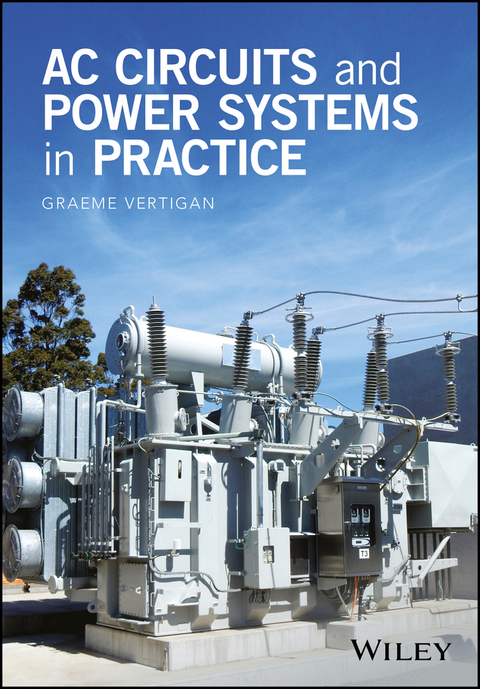
AC Circuits and Power Systems in Practice (eBook)
John Wiley & Sons (Verlag)
978-1-118-92461-7 (ISBN)
The essential guide that combines power system fundamentals with the practical aspects of equipment design and operation in modern power systems
Written by an experienced power engineer, AC Circuits and Power Systems in Practice offers a comprehensive guide that reviews power system fundamentals and network theorems while exploring the practical aspects of equipment design and application. The author covers a wide-range of topics including basic circuit theorems, phasor diagrams, per-unit quantities and symmetrical component theory, as well as active and reactive power and their effects on network stability, voltage support and voltage collapse. Magnetic circuits, reactor and transformer design are analyzed, as is the operation of step voltage regulators. In addition, detailed introductions are provided to earthing systems in LV and MV networks, the adverse effects of harmonics on power equipment and power system protection. Finally, European and American engineering standards are presented where appropriate throughout the text, to familiarize the reader with their use and application.
This book is written as a practical power engineering text for engineering students and recent graduates. It contains more than 400 illustrations and is designed to provide the reader with a broad introduction to the subject and to facilitate further study. Many of the examples included come from industry and are not normally covered in undergraduate syllabi. They are provided to assist in bridging the gap between tertiary study and industrial practice, and to assist the professional development of recent graduates. The material presented is easy to follow and includes both mathematical and visual representations using phasor diagrams. Problems included at the end of most chapters are designed to walk the reader through practical applications of the associated theory.
Graeme Vertigan is a consulting engineer working in the Australian power supply industry. He has delivered courses on Energy Metering for the national electricity market operator since 2009, and was formerly the senior electrical engineer at a large Tasmanian zinc refinery. He was also employed as a part time lecturer at the University of Tasmania for many years.
GRAEME VERTIGAN is a consulting engineer working in the Australian power supply industry. He has delivered courses on Energy Metering for the national electricity market operator since 2009, and was formerly the senior electrical engineer at a large Tasmanian zinc refinery. He was also employed as a part time lecturer at the University of Tasmania for many years.
"This book combines the author?s rich experience in industry and teaching expertise in university. It covers the fundamental topics of AC circuits, and the application of those theories are discussed with numerous examples as well as the requirements of Engineering Standards. The writing style is logical and explicit, while illustrations and diagrams are with great accuracy, facilitating readers to have a systematic and in-depth understanding. Overall, I think this book can be an invaluable guide for recent graduate engineers working in power industry."-- Adrian Chen, Electrical Engineer, Moolarben Coal Operations Pty Ltd, Australia?This is a refreshingly practical text which covers a wide range of topics relating to AC power systems. The book is divided into two parts with part one providing a broad overview of AC power systems and a review of fundamental AC circuit theory. Part two of the book covers specific areas of AC power systems in more detail with chapters on three phase transformers, voltage and current measurement, energy metering, harmonics and power system protection. One standout feature of this book is the writing style which I found to be very straight forward and easy to read. Additionally, excellent diagrams and illustrations work well to reinforce the subject material. The text is very well referenced with a list of sources provided at the conclusion of each chapter. The industry based examples in the text work well to link electrical engineering theory and practice and as such this book should find appeal with both undergraduate students studying a course of electrical engineering and recent graduates.?- James Lamont, Electrical Engineering Technical Officer, Deakin University, Australia?..written with practice in mind, enhancing its readability... the book covers the theory well, while not forgetting other aspects such as operations and safety. Given Graeme?s engineering practice, along with his academic work, he has been able to write a book that will serve engineering students well but also continue to serve them in their work place.?- Robbie Bell | Electrical Engineer, Hydro Tasmania, Australia?Had I read this text ten years ago, my transition to the workforce would have been much easier. As a graduate electrical power engineer I found there was a distinct lack of resources to help close the gap between academia and industry.The author, who is clearly accomplished across both areas, seamlessly guides the reader through challenging concepts while equipping them for further application.AC Circuits and Power Systems in Practice is a must-read for undergraduates, recent graduates, and experienced electrical professionals alike.?-Tim Sutton MIEAust CPEng NER, Senior Network Planning Engineer, Tasmanian Networks Pty Ltd, Australia?This is a refreshingly practical text which covers a wide range of topics relating to AC power systems. The book is divided into two parts with part one providing a broad overview of AC power systems and a review of fundamental AC circuit theory. Part two of the book covers specific areas of AC power systems in more detail with chapters on three phase transformers, voltage and current measurement, energy metering, harmonics and power system protection. One standout feature of this book is the writing style which I found to be very straight forward and easy to read. Additionally, excellent diagrams and illustrations work well to reinforce the subject material. The text is very well referenced with a list of sources provided at the conclusion of each chapter. The industry based examples in the text work well to link electrical engineering theory and practice and as such this book should find appeal with both undergraduate students studying a course of electrical engineering and recent graduates.?- James Lamont, Electrical Engineering Technical Officer, Deakin University, Australia
Preface
This book is written as a practical power engineering text for engineering students and recent graduates. It contains more than 400 illustrations and is designed to provide the reader with a broad introduction to the subject and to facilitate further study. Many of the examples included come from industry and are not normally covered in undergraduate syllabi. They are provided to assist in bridging the gap between tertiary study and industrial practice, and to assist the professional development of recent graduates. The material presented is easy to follow and includes both mathematical and visual representations using phasor diagrams. Problems included at the end of most chapters are designed to walk the reader through practical applications of the associated theory.
The text is divided into two parts. The first (Chapters 1–6) is primarily intended for undergraduate students. It includes a general overview of the power system, AC circuit theory, network theorems and phasor analysis, in addition to a discussion of active and reactive power, magnetic circuits and an introduction to current and voltage transformer operation. Part 1 concludes with a discussion of symmetrical component theory and the parameters affecting the flow of power in AC networks, including the phenomenon of voltage collapse.
Chapter 1 provides a general overview of low, medium and high voltage power systems, including the changes to the generation profile presently occurring and their implications for future network development.
Chapter 2 introduces RMS quantities and phasor representation of alternating voltages and currents. Elementary relationships between the voltage and currents in resistors, capacitors and inductors are derived and represented as phasor quantities. This chapter demonstrates the use of phasor diagrams as a tool for analysing complex circuits and for gaining a visual insight into their operation. It also reviews voltage and current sign conventions, Kirchhoff’s current and voltage laws and their application to the principle of superposition, as well as Thévenin and Norton’s Theorems. Series and parallel resonant circuits are also introduced, together with the concept of the quality factor, Q and its application to resonant circuits.
Chapter 2 also contains several phasor analysis examples, including balancing the load of a single‐phase induction furnace across three phases, the operation of a phase sequence indicator, power factor correction and capacitive voltage support for an inductive load.
The concepts of active power, reactive power and power factor are explained in Chapter 3, together with a discussion of the electrical characteristics of large and small commercial loads. The need for power factor correction (PFC) is considered together with a practical method of sizing PFC equipment for a given load. The chapter concludes with a general introduction to energy retailing, including transmission and distribution loss factors and maximum demand limits and charges.
Chapter 4 introduces the idea of a magnetic circuit and its application to voltage and current transformers. The properties of magnetic materials are considered, including air gaps necessary in reactor design. The constant flux model of a two‐winding transformer and its equivalent circuit are developed, and per‐unit quantities are introduced through numerical examples. Finally, the apparent difference between current and voltage transformers is explained. Examples include the reactor design and the determination of the Q factor, the magnetic analysis of an electromagnetic sheet‐metal folding machine, and transformer operation from the point of view of mutual coupling.
Symmetrical component theory is introduced in Chapter 5, with the concept of positive, negative and zero‐sequence components, sequence networks and sequence impedances. Sequence network connections are analysed for common system faults, and their use in determining the primary phase currents of a transformer with a faulted secondary is described. Examples include a method of locating faults in MV feeders as well as the design of an electronic negative sequence filter.
Chapter 6 considers the flow of active and reactive power in AC networks, including a discussion of the degree of coupling between them and the network parameters influencing each. The phenomenon of voltage collapse in networks is also discussed as well as steps generally taken by authorities to prevent one. Examples include voltage drops in transmission and distribution networks as functions of the system X/R ratio, and the practical application of phase shifting transformers to control active and reactive power flows in transmission networks.
The second part of the book (Chapters 7–14) contains material appropriate to final year students and recent engineering graduates and is written to assist a rapid integration into the engineering profession. It introduces the practical application of engineering standards and compares IEEE standards published in the USA with those published by the IEC in Europe.
Part 2 begins in Chapter 7 with a detailed discussion of three‐phase transformers, including impedance calculations and the influence of core architectures and winding arrangements on positive, negative and zero‐sequence impedances. Vector grouping, transformer voltage regulation, magnetising characteristics and zero‐sequence impedances are examined, as are tap‐changing techniques and the parallel operation of transformers. Examples include a detailed operational analysis of step voltage regulators and phase shifting transformers.
Chapter 8 examines the characteristics of both inductive and capacitive voltage transformers. It begins with a detailed examination of the inherent phase and magnitude errors and presents equations relating them to elements within the transformer equivalent circuit and the applied burden. IEEE and IEC voltage transformer standards are compared, with particular reference to ratings and accuracy classes. A simple method for error conversion between different burdens is presented, together with a discussion of the use of voltage transformers in protection and metering applications. The definitions of earth fault factor, effective earthing and the phenomenon of ferro‐resonance are discussed. Finally, the operating principles of non‐conventional voltage transformers are briefly examined.
Chapter 9 analyses the operating principles and limitations of magnetic current transformers in metering and protection applications. The relevant IEEE and IEC standards are again compared. Magnitude and phase errors as well as ratio and transformer correction factors are defined and evaluated from elements within the CT equivalent circuit including the connected burden. Magnetising admittances and saturation effects are discussed and the concept of composite error and methods of measuring it in protection cores are described. The significance of the knee point voltage and accuracy limit factors in protection CTs are explained and the various protection classes defined in each standard are also considered. The derivation of the over‐current ratio curve from the magnetising characteristic is described together with the series and parallel CT connections used in both protection and metering applications. Finally, non‐conventional current transformers are introduced together with a discussion of their operating principles. Examples include the design of a simple current transformer test set, and the evaluation of CT errors from magnetising admittance data.
Three‐phase energy metering circuits are described in Chapter 10. The concept of a metering interval is introduced and the advantages offered by static meters as compared to accumulation meters are explained. Both the three‐element and two‐element approaches to three‐phase metering are analysed, including Blondel’s theorem. Several non‐Blondel compliant metering topologies are also described. This chapter considers the response of these circuits to negative and zero‐sequence components and the degree of error they introduce. It also evaluates the overall metering error as a result of the inherent errors in current and voltage transformers. The final correction factor as defined in the IEEE standard is described and is related to the transformer correction factors for the associated voltage and current transformers. Examples include a comparison of MV and LV metering across a transformer, the recovery of the correct metering data from a faulted two‐element metering installation and the analysis of a non‐Blondel compliant metering topology.
Chapter 11 provides an introduction to the various earthing systems used in MV and LV electricity networks. It begins with an examination of the effects of electric current on the human body, which determine to a large extent the operational requirements of earthing systems. Chapter 11 continues with a discussion of the TT, TN and IT low voltage earthing systems, as well as impedance earthed and un‐earthed neutrals used in medium voltage systems, including resonant earthing. An example of an earth grid design is presented according to the process outlined in the American standard IEEE 80.
Power system protection is introduced in Chapter 12, beginning with a general discussion of protection principles including primary and backup protection, check relays, zones of protection, discrimination and protection reliability. It concludes...
| Erscheint lt. Verlag | 29.9.2017 |
|---|---|
| Sprache | englisch |
| Themenwelt | Technik ► Elektrotechnik / Energietechnik |
| Schlagworte | Active and Reactive Power • Arc Flash and Electric Shock Injury • Blondel Compliant Metering • Capacitive Voltage Support • Circuit Theory & Design • Common Bus-bar Configurations • Current Transformers (CTs) • Device Numbers • Effects of Current on the Human Body • Electrical & Electronics Engineering • Electrical safety • Elektrotechnik u. Elektronik • Energie • Energietechnik • Energy • Energy metering • Energy Retailing • fourier analysis • Graeme Vertigan</p> • Harmonic Loss in Transformers • Harmonic Measurement • Harmonics in Power Systems • Harmonic Standards and the Assessment of Distorting Loads • High, Medium and Low Voltage Transmission and Distribution Networks • Inductor Design • Limits of Approach • <p>Guide to AC Circuits and Power Systems • Magnetic Circuits and Materials • Magnetising Current Effects • Magnitude and Phase Errors • Metering Class CTs • network faults • Network planning • Network Theorems • Over-current, Differential, Bus Zone and Distance Protection Systems • Phase Shift Transformers • Phasor Diagrams and Phasor Analysis • Power Factor • Power Flows in AC Networks • Power system protection • Power Technology & Power Engineering • Protection Class VTs • Protection CT Applications • Residual Current Devices • Resonant and Impedance Earthing • Schaltkreise - Theorie u. Entwurf • Schaltkreistechnik • Series and Parallel Resonance • Step Voltage Regulators • Switching Plans, Isolation and Permit to Work Procedures • Symmetrical component theory • Synchronous and Asynchronous Generation • Tap-changer Operation • The One Line Diagram • The Per-Unit System • Three Phase Transformers • Transformer Core Architectures • Transformer Theory and Operation • TT, TN and IT Earthing Systems • Two and Three Wire Metering Circuits • Vector Groups • Voltage Transformers (VTs) • X/R Ratios: Voltage Stability and Voltage Collapse |
| ISBN-10 | 1-118-92461-4 / 1118924614 |
| ISBN-13 | 978-1-118-92461-7 / 9781118924617 |
| Informationen gemäß Produktsicherheitsverordnung (GPSR) | |
| Haben Sie eine Frage zum Produkt? |
 EPUB (Adobe DRM)
Kopierschutz: Adobe-DRM
Adobe-DRM ist ein Kopierschutz, der das eBook vor Mißbrauch schützen soll. Dabei wird das eBook bereits beim Download auf Ihre persönliche Adobe-ID autorisiert. Lesen können Sie das eBook dann nur auf den Geräten, welche ebenfalls auf Ihre Adobe-ID registriert sind.
Details zum Adobe-DRM
Dateiformat: EPUB (Electronic Publication)
EPUB ist ein offener Standard für eBooks und eignet sich besonders zur Darstellung von Belletristik und Sachbüchern. Der Fließtext wird dynamisch an die Display- und Schriftgröße angepasst. Auch für mobile Lesegeräte ist EPUB daher gut geeignet.
Systemvoraussetzungen:
PC/Mac: Mit einem PC oder Mac können Sie dieses eBook lesen. Sie benötigen eine
eReader: Dieses eBook kann mit (fast) allen eBook-Readern gelesen werden. Mit dem amazon-Kindle ist es aber nicht kompatibel.
Smartphone/Tablet: Egal ob Apple oder Android, dieses eBook können Sie lesen. Sie benötigen eine
Geräteliste und zusätzliche Hinweise
Buying eBooks from abroad
For tax law reasons we can sell eBooks just within Germany and Switzerland. Regrettably we cannot fulfill eBook-orders from other countries.
aus dem Bereich