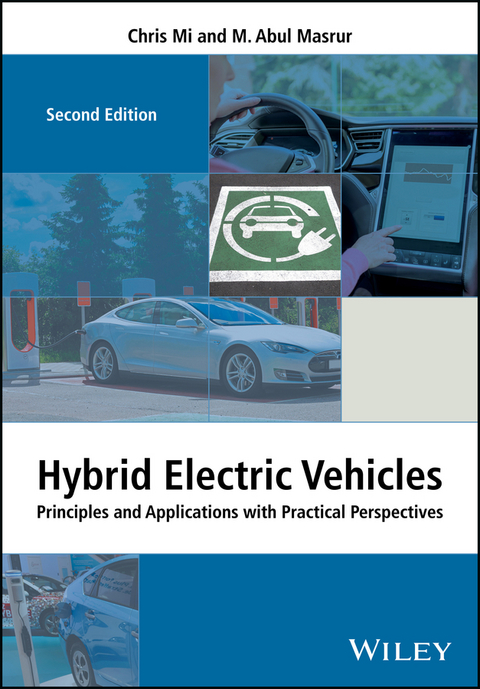
Hybrid Electric Vehicles (eBook)
John Wiley & Sons (Verlag)
978-1-118-97054-6 (ISBN)
The latest developments in the field of hybrid electric vehicles
Hybrid Electric Vehicles provides an introduction to hybrid vehicles, which include purely electric, hybrid electric, hybrid hydraulic, fuel cell vehicles, plug-in hybrid electric, and off-road hybrid vehicular systems. It focuses on the power and propulsion systems for these vehicles, including issues related to power and energy management. Other topics covered include hybrid vs. pure electric, HEV system architecture (including plug-in & charging control and hydraulic), off-road and other industrial utility vehicles, safety and EMC, storage technologies, vehicular power and energy management, diagnostics and prognostics, and electromechanical vibration issues.
Hybrid Electric Vehicles, Second Edition is a comprehensively updated new edition with four new chapters covering recent advances in hybrid vehicle technology. New areas covered include battery modelling, charger design, and wireless charging. Substantial details have also been included on the architecture of hybrid excavators in the chapter related to special hybrid vehicles. Also included is a chapter providing an overview of hybrid vehicle technology, which offers a perspective on the current debate on sustainability and the environmental impact of hybrid and electric vehicle technology.
- Completely updated with new chapters
- Covers recent developments, breakthroughs, and technologies, including new drive topologies
- Explains HEV fundamentals and applications
- Offers a holistic perspective on vehicle electrification
Hybrid Electric Vehicles: Principles and Applications with Practical Perspectives, Second Edition is a great resource for researchers and practitioners in the automotive industry, as well as for graduate students in automotive engineering.
Chris Mi, PhD, is the Professor and Chair of Electrical and Computer Engineering, and Director of DTE Power Electronics Laboratory at San Diego State University.
M. Abul Masrur, PhD, is an Adjunct Professor at the University of Detroit Mercy, where he has been teaching courses on Advanced Electric and Hybrid Vehicles, Vehicular Power Systems, Electric Drives, and Power Electronics.
The latest developments in the field of hybrid electric vehicles Hybrid Electric Vehicles provides an introduction to hybrid vehicles, which include purely electric, hybrid electric, hybrid hydraulic, fuel cell vehicles, plug-in hybrid electric, and off-road hybrid vehicular systems. It focuses on the power and propulsion systems for these vehicles, including issues related to power and energy management. Other topics covered include hybrid vs. pure electric, HEV system architecture (including plug-in & charging control and hydraulic), off-road and other industrial utility vehicles, safety and EMC, storage technologies, vehicular power and energy management, diagnostics and prognostics, and electromechanical vibration issues. Hybrid Electric Vehicles, Second Edition is a comprehensively updated new edition with four new chapters covering recent advances in hybrid vehicle technology. New areas covered include battery modelling, charger design, and wireless charging. Substantial details have also been included on the architecture of hybrid excavators in the chapter related to special hybrid vehicles. Also included is a chapter providing an overview of hybrid vehicle technology, which offers a perspective on the current debate on sustainability and the environmental impact of hybrid and electric vehicle technology. Completely updated with new chapters Covers recent developments, breakthroughs, and technologies, including new drive topologies Explains HEV fundamentals and applications Offers a holistic perspective on vehicle electrification Hybrid Electric Vehicles: Principles and Applications with Practical Perspectives, Second Edition is a great resource for researchers and practitioners in the automotive industry, as well as for graduate students in automotive engineering.
Chris Mi, PhD, is the Professor and Chair of Electrical and Computer Engineering, and Director of DTE Power Electronics Laboratory at San Diego State University. M. Abul Masrur, PhD, is an Adjunct Professor at the University of Detroit Mercy, where he has been teaching courses on Advanced Electric and Hybrid Vehicles, Vehicular Power Systems, Electric Drives, and Power Electronics.
1
Introduction
Modern society relies heavily on fossil fuel based transportation for economic and social development – freely moving goods and people. There are about 800 million cars in the world and about 260 million motor vehicles on the road in the United States in 2014 according to the US Department of Transportation’s estimate [1]. In 2009, China overtook the United States to become the world’s largest auto maker and auto market, with output and sales respectively hitting 13.79 and 13.64 million units in that year [2]. With further urbanization, industrialization, and globalization, the trend of rapid increase in the number of personal automobiles worldwide is inevitable. The issues related to this trend become evident because transportation relies heavily on oil. Not only are the oil resources on Earth limited, but also the emissions from burning oil products have led to climate change, poor urban air quality, and political conflict. Thus, global energy system and environmental problems have emerged, which can be attributed to a large extent to personal transportation.
Personal transportation offers people the freedom to go wherever and whenever they want. However, this freedom of choice creates a conflict, leading to growing concerns about the environment and concerns about the sustainability of human use of natural resources.
First, the world faces a serious challenge in energy demand and supply. The world consumes approximately 85 million barrels of oil every day but there are only 1300 billion barrels of proven reserves of oil. At the current rate of consumption, the world will run out of oil in 40 years [3]. New discoveries of oil reserves are at a slower pace than the increase in demand. Of the oil consumed, 60% is used for transportation [4]. The United States consumes approximately 25% of the world’s total oil [5]. Reducing oil consumption in the personal transportation sector is essential for achieving energy and environmental sustainability.
Second, the world faces a great challenge from global climate change. The emissions from burning fossil fuels increase the carbon dioxide (CO2) concentration (also referred to as greenhouse gas or GHG emissions) in the Earth’s atmosphere. The increase in CO2 concentration leads to excessive heat being captured on the Earth’s surface, which leads to a global temperature increase and extreme weather conditions in many parts of the world. The long‐term consequences of global warming can lead to rising sea levels and instability of ecosystems.
Gasoline and diesel powered vehicles are among the major contributors to CO2 emissions. In addition, there are other emissions from conventional fossil fuel powered vehicles, including carbon monoxide (CO) and nitrogen oxides (NO and NO2, or NOX) from burning gasoline, hydrocarbons or volatile organic compounds (VOCs) from evaporated, unburned fuel, and sulfur oxide and particulate matter (soot) from burning diesel fuel. These emissions cause air pollution and ultimately affect human and animal health.
Third, society needs sustainability, but the current model is far from it. Cutting fossil fuel usage and reducing carbon emissions are part of the collective effort to retain human uses of natural resources within sustainable limits. Therefore, future personal transportation should provide enhanced freedom, sustainable mobility, and sustainable economic growth and prosperity for society. In order to achieve these, vehicles driven by electricity from clean, secure, and smart energy are essential.
Electrically driven vehicles have many advantages and challenges. Electricity is more efficient than the combustion process in a car. Well‐to‐wheel studies show that, even if the electricity is generated from petroleum, the equivalent miles that can be driven by 1 gallon (3.8 l) of gasoline is 108 miles (173 km) in an electric car, compared to 33 miles (53 km) in an internal combustion engine (ICE) car [6–8]. In a simpler comparison, it costs 2 cents per mile to use electricity (at US $0.12 per kWh) but 10 cents per mile to use gasoline (at $3.30 per gallon) for a compact car.
Electricity can be generated through renewable sources, such as hydroelectric, wind, solar, and biomass. On the other hand, the current electricity grid has extra capacity available at night when usage of electricity is off‐peak. It is ideal to charge electric vehicles (EVs) at night when the grid has the extra energy capacity.
High cost, limited driving range, and long charging time are the main challenges for battery‐powered EVs. Hybrid electric vehicles (HEVs), which use both an ICE and an electric motor to drive the vehicle, overcome the cost and range issues of a pure EV without the need to plug in to charge. The fuel consumption of HEVs can be significantly reduced compared to conventional gasoline engine‐powered vehicles. However, the vehicle still operates on gasoline/diesel fuel.
Plug‐in hybrid electric vehicles (PHEVs) are equipped with a larger battery pack and a larger‐sized motor compared to HEVs. PHEVs can be charged from the grid and driven a limited distance (20–40 miles) using electricity, referred to as charge‐depletion (CD) mode operation. Once the battery energy has been depleted, PHEVs operate similar to a regular HEV, referred to as charge‐sustain (CS) mode operation, or extended range operation. Since most of the personal vehicles are for commuting and 75% of them are driven only 40 miles or less daily [9], a significant amount of fossil fuel can be displaced by deploying PHEVs capable of a range of 40 miles of purely electricity‐based propulsion. In the extended range operation, a PHEV works similar to an HEV by using the onboard electric motor and battery to optimize the engine and vehicle system operation to achieve a higher fuel efficiency. Thanks to the larger battery power and energy capacity, the PHEV can recover more kinetic energy during braking, thereby further increasing fuel efficiency.
1.1 Sustainable Transportation
The current model of the personal transportation system is not sustainable in the long run because the Earth has limited reserves of fossil fuel, which provide 97% of all transportation energy needs at the present time [10]. To understand how sustainable transportation can be achieved, let us look at the ways energy can be derived and the ways vehicles are powered.
The energy available to us can be divided into three categories: renewable energy, fossil fuel‐based non‐renewable energy, and nuclear energy. Renewable energy includes hydropower, solar, wind, ocean, geothermal, biomass, and so on. Non‐renewable energy includes coal, oil, and natural gas. Nuclear energy, though abundant, is not renewable since there are limited resources of uranium and other radioactive elements on Earth. In addition, there is concern on nuclear safety (such as the accident in Japan due to earthquake and tsunami) and nuclear waste processing in the long term. Biomass energy is renewable because it can be derived from wood, crops, cellulose, garbage, and landfill. Electricity and hydrogen are secondary forms of energy. They can be generated by using a variety of sources of original energy, including renewable and non‐renewable energy. Gasoline, diesel, and syngas are energy carriers derived from fossil fuel.
Figure 1.1 shows the different types of sources of energy, energy carriers, and vehicles. Conventional gasoline/diesel‐powered vehicles rely on liquid fuel which can only be derived from fossil fuel. HEVs, though more efficient and consuming less fuel than conventional vehicles, still rely on fossil fuel as the primary energy. Therefore, both conventional cars and HEVs are not sustainable. EVs and fuel cell vehicles rely on electricity and hydrogen, respectively. Both electricity and hydrogen can be generated from renewable energy sources, therefore they are sustainable as long as only renewable energy sources are used for the purpose. PHEVs, though not totally sustainable, offer the advantages of both conventional vehicles and EVs at the same time. PHEVs can displace fossil fuel usage by using grid electricity. They are not the ultimate solution for sustainability but they build a pathway to future sustainability.
Figure 1.1 A sustainable.
1.1.1 Population, Energy, and Transportation
The world’s population is growing at a rapid pace, as shown in Figure 1.2a [11]. At the same time, personal vehicle sales are also growing at a rapid pace, as shown in Figure 1.2a (www.dot.gov, also http://en.wikipedia.org/wiki/Passenger_vehicles_in_the_United_States). There is a clear correlation between population growth and the number of vehicles sold every year.
Figure 1.2 Trends of world population and vehicles sold per year. (a) World population, in billion. (b) Passenger cars sold per year, in millions.
Fuel economy, as used in the United States, evaluates how many miles can be driven with 1 gallon of gas, or miles per gallon (MPG). Fuel consumption, as used in most countries in the world, evaluates the gasoline (or diesel) consumption in liters for every 100 km the car is driven (l per 100 km). The US Corporate Average Fuel Economy Standard, known as the CAFÉ standard, sets the fuel economy for passenger cars at 27.5 MPG from 1989 to 2008 [12]. With an average 27.5 MPG fuel economy, an average 15,000 miles driven per year, and 250...
| Erscheint lt. Verlag | 11.9.2017 |
|---|---|
| Reihe/Serie | Automotive Series |
| Automotive Series | Automotive Series |
| Sprache | englisch |
| Themenwelt | Technik ► Elektrotechnik / Energietechnik |
| Technik ► Fahrzeugbau / Schiffbau | |
| Technik ► Maschinenbau | |
| Schlagworte | 2nd Edition • Automotive • automotive development • automotive engineering • battery charging • Battery Management Systems • Battery Modeling • capacitive power transfer • car engineering • eco-friendly vehicles • Electrical & Electronics Engineering • electric cars • electric machine drives • Electric Vehicles • Electric Vehicle Technology • Elektrotechnik u. Elektronik • Energie • Energietechnik • Energy • Energy Storage • environmental impact of hybrid and electric vehicle technology • environment-friendly cars • Fahrzeugtechnik • Fuel Cell Vehicles • green vehicles • HEV system architecture • Hybridantrieb • hybrid car research • hybrid cars • hybrid electric power and propulsion systems • Hybrid electric vehicles • Hybrid Electric Vehicles: Principles and Applications with Practical Perspectives • hybrid hydraulic vehicles • hybrid vehicle design • hybrid vehicle engineering • hybrid vehicle research • hybrid vehicle technology • inductive power transfer • Leistungselektronik • Maschinenbau • mechanical engineering • off-road hybrid vehicular systems • plug-in hybrid electric cars • Power Electronics • Power Technology & Power Engineering • sustainability • Wireless charging • Wireless Power Transfer |
| ISBN-10 | 1-118-97054-3 / 1118970543 |
| ISBN-13 | 978-1-118-97054-6 / 9781118970546 |
| Informationen gemäß Produktsicherheitsverordnung (GPSR) | |
| Haben Sie eine Frage zum Produkt? |
 EPUB (Adobe DRM)
Kopierschutz: Adobe-DRM
Adobe-DRM ist ein Kopierschutz, der das eBook vor Mißbrauch schützen soll. Dabei wird das eBook bereits beim Download auf Ihre persönliche Adobe-ID autorisiert. Lesen können Sie das eBook dann nur auf den Geräten, welche ebenfalls auf Ihre Adobe-ID registriert sind.
Details zum Adobe-DRM
Dateiformat: EPUB (Electronic Publication)
EPUB ist ein offener Standard für eBooks und eignet sich besonders zur Darstellung von Belletristik und Sachbüchern. Der Fließtext wird dynamisch an die Display- und Schriftgröße angepasst. Auch für mobile Lesegeräte ist EPUB daher gut geeignet.
Systemvoraussetzungen:
PC/Mac: Mit einem PC oder Mac können Sie dieses eBook lesen. Sie benötigen eine
eReader: Dieses eBook kann mit (fast) allen eBook-Readern gelesen werden. Mit dem amazon-Kindle ist es aber nicht kompatibel.
Smartphone/Tablet: Egal ob Apple oder Android, dieses eBook können Sie lesen. Sie benötigen eine
Geräteliste und zusätzliche Hinweise
Buying eBooks from abroad
For tax law reasons we can sell eBooks just within Germany and Switzerland. Regrettably we cannot fulfill eBook-orders from other countries.
aus dem Bereich