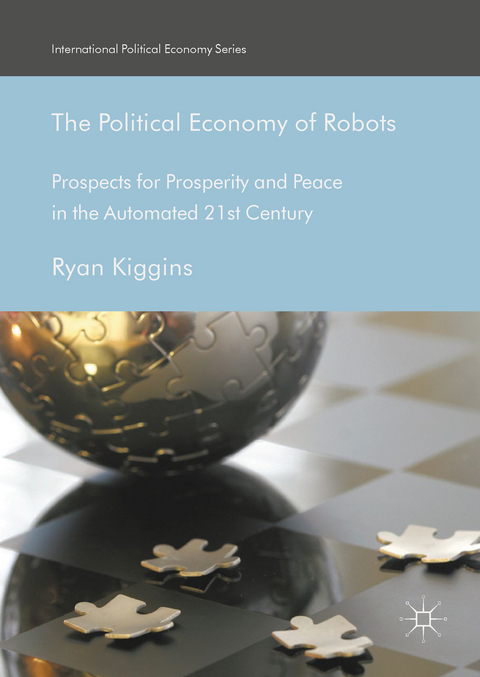
The Political Economy of Robots (eBook)
336 Seiten
Springer International Publishing (Verlag)
9783319514666 (ISBN)
This collection examines implications of technological automation to global prosperity and peace. Focusing on robots, information communication technologies, and other automation technologies, it offers brief interventions that assess how automation may alter extant political, social, and economic institutions, norms, and practices that comprise the global political economy. In doing so, this collection deals directly with such issues as automated production, trade, war, state sanctioned robot violence, financial speculation, transnational crime, and policy decision making. This interdisciplinary volume will appeal to students, scholars and practitioners grappling with political, economic, and social problems that arise from rapid technological change that automates the prospects for human prosperity and peace.
Ryan Kiggins is Visiting Assistant Professor in the Department of Political Science at the University of Central Oklahoma, USA. He edited The Political Economy of Rare Earth Elements: Rising Powers and Technological Change, which was published as part of the International Political Economy series in 2015.
Contents 6
Editor and Contributors 9
Acronyms 14
1 Robots and Political Economy 17
Utopia or Reality? 17
Human Prosperity and Peace 20
Information and the Robotic Revolution 22
References 30
2 The Politics of Global Value Chains 33
Introduction 33
Origins and Scope of the GVC 36
IPR and Corporate Hegemony 39
Transnational Corporations and Contract Manufacturers 45
ECM, Labor, and the Race to the Bottom 47
Automation, Change, and Adjustment 49
Conclusion 52
References 53
3 Drug Smuggling and Automated Borders: A Losing Battle of Escalation or State/Non-state Symbiosis 57
4 Policy Implications of People Analytics and the Automated Workplace 76
Introduction 76
People Analytics 79
Artificial Intelligence and Software Algorithms 84
Robotics 89
Conclusion 92
References 93
5 Automatic Medicine? Technology and the Future of Primary Health Care 96
Introduction 96
Philosophy of Medical Technology 99
Three Examples 101
Discussion 108
Conclusion 111
References 112
6 Repressive Robots and the Radical Possibilities of Emancipated Automation 116
Weapons Grade Law Enforcement 116
Lethal Robots and the Repressive State Apparatus 119
The Shattered Laws of Robotics 123
Radically Humanized Technology? 126
Thinking Fromm’s Futures in Blomkamp’s Elysium and Chappie 132
Concluding Remarks 135
References 138
7 The Political Economy of Bots: Theory and Method in the Study of Social Automation 141
Introduction 141
A Brief History of Bots 143
A Bot Timeline 145
Automated Actors and Political Communication 146
Units of Analysis: Old, New, and Aggregate 147
Understanding Networks 148
Understanding Software and Algorithms 150
Understanding Modifications to Classical Units of Analysis 152
Automation, Qualitative Methods, and STS 154
Reconsidering Without Reinventing: Key Concepts in Ethnography of Information 154
The “Technically” Social: Challenges to Theory and Method 159
When Substrate Becomes Substance: Implications for Communication 161
Conclusion 163
References 164
8 The Safe Hand: Liquidity, Money, and Financial Innovation 170
Safe Assets, Financial Innovation, and Financial Technology 170
The Financial Crisis and the Safe Assets Debate 172
The Nature of Liquidity and Money as a Means-in-Itself 177
Money and Financial Innovation: Some Historical Episodes 179
The Chartalist Turn: How American Farmers Became a Constituency of Credit 182
Financial Innovation in a Chartalist World 186
References 192
9 Against Our Better Judgment: Practical Wisdom in an Age of Smart(er) Machines 196
The Rise of the Machines 197
Becoming Dangerous Stupid 205
Wicked Problems and Practical Wisdom 211
Conclusion 217
References 218
10 Big Data, Artificial Intelligence, and Autonomous Policy Decision-Making: A Crisis in International Relations Theory? 223
References 242
11 Diplomacy’s Lesson’s Learned: First World War Submarine Warfare and the 21st Century Drone 247
Lesson One: Patience 248
Lesson Two: Clarity 251
Final Thoughts 256
12 Conflict, Cohesion, and Comrades in Arms: Social Implications of Robotics in the Military 260
The Military of Tomorrow: Robotically Enhanced 261
Military Robotics and the Likelihood of Revolutionary Change 264
Problem One: The Traditional Understanding of Military Leadership 266
Replicating or Reproducing Military Leadership in a Robotic Age: Ethical Dilemmas 268
A New Definition of Leadership 270
Problem Two: A New Paradigm of Unit Cohesion 272
Conclusion 276
13 Robots Writing Chinese and Fighting Underwater 281
Future US Directions in Military Robotics 283
Robotics Development in China: Institutional Setting 287
Military Robotics in China 292
Ethics and Diplomacy 295
Conclusion 296
References 297
14 Armed Drones: Automation, Autonomy, and Ethical Decision-Making 301
Autonomy and Ethical Decision-Making 301
Air Power, Just War and Ethical Hierarchy 303
Historical Air Power and Linear Ethical Hierarchy 304
Current Drone Use and Linear Ethical Hierarchy 306
Increasing Automation, Autonomy and in Bello Ethics 309
The Challenge of Autonomous Lethal Drones to Linear Ethical Hierarchies 311
Political Decision-Making and the Ethics of Resorting to Lethal Autonomous Drones 314
Summary 320
References 322
15 Lethal Autonomous Systems and the Plight of the Non-combatant 326
Why Technology Can Lead to a Reduction in Casualties on the Battlefield 329
Addressing Some of the Counter-Arguments 330
A Plea for the Noncombatant 331
The Way Forward? 332
16 Outlook for Prosperity and Peace in the Emergent Global Political Economy of Robots 336
References 341
Index 342
| Erscheint lt. Verlag | 16.9.2017 |
|---|---|
| Reihe/Serie | International Political Economy Series | International Political Economy Series |
| Zusatzinfo | XVII, 336 p. |
| Verlagsort | Cham |
| Sprache | englisch |
| Themenwelt | Geschichte ► Allgemeine Geschichte ► Zeitgeschichte |
| Sozialwissenschaften ► Politik / Verwaltung ► Vergleichende Politikwissenschaften | |
| Technik ► Elektrotechnik / Energietechnik | |
| Technik ► Maschinenbau | |
| Wirtschaft ► Betriebswirtschaft / Management ► Unternehmensführung / Management | |
| Schlagworte | Artificial Intelligence • Automated financial speculation • Automated governance • Automated production • Automated terrorism • Automated transnational crime • Automated war • Automation • Autonomous Robots • Commercial and military drones • Global politics • International Relations • Internet enabled devices • Policy • security |
| ISBN-13 | 9783319514666 / 9783319514666 |
| Informationen gemäß Produktsicherheitsverordnung (GPSR) | |
| Haben Sie eine Frage zum Produkt? |
 PDF (Wasserzeichen)
DRM: Digitales Wasserzeichen
Dieses eBook enthält ein digitales Wasserzeichen und ist damit für Sie personalisiert. Bei einer missbräuchlichen Weitergabe des eBooks an Dritte ist eine Rückverfolgung an die Quelle möglich.
Dateiformat: PDF (Portable Document Format)
Mit einem festen Seitenlayout eignet sich die PDF besonders für Fachbücher mit Spalten, Tabellen und Abbildungen. Eine PDF kann auf fast allen Geräten angezeigt werden, ist aber für kleine Displays (Smartphone, eReader) nur eingeschränkt geeignet.
Systemvoraussetzungen:
PC/Mac: Mit einem PC oder Mac können Sie dieses eBook lesen. Sie benötigen dafür einen PDF-Viewer - z.B. den Adobe Reader oder Adobe Digital Editions.
eReader: Dieses eBook kann mit (fast) allen eBook-Readern gelesen werden. Mit dem amazon-Kindle ist es aber nicht kompatibel.
Smartphone/Tablet: Egal ob Apple oder Android, dieses eBook können Sie lesen. Sie benötigen dafür einen PDF-Viewer - z.B. die kostenlose Adobe Digital Editions-App.
Buying eBooks from abroad
For tax law reasons we can sell eBooks just within Germany and Switzerland. Regrettably we cannot fulfill eBook-orders from other countries.
aus dem Bereich