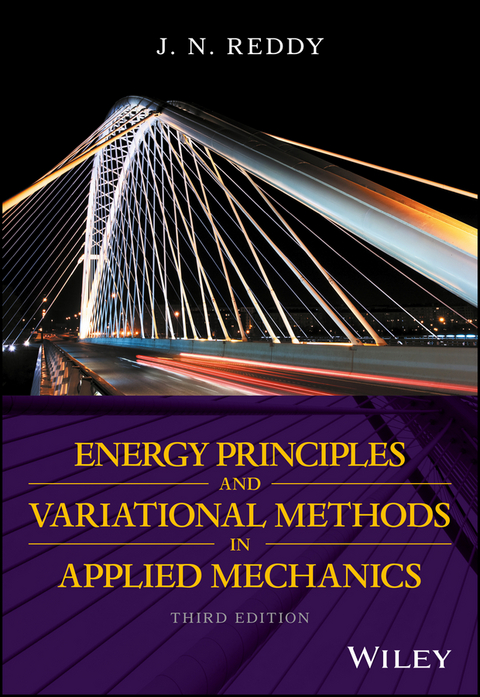
Energy Principles and Variational Methods in Applied Mechanics (eBook)
John Wiley & Sons (Verlag)
978-1-119-08738-0 (ISBN)
A comprehensive guide to using energy principles and variational methods for solving problems in solid mechanics
This book provides a systematic, highly practical introduction to the use of energy principles, traditional variational methods, and the finite element method for the solution of engineering problems involving bars, beams, torsion, plane elasticity, trusses, and plates.
It begins with a review of the basic equations of mechanics, the concepts of work and energy, and key topics from variational calculus. It presents virtual work and energy principles, energy methods of solid and structural mechanics, Hamilton's principle for dynamical systems, and classical variational methods of approximation. And it takes a more unified approach than that found in most solid mechanics books, to introduce the finite element method.
Featuring more than 200 illustrations and tables, this Third Edition has been extensively reorganized and contains much new material, including a new chapter devoted to the latest developments in functionally graded beams and plates.
- Offers clear and easy-to-follow descriptions of the concepts of work, energy, energy principles and variational methods
- Covers energy principles of solid and structural mechanics, traditional variational methods, the least-squares variational method, and the finite element, along with applications for each
- Provides an abundance of examples, in a problem-solving format, with descriptions of applications for equations derived in obtaining solutions to engineering structures
- Features end-of-the-chapter problems for course assignments, a Companion Website with a Solutions Manual, Instructor's Manual, figures, and more
Energy Principles and Variational Methods in Applied Mechanics, Third Edition is both a superb text/reference for engineering students in aerospace, civil, mechanical, and applied mechanics, and a valuable working resource for engineers in design and analysis in the aircraft, automobile, civil engineering, and shipbuilding industries.
J. N. REDDY, PhD, is a University Distinguished Professor and inaugural holder of the Oscar S. Wyatt Endowed Chair in Mechanical Engineering at Texas A&M University, College Station, TX. He has authored and coauthored several books, including Energy and Variational Methods in Applied Mechanics: Advanced Engineering Analysis (with M. L. Rasmussen), and A Mathematical Theory of Finite Elements (with J. T. Oden), both published by Wiley.
A comprehensive guide to using energy principles and variational methods for solving problems in solid mechanics This book provides a systematic, highly practical introduction to the use of energy principles, traditional variational methods, and the finite element method for the solution of engineering problems involving bars, beams, torsion, plane elasticity, trusses, and plates. It begins with a review of the basic equations of mechanics, the concepts of work and energy, and key topics from variational calculus. It presents virtual work and energy principles, energy methods of solid and structural mechanics, Hamilton s principle for dynamical systems, and classical variational methods of approximation. And it takes a more unified approach than that found in most solid mechanics books, to introduce the finite element method. Featuring more than 200 illustrations and tables, this Third Edition has been extensively reorganized and contains much new material, including a new chapter devoted to the latest developments in functionally graded beams and plates. Offers clear and easy-to-follow descriptions of the concepts of work, energy, energy principles and variational methods Covers energy principles of solid and structural mechanics, traditional variational methods, the least-squares variational method, and the finite element, along with applications for each Provides an abundance of examples, in a problem-solving format, with descriptions of applications for equations derived in obtaining solutions to engineering structures Features end-of-the-chapter problems for course assignments, a Companion Website with a Solutions Manual, Instructor's Manual, figures, and more Energy Principles and Variational Methods in Applied Mechanics, Third Edition is both a superb text/reference for engineering students in aerospace, civil, mechanical, and applied mechanics, and a valuable working resource for engineers in design and analysis in the aircraft, automobile, civil engineering, and shipbuilding industries.
J. N. REDDY, PhD, is a University Distinguished Professor and inaugural holder of the Oscar S. Wyatt Endowed Chair in Mechanical Engineering at Texas A&M University, College Station, TX. He has authored and coauthored several books, including Energy and Variational Methods in Applied Mechanics: Advanced Engineering Analysis (with M. L. Rasmussen), and A Mathematical Theory of Finite Elements (with J. T. Oden), both published by Wiley.
Cover 1
Title Page 5
Copyright 6
Dedication 7
Contents 9
About the Author 19
About the Companion Website 21
Preface to the Third Edition 23
Preface to the Second Edition 25
Preface to the First Edition 27
Chapter 1 Introduction and Mathematical Preliminaries 29
1.1 Introduction 29
1.1.1 Preliminary Comments 29
1.1.2 The Role of Energy Methods and Variational Principles 29
1.1.3 A Brief Review of Historical Developments 30
1.1.4 Preview 32
1.2 Vectors 33
1.2.1 Introduction 33
1.2.2 Definition of a Vector 34
1.2.3 Scalar and Vector Products 36
1.2.4 Components of a Vector 40
1.2.5 Summation Convention 41
1.2.6 Vector Calculus 45
1.2.7 Gradient, Divergence, and Curl Theorems 50
1.3 Tensors 54
1.3.1 Second-Order Tensors 54
1.3.2 General Properties of a Dyadic 57
1.3.3 Nonion Form and Matrix Representation of a Dyad 58
1.3.4 Eigenvectors Associated with Dyads 62
1.4 Summary 67
Problems 68
Chapter 2 Review of Equations of Solid Mechanics 75
2.1 Introduction 75
2.1.1 Classification of Equations 75
2.1.2 Descriptions of Motion 76
2.2 Balance of Linear and Angular Momenta 78
2.2.1 Equations of Motion 78
2.2.2 Symmetry of Stress Tensors 82
2.3 Kinematics of Deformation 84
2.3.1 Green-Lagrange Strain Tensor 84
2.3.2 Strain Compatibility Equations 90
2.4 Constitutive Equations 93
2.4.1 Introduction 93
2.4.2 Generalized Hooke's Law 94
2.4.3 Plane Stress-Reduced Constitutive Relations 96
2.4.4 Thermoelastic Constitutive Relations 98
2.5 Theories of Straight Beams 99
2.5.1 Introduction 99
2.5.2 The Bernoulli-Euler Beam Theory 101
2.5.3 The Timoshenko Beam Theory 104
2.5.4 The von Karman Theory of Beams 109
2.5.4.1 Preliminary Discussion 109
2.5.4.2 The Bernoulli-Euler Beam Theory 110
2.5.4.3 The Timoshenko Beam Theory 112
Problems 116
Chapter 3 Work, Energy, and Variational Calculus 125
3.1 Concepts of Work and Energy 125
3.1.1 Preliminary Comments 125
3.1.2 External and Internal Work Done 126
3.2 Strain Energy and Complementary Strain Energy 130
3.2.1 General Development 130
3.2.2 Expressions for Strain Energy and Complementary Strain Energy Densities of Isotropic Linear Elastic Solids 135
3.2.2.1 Strain Energy Density 135
3.2.2.2 Complementary Strain Energy Density 136
3.2.3 Strain Energy and Complementary Strain Energy for Trusses 137
3.2.4 Strain Energy and Complementary Strain Energy for Torsional Members 142
3.2.5 Strain Energy and Complementary Strain Energy for Beams 145
3.2.5.1 The Bernuolli-Euler Beam Theory 145
3.2.5.2 The Timoshenko Beam Theory 147
3.3 Total Potential Energy and Total Complementary Energy 151
3.3.1 Introduction 151
3.3.2 Total Potential Energy of Beams 152
3.3.3 Total Complementary Energy of Beams 153
3.4 Virtual Work 154
3.4.1 Virtual Displacements 154
3.4.2 Virtual Forces 159
3.5 Calculus of Variations 163
3.5.1 The Variational Operator 163
3.5.2 Functionals 166
3.5.3 The First Variation of a Functional 167
3.5.4 Fundamental Lemma of Variational Calculus 168
3.5.5 Extremum of a Functional 169
3.5.6 The Euler Equations 171
3.5.7 Natural and Essential Boundary Conditions 174
3.5.8 Minimization of Functionals with Equality Constraints 179
3.5.8.1 The Lagrange Multiplier Method 179
3.5.8.2 The Penalty Function Method 181
3.6 Summary 184
Problems 187
Chapter 4 Virtual Work and Energy Principles of Mechanics 195
4.1 Introduction 195
4.2 The Principle of Virtual Displacements 195
4.2.1 Rigid Bodies 195
4.2.2 Deformable Solids 196
4.2.3 Unit Dummy-Displacement Method 200
4.3 The Principle of Minimum Total Potential Energy and Castigliano's Theorem I 207
4.3.1 The Principle of Minimum Total Potential Energy 207
4.3.2 Castigliano's Theorem I 216
4.4 The Principle of Virtual Forces 224
4.4.1 Deformable Solids 224
4.4.2 Unit Dummy-Load Method 226
4.5 Principle of Minimum Total Complementary Potential Energy and Castigliano's Theorem II 232
4.5.1 The Principle of the Minimum Total Complementary Potential Energy 232
4.5.2 Castigliano's Theorem II 234
4.6 Clapeyron's, Betti's, and Maxwell's Theorems 245
4.6.1 Principle of Superposition for Linear Problems 245
4.6.2 Clapeyron's Theorem 248
4.6.3 Types of Elasticity Problems and Uniqueness of Solutions 252
4.6.4 Betti's Reciprocity Theorem 254
4.6.5 Maxwell's Reciprocity Theorem 258
4.7 Summary 260
Problems 263
Chapter 5 Dynamical Systems: Hamilton's Principle 271
5.1 Introduction 271
5.2 Hamilton's Principle for Discrete Systems 271
5.3 Hamilton's Principle for a Continuum 277
5.4 Hamilton's Principle for Constrained Systems 283
5.5 Rayleigh's Method 288
5.6 Summary 290
Problems 291
Chapter 6 Direct Variational Methods 297
6.1 Introduction 297
6.2 Concepts from Functional Analysis 298
6.2.1 General Introduction 298
6.2.2 Linear Vector Spaces 299
6.2.3 Normed and Inner Product Spaces 304
6.2.3.1 Norm 304
6.2.3.2 Inner Product 307
6.2.3.3 Orthogonality 308
6.2.4 Transformations, and Linear and Bilinear Forms 309
6.2.5 Minimum of a Quadratic Functional 310
6.3 The Ritz Method 315
6.3.1 Introduction 315
6.3.2 Description of the Method 316
6.3.3 Properties of Approximation Functions 321
6.3.3.1 Preliminary Comments 321
6.3.3.2 Boundary Conditions 321
6.3.3.3 Convergence 322
6.3.3.4 Completeness 322
6.3.3.5 Requirements on 0 and i 323
6.3.4 General Features of the Ritz Method 327
6.3.5 Examples 328
6.3.6 The Ritz Method for General Boundary-Value Problems 351
6.3.6.1 Preliminary Comments 351
6.3.6.2 Weak Forms 351
6.3.6.3 Model Equation 1 352
6.3.6.4 Model Equation 2 356
6.3.6.5 Model Equation 3 358
6.3.6.6 Ritz Approximations 360
6.4 Weighted-Residual Methods 365
6.4.1 Introduction 365
6.4.2 The General Method of Weighted Residuals 367
6.4.3 The Galerkin Method 372
6.4.4 The Least-Squares Method 377
6.4.5 The Collocation Method 384
6.4.6 The Subdomain Method 387
6.4.7 Eigenvalue and Time-Dependent Problems 389
6.4.7.1 Eigenvalue Problems 389
6.4.7.2 Time-Dependent Problems 390
6.5 Summary 409
Problems 411
Chapter 7 Theory and Analysis of Plates 419
7.1 Introduction 419
7.1.1 General Comments 419
7.1.2 An Overview of Plate Theories 421
7.1.2.1 The Classical Plate Theory 422
7.1.2.2 The First-Order Plate Theory 423
7.1.2.3 The Third-Order Plate Theory 424
7.1.2.4 Stress-Based Theories 425
7.2 The Classical Plate Theory 426
7.2.1 Governing Equations of Circular Plates 426
7.2.2 Analysis of Circular Plates 433
7.2.2.1 Analytical Solutions for Bending 433
7.2.2.2 Analytical Solutions for Buckling 439
7.2.2.3 Variational Solutions 442
7.2.3 Governing Equations in Rectangular Coordinates 455
7.2.4 Navier Solutions of Rectangular Plates 463
7.2.4.1 Bending 466
7.2.4.2 Natural Vibration 471
7.2.4.3 Buckling Analysis 473
7.2.4.4 Transient Analysis 475
7.2.5 Levy Solutions of Rectangular Plates 477
7.2.6 Variational Solutions: Bending 482
7.2.7 Variational Solutions: Natural Vibration 498
7.2.8 Variational Solutions: Buckling 503
7.2.8.1 Rectangular Plates Simply Supported along Two Opposite Sides and Compressed in the Direction Perpendicular to Those Sides 503
7.2.8.2 Formulation for Rectangular Plates with Arbitrary Boundary Conditions 506
7.3 The First-Order Shear Deformation Plate Theory 514
7.3.1 Equations of Circular Plates 514
7.3.2 Exact Solutions of Axisymmetric Circular Plates 516
7.3.3 Equations of Plates in Rectangular Coordinates 520
7.3.4 Exact Solutions of Rectangular Plates 524
7.3.4.1 Bending Analysis 526
7.3.4.2 Natural Vibration 529
7.3.4.3 Buckling Analysis 530
7.3.5 Variational Solutions of Circular and Rectangular Plates 531
7.3.5.1 Axisymmetric Circular Plates 531
7.3.5.2 Rectangular Plates 533
7.4 Relationships between Bending Solutions of Classical and Shear Deformation Theories 535
7.4.1 Beams 535
7.4.1.1 Governing Equations 536
7.4.1.2 Relationships between BET and TBT 536
7.4.2 Circular Plates 540
7.4.3 Rectangular Plates 544
7.5 Summary 549
Problems 549
Chapter 8 An Introduction to the Finite Element Method 555
8.1 Introduction 555
8.2 Finite Element Analysis of Straight Bars 557
8.2.1 Governing Equation 557
8.2.2 Representation of the Domain by Finite Elements 558
8.2.3 Weak Form over an Element 559
8.2.4 Approximation over an Element 560
8.2.5 Finite Element Equations 565
8.2.5.1 Linear Element 566
8.2.5.2 Quadratic Element 567
8.2.6 Assembly (or Connectivity) of Elements 567
8.2.7 Imposition of Boundary Conditions 570
8.2.8 Postprocessing 571
8.3 Finite Element Analysis of the Bernoulli-Euler Beam Theory 577
8.3.1 Governing Equation 577
8.3.2 Weak Form over an Element 578
8.3.4 Finite Element Model 580
8.3.5 Assembly of Element Equations 581
8.3.6 Imposition of Boundary Conditions 583
8.4 Finite Element Analysis of the Timoshenko Beam Theory 586
8.4.1 Governing Equations 586
8.4.2 Weak Forms 586
8.4.3 Finite Element Models 587
8.4.4 Reduced Integration Element (RIE) 587
8.4.5 Consistent Interpolation Element (CIE) 589
8.4.6 Superconvergent Element (SCE) 590
8.5 Finite Element Analysis of the Classical Plate Theory 593
8.5.1 Introduction 593
8.5.2 General Formulation 594
8.5.3 Conforming and Nonconforming Plate Elements 596
8.5.4 Fully Discretized Finite Element Models 597
8.5.4.1 Static Bending 597
8.5.4.2 Buckling 597
8.5.4.3 Natural Vibration 598
8.5.4.4 Transient Response 598
8.6 Finite Element Analysis of the First-Order Shear Deformation Plate Theory 602
8.6.1 Governing Equations and Weak Forms 602
8.6.2 Finite Element Approximations 604
8.6.3 Finite Element Model 605
8.6.4 Numerical Integration 607
8.6.5 Numerical Examples 610
8.6.5.1 Isotropic Plates 610
8.6.5.2 Laminated Plates 612
8.7 Summary 615
Problems 616
Chapter 9 Mixed Variational and Finite Element Formulations 623
9.1 Introduction 623
9.1.1 General Comments 623
9.1.2 Mixed Variational Principles 623
9.1.3 Extremum and Stationary Behavior of Functionals 625
9.2 Stationary Variational Principles 627
9.2.1 Minimum Total Potential Energy 627
9.2.2 The Hellinger-Reissner Variational Principle 629
9.2.3 The Reissner Variational Principle 633
9.3 Variational Solutions Based on Mixed Formulations 634
9.4 Mixed Finite Element Models of Beams 638
9.4.1 The Bernoulli-Euler Beam Theory 638
9.4.1.1 Governing Equations and Weak Forms 638
9.4.1.2 Weak-Form Mixed Finite Element Model 638
9.4.1.3 Weighted-Residual Finite Element Models 641
9.4.2 The Timoshenko Beam Theory 643
9.4.2.1 Governing Equations 643
9.4.2.2 General Finite Element Model 643
9.4.2.3 ASD-LLCC Element 645
9.4.2.4 ASD-QLCC Element 645
9.4.2.5 ASD-HQLC Element 646
9.5 Mixed Finite Element Models of the Classical Plate Theory 648
9.5.1 Preliminary Comments 648
9.5.2 Mixed Model I 648
9.5.2.1 Governing Equations 648
9.5.2.2 Weak Forms 649
9.5.2.3 Finite Element Model 650
9.5.3 Mixed Model II 653
9.5.3.1 Governing Equations 653
9.5.3.2 Weak Forms 653
9.5.3.3 Finite Element Model 654
9.6 Summary 658
Problems 659
Chapter 10 Analysis of Functionally Graded Beams and Plates 663
10.1 Introduction 663
10.2 Functionally Graded Beams 666
10.2.1 The Bernoulli-Euler Beam Theory 666
10.2.1.1 Displacement and Strain Fields 666
10.2.1.2 Equations of Motion and Boundary Conditions 666
10.2.2 The Timoshenko Beam Theory 667
10.2.2.1 Displacement and Strain Fields 667
10.2.2.2 Equations of Motion and Boundary Conditions 668
10.2.3 Equations of Motion in Terms of Generalized Displace-ments 669
10.2.3.1 Constitutive Equations 669
10.2.3.2 Stress Resultants of BET 669
10.2.3.3 Stress Resultants of TBT 670
10.2.3.4 Equations of Motion of the BET 670
10.2.3.5 Equations of Motion of the TBT 670
10.2.4 Stiffness Coefficients 671
10.3 Functionally Graded Circular Plates 673
10.3.1 Introduction 673
10.3.2 Classical Plate Theory 674
10.3.2.1 Displacement and Strain Fields 674
10.3.2.2 Equations of Motion 674
10.3.3 First-Order Shear Deformation Theory 675
10.3.3.1 Displacement and Strain Fields 675
10.3.3.2 Equations of Motion 676
10.3.4 Plate Constitutive Relations 677
10.3.4.1 Classical Plate Theory 677
10.3.4.2 First-Order Plate Theory 677
10.4 A General Third-Order Plate Theory 678
10.4.1 Introduction 678
10.4.2 Displacements and Strains 679
10.4.3 Equations of Motion 681
10.4.4 Constitutive Relations 685
10.4.5 Specialization to Other Theories 686
10.4.5.1 A General Third-Order Plate Theory with Traction-Free Top and Bottom Surfaces 686
10.4.5.2 The Reddy Third-Order Plate Theory 689
10.4.5.3 The First-Order Plate Theory 691
10.4.5.4 The Classical Plate Theory 692
10.5 Navier's Solutions 692
10.5.1 Preliminary Comments 692
10.5.2 Analysis of Beams 693
10.5.2.1 Bernoulli-Euler Beams 693
10.5.2.2 Timoshenko Beams 695
10.5.2.3 Numerical Results 697
10.5.3 Analysis of Plates 699
10.5.3.1 Boundary Conditions 700
10.5.3.2 Expansions of Generalized Displacements 700
10.5.3.3 Bending Analysis 701
10.5.3.4 Free Vibration Analysis 704
10.5.3.5 Buckling Analysis 705
10.5.3.6 Numerical Results 707
10.6 Finite Element Models 709
10.6.1 Bending of Beams 709
10.6.1.1 Bernoulli-Euler Beam Theory 709
10.6.1.2 Timoshenko Beam Theory 711
10.6.2 Axisymmetric Bending of Circular Plates 712
10.6.2.1 Classical Plate Theory 712
10.6.2.2 First-Order Shear Deformation Plate Theory 714
10.6.3 Solution of Nonlinear Equations 716
10.6.3.1 Time Approximation 716
10.6.3.2 Newton's Iteration Approach 716
10.6.3.3 Tangent Stiffness Coefficients for the BET 718
10.6.3.4 Tangent Stiffness Coefficients for the TBT 720
10.6.3.5 Tangent Stiffness Coefficients for the CPT 721
10.6.3.6 Tangent Stiffness Coefficients for the FSDT 721
10.6.4 Numerical Results for Beams and Circular Plates 722
10.6.4.1 Beams 722
10.6.4.2 Circular Plates 725
10.7 Summary 727
Problems 728
References 729
Answers To Most Problems 739
Index 751
EULA 759
| Erscheint lt. Verlag | 5.9.2017 |
|---|---|
| Sprache | englisch |
| Themenwelt | Mathematik / Informatik ► Mathematik ► Analysis |
| Mathematik / Informatik ► Mathematik ► Angewandte Mathematik | |
| Technik ► Maschinenbau | |
| Schlagworte | applications for energy principles in structural mechanics • Bauingenieur- u. Bauwesen • Baustatik • Baustatik u. Baumechanik • Civil Engineering & Construction • Computational / Numerical Methods • Energy Principles • energy principles in solid mechanics • Festkörpermechanik • Finite Element Applications • Finite Element Method • finite element method in applied engineering • finite element method in solid mechanics • finite elements • finite element solutions for engineering involving plane elasticity • finite element solutions for problems involving plates • finite element solutions for problems involving trusses • finite element solutions for solving problems involving beams • finite element solutions for structural problems • finite element solutions for torsion problems • finite elements solutions for problems involving bars • <p>variational methods • Maschinenbau • mechanical engineering • Mechanik • problems in solid mechanics • Rechnergestützte / Numerische Verfahren im Maschinenbau • solid mechanics • solving problems in solid mechanics • Structural Theory & Structural Mechanics • variational method applications • variational method for solving engineering problems involving bars</p> • variational method for solving engineering problems involving plane elasticity • variational method for solving problems involving bars • variational method for solving problems involving beams • variational method for solving problems involving plates • variational method for solving problems involving trusses • variational method for solving torsion problems • variational methods for solving engineering problems • variational methods for solving engineering problems involving beams • variational methods for solving engineering problems involving plates • variational methods for solving engineering problems involving torsion problems • variational methods for solving engineering problems involving trusses • variational methods in applied mechanics • variational methods in solid mechanics |
| ISBN-10 | 1-119-08738-4 / 1119087384 |
| ISBN-13 | 978-1-119-08738-0 / 9781119087380 |
| Informationen gemäß Produktsicherheitsverordnung (GPSR) | |
| Haben Sie eine Frage zum Produkt? |
 PDF (Adobe DRM)
Kopierschutz: Adobe-DRM
Adobe-DRM ist ein Kopierschutz, der das eBook vor Mißbrauch schützen soll. Dabei wird das eBook bereits beim Download auf Ihre persönliche Adobe-ID autorisiert. Lesen können Sie das eBook dann nur auf den Geräten, welche ebenfalls auf Ihre Adobe-ID registriert sind.
Details zum Adobe-DRM
Dateiformat: PDF (Portable Document Format)
Mit einem festen Seitenlayout eignet sich die PDF besonders für Fachbücher mit Spalten, Tabellen und Abbildungen. Eine PDF kann auf fast allen Geräten angezeigt werden, ist aber für kleine Displays (Smartphone, eReader) nur eingeschränkt geeignet.
Systemvoraussetzungen:
PC/Mac: Mit einem PC oder Mac können Sie dieses eBook lesen. Sie benötigen eine
eReader: Dieses eBook kann mit (fast) allen eBook-Readern gelesen werden. Mit dem amazon-Kindle ist es aber nicht kompatibel.
Smartphone/Tablet: Egal ob Apple oder Android, dieses eBook können Sie lesen. Sie benötigen eine
Geräteliste und zusätzliche Hinweise
Buying eBooks from abroad
For tax law reasons we can sell eBooks just within Germany and Switzerland. Regrettably we cannot fulfill eBook-orders from other countries.
aus dem Bereich