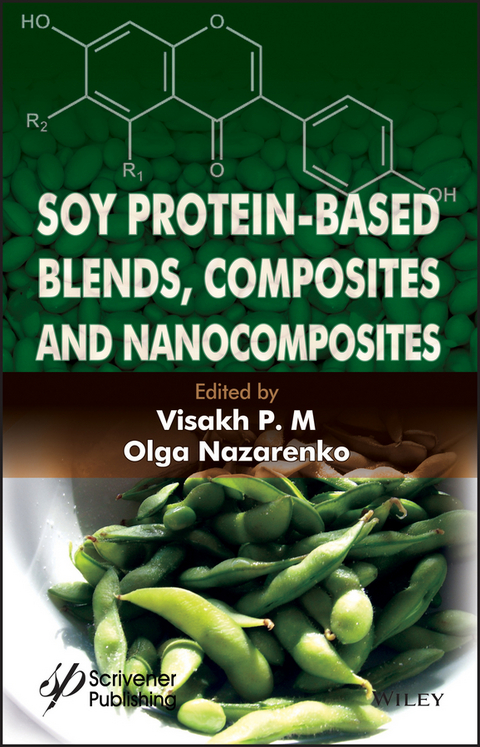
Soy Protein-Based Blends, Composites and Nanocomposites (eBook)
276 Seiten
John Wiley & Sons (Verlag)
978-1-119-41903-7 (ISBN)
Many of the recent research accomplishments in the area of soy-based blends, composites and bionanocomposites are presented in this book. In addition to introducing soy protein and its structure and relationship properties, the book covers many other relevant topics such as the state-of-the-art, new challenges, advances and opportunities in the field such as: biomedical applications of soy protein; electrospinning of soy protein nanofibers, their synthesis and applications; soy protein-based materials rheology; soy proteins as a potential source of active peptides of nutraceutical significance; soy protein isolate-based films; and use of soy protein-based carriers for encapsu??lating bioactive ingredients.
Visakh P. M is working as post doc. researcher at Tomsk Polytechnic University, Russia. He obtained his PhD, MPhil and MSc degrees from the School of Chemical Sciences, Mahatma Gandhi University, Kottayam, Kerala, India. He has edited 15 books for a variety of international publishers and has been a visiting researcher in many countries since 2011. His research interests include polymer nanocomposites, bio-nanocomposites and rubber based nanocomposites, fire retardant polymers, liquid crystalline polymers and silicon sensors. Olga Nazarenko obtained her PhD in Technical Sciences from Tomsk Polytechnic University, Russia where she is now a Professor in the Ecology and Basic Safety Department. In 2007 she obtained her DSc. in Processes and Apparatus of Chemical Technology. She has 170 publications, 3 books and 8 textbooks and 7 patents to her credit.
Preface xiv
1 Soy Protein: State-of-the-Art, New Challenges and Opportunities 1
Visakh P. M.
1.1 Soy Protein: Introduction, Structure and Properties Relationship 1
1.2 Advances in Soy Protein-Based Nanocomposites 3
1.3 Applications of Soy Protein-Based Blends, Composites, and Nanocomposites 5
1.4 Biomedical Applications of Soy Protein 6
1.5 Electrospinning of Soy Protein Nanofibers: Synthesis and Applications 8
1.6 Soy Proteins as Potential Source of Active Peptides of Nutraceutical Significance 10
1.7 Soy Protein Isolate-Based Films 12
1.8 Use of Soy Protein-Based Carriers for
Encapsulating Bioactive Ingredients 14
References 15
2 Soy Protein: Introduction, Structure and Properties Relationship 23
Visakh P. M.
2.1 Introduction 23
2.2 Structure of Soy Proteins 23
2.3 Source of Soy Proteins 24
2.4 Properties of Soy Proteins 26
2.5 Chemical Modification of Soy Proteins 29
2.6 Characterization of Soy Proteins 30
References 33
3 Advances in Soy Protein-Based Nanocomposites 39
Huafeng Tian Gaiping Guo and Xiaogang Luo
3.1 Introduction 40
3.2 Preparation Methods of Soy Protein Nanocomposites 41
3.3 Properties of Thermoplastic Soy Protein Nanocomposites 43
3.4 Protein-Based Nanocomposites 48
3.5 Conclusion 61
Acknowledgements 61
References 61
4 Applications of Soy Protein-Based Blends, Composites, and Nanocomposites 67
Ruann Janser Soares de Castro, André Ohara, Paula Okuro, Camila Utsunomia, Joelise de Alencar Figueira Angelotti, Fabíola Aliaga de Lima and Hélia Harumi Sato
4.1 Introduction 68
4.2 Applications of Soy Protein Particulars 69
4.3 Applications of Soy Protein-Based Blends 79
4.4 Applications of Soy Protein-Based Composites 86
4.5 Applications of Soy Protein-Based Nanocomposites 90
4.6 Conclusion 92
References 93
5 Biomedical Applications of Soy Protein 103
Blessing A. Aderibigbe
5.1 Introduction 103
5.2 The forms of SP 105
5.3 Wound-Dressing Materials 107
5.4 Potential Applications of SP in Regenerative Medicine and Tissue Engineering 113
5.5 Application of SP Product for Regeneration of Bone 118
5.6 Application of SP in Drug Delivery Systems 121
5.7 Conclusion 126
References 128
6 Electrospinning of Soy Protein Nanofibers: Synthesis and Applications 135
Carlos L. Salas
6.1 Introduction 136
6.2 Properties of Soybean Proteins That Affect Electrospinning 136
6.3 Applications 148
6.4 Conclusion and Outlook 152
References 153
7 Soy Proteins as Potential Source of Active Peptides of Nutraceutical Significance 155
Junus Salampessy and Narsimha Reddy
7.1 Introduction 156
7.2 Soy Proteins as Source of Bioactive Peptides 157
7.3 Identification of Potential Bioactive Peptides from Soy Proteins 159
7.4 Production of Bioactive Peptides from Soy Proteins 169
7.5 Potential Applications of Bioactive Peptides from Soy Proteins 183
7.6 Conclusion 185
References 186
8 Soy Protein Isolate-Based Films 193
Shifeng Zhang
8.1 Introduction 193
8.2 Soy Protein Film Preparation 196
8.3 Characterization of Soy Protein Films 199
8.4 Modifications 211
8.5 Applications 215
References 218
9 Use of Soy Protein-Based Carriers for Encapsulating Bioactive Ingredients 229
Zhen-Xing Tang and Jie-Yu Liang
9.1 Introduction 229
9.2 Encapsulation Methods 231
9.3 Soy Protein-Based Encapsulation Carriers 233
9.4 Conclusion 242
References 242
| Erscheint lt. Verlag | 17.8.2017 |
|---|---|
| Sprache | englisch |
| Themenwelt | Naturwissenschaften ► Chemie |
| Technik ► Maschinenbau | |
| Schlagworte | Biopolymere • biopolymers • Composites • Materials Science • Materialwissenschaften • Nanomaterialien • nanomaterials • Nanotechnologie • nanotechnology • Polymer Science & Technology • Polymerwissenschaft u. -technologie • Verbundwerkstoffe |
| ISBN-10 | 1-119-41903-4 / 1119419034 |
| ISBN-13 | 978-1-119-41903-7 / 9781119419037 |
| Informationen gemäß Produktsicherheitsverordnung (GPSR) | |
| Haben Sie eine Frage zum Produkt? |
 PDF (Adobe DRM)
Kopierschutz: Adobe-DRM
Adobe-DRM ist ein Kopierschutz, der das eBook vor Mißbrauch schützen soll. Dabei wird das eBook bereits beim Download auf Ihre persönliche Adobe-ID autorisiert. Lesen können Sie das eBook dann nur auf den Geräten, welche ebenfalls auf Ihre Adobe-ID registriert sind.
Details zum Adobe-DRM
Dateiformat: PDF (Portable Document Format)
Mit einem festen Seitenlayout eignet sich die PDF besonders für Fachbücher mit Spalten, Tabellen und Abbildungen. Eine PDF kann auf fast allen Geräten angezeigt werden, ist aber für kleine Displays (Smartphone, eReader) nur eingeschränkt geeignet.
Systemvoraussetzungen:
PC/Mac: Mit einem PC oder Mac können Sie dieses eBook lesen. Sie benötigen eine
eReader: Dieses eBook kann mit (fast) allen eBook-Readern gelesen werden. Mit dem amazon-Kindle ist es aber nicht kompatibel.
Smartphone/Tablet: Egal ob Apple oder Android, dieses eBook können Sie lesen. Sie benötigen eine
Geräteliste und zusätzliche Hinweise
Buying eBooks from abroad
For tax law reasons we can sell eBooks just within Germany and Switzerland. Regrettably we cannot fulfill eBook-orders from other countries.
aus dem Bereich