A Network-Based Approach to Cell Metabolism (eBook)
XX, 151 Seiten
Springer International Publishing (Verlag)
978-3-319-64000-6 (ISBN)
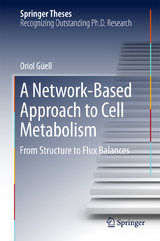
This thesis uses a systems-level approach to study the cellular metabolism, unveiling new mechanisms and responses that were impossible to reach with traditional reductionists procedures.
The results reported here have a potential application in areas like metabolic engineering and disease treatment. They could also be used in determining the accuracy of the gene essentiality of new genome-scale reconstructions.
Different methods and techniques, within the contexts of Systems Biology and the field known as Complex Networks Analysis have been applied in this work to show different features of the robustness of metabolic networks. The specific issues addressed here range from pure topological aspec
ts of the networks themselves to the balance of biochemical fluxes.
Oriol Güell holds a Ph.D. in Physical Chemistry from the University of Barcelona, Spain, and has broad experience in the theoretical modelling and the experimental applications of magnetic colloidal dispersions and in the computer modelling of metabolic networks. Currently, his main research focuses on obtaining and applying bio-based polymers and plasticisers and studying their associated physicochemical properties.
Oriol Güell holds a Ph.D. in Physical Chemistry from the University of Barcelona, Spain, and has broad experience in the theoretical modelling and the experimental applications of magnetic colloidal dispersions and in the computer modelling of metabolic networks. Currently, his main research focuses on obtaining and applying bio-based polymers and plasticisers and studying their associated physicochemical properties.
Cellular Metabolism at the Systems Level.- Methods and Data.- Structural Knockout Cascades in Metabolic Networks.- Effects of Reaction Knockouts on Steady States of Metabolism.- Detection of Evolution and Adaptation Fingerprints in Metabolic Networks.- Assessing FBA Optimal States in the Feasible Flux Phenotypic Space.- Conclusions.
| Erscheint lt. Verlag | 16.8.2017 |
|---|---|
| Reihe/Serie | Springer Theses | Springer Theses |
| Zusatzinfo | XX, 151 p. 49 illus. |
| Verlagsort | Cham |
| Sprache | englisch |
| Themenwelt | Naturwissenschaften ► Biologie |
| Naturwissenschaften ► Chemie | |
| Technik | |
| Schlagworte | biochemical engineering • Chemical biology • complex networks • Flux Balance Analysis • metabolic networks • Physical Chemistry • systems biology |
| ISBN-10 | 3-319-64000-3 / 3319640003 |
| ISBN-13 | 978-3-319-64000-6 / 9783319640006 |
| Informationen gemäß Produktsicherheitsverordnung (GPSR) | |
| Haben Sie eine Frage zum Produkt? |
 PDF (Wasserzeichen)
DRM: Digitales Wasserzeichen
Dieses eBook enthält ein digitales Wasserzeichen und ist damit für Sie personalisiert. Bei einer missbräuchlichen Weitergabe des eBooks an Dritte ist eine Rückverfolgung an die Quelle möglich.
Dateiformat: PDF (Portable Document Format)
Mit einem festen Seitenlayout eignet sich die PDF besonders für Fachbücher mit Spalten, Tabellen und Abbildungen. Eine PDF kann auf fast allen Geräten angezeigt werden, ist aber für kleine Displays (Smartphone, eReader) nur eingeschränkt geeignet.
Systemvoraussetzungen:
PC/Mac: Mit einem PC oder Mac können Sie dieses eBook lesen. Sie benötigen dafür einen PDF-Viewer - z.B. den Adobe Reader oder Adobe Digital Editions.
eReader: Dieses eBook kann mit (fast) allen eBook-Readern gelesen werden. Mit dem amazon-Kindle ist es aber nicht kompatibel.
Smartphone/Tablet: Egal ob Apple oder Android, dieses eBook können Sie lesen. Sie benötigen dafür einen PDF-Viewer - z.B. die kostenlose Adobe Digital Editions-App.
Buying eBooks from abroad
For tax law reasons we can sell eBooks just within Germany and Switzerland. Regrettably we cannot fulfill eBook-orders from other countries.
aus dem Bereich