


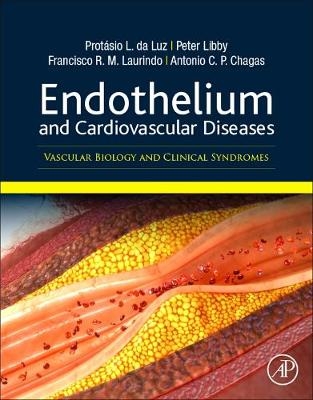
Endothelium and Cardiovascular Diseases
Academic Press Inc (Verlag)
978-0-12-812348-5 (ISBN)
- Titel erscheint in neuer Auflage
- Artikel merken
Written by known experts, and covering all aspects of endothelial function in health and disease, this reference represents an assembly of recent knowledge that is essential to both basic investigators and clinicians.
Professor Protásio L. da Luz, MD, FACC received his medical degree and completed a Residency and Specialization in Cardiology at Universidade de São Paulo Brazil (USP), and completed a postgraduate Fellowship in Critical Care Medicine at the University of Southern California. He has been a Research Scientist at Cedars-Sinai Medical Center, Full Professor of Cardiology at the Heart Institute (InCor) School of Medicine, USP, and Director of the InCor’s Cardiology Division and Atherosclerosis Unit. He is a Full Member of the Brazilian Academy of Sciences, Academy of Sciences of the State of São Paulo, and has authored or co-authored over 490 scientific publications and book chapters (258 of them peer-reviewed). Primary research interests include endothelium, atherosclerosis, coronary artery disease and prevention, and translational medicine. He received the Brazilian National Award for Scientific Merit, the Order of Medical Merit from the Brazilian government, and the Fundação Conrado Wessel Award in Medicine. Dr. Peter Libby is a cardiovascular medicine specialist at Brigham and Women’s Hospital and Mallinckrodt Professor of Medicine at Harvard Medical School (HMS). Receiving his medical degree from the University of California, San Diego School of Medicine, he undertook a cellular physiology research fellowship at HMS. After a residency in internal medicine and a fellowship in cardiovascular disease, he became board certified in both. He is an editor of the leading cardiovascular medicine textbook, and the author of over 500 peer-reviewed publications, 575 reviews, chapters, etc. He has received funding from the American Heart Association (AHA) and National Institutes of Health, plus recognitions on four continents, including the AHA and American College of Cardiology’s highest research awards, the Gold Medal of the European Society of Cardiology, the Anitschkow award from the European Atherosclerosis Society, the Ernst Jung Gold Medal for Medicine, and the Earl Benditt award for vascular biology. Professor Francisco Rafael Martins Laurindo, MD received his medical degree and completed his Internal Medicine and Cardiology residency at the Heart Institute at the University of São Paulo School of Medicine in Brazil (FMUSP), where he earned his PhD on signaling processes in the vascular system. He trained in Physiology and Pharmacology at the University of Health Sciences, Bethesda, Maryland. He founded and has directed the Vascular Biology Laboratory at the Heart Institute (InCor), FMUSP since 2008. He is author or co-author of over 145 publications in peer-reviewed journals. He is a member of the Board of Directors of the Brazilian Academy of Sciences and a past Council Member of the Society for Free Radical Biology. He belongs to the Editorial Boards of Free Radical Biology and Medicine and Clinical Science, and served as Chair and Vice-Chair of the Gordon Research Conference on Nox Family NADPH Oxidases. Antonio Carlos Palandri Chagas MD, PhD, is Professor of Medicine and Chief of Cardiology at the Medical School of ABC, São Paulo Brazil, where he earned his medical degree. His Residency in Internal Medicine and postgraduate work in cardiology were at the University of São Paulo; his PhD thesis covered myocardial ischemia. His postdoctoral fellowship was at the University of California San Francisco’s Cardiovascular Research Institute. A Fellow of the American College of Cardiology (ACC) who serves on the board of the JACC, he was the Brazilian Chapter’s first governor. He belongs to the European Society of Cardiology. He was president of the São Paulo State Society of Cardiology, and the Brazilian Society of Cardiology. He attained ACC’s International Service Award; Chief of the Department of Internal Medicine at the Medical School of ABC; and Chair of ACC’s International Assembly of Governors. He has authored over 145 peer-reviewed journal publications.
Part I – Basic FeaturesSection I – Structure1. Vascular Endothelium: a perspective2. Development of the coronary system: perspectives for cellular therapy from differentiaton of its precursors3. Translational pathways in endothelial cell: Implications for angiogenesis4. Endothelial barrier: factors that regulate its permeability5. Growth factors, endothelial progenitor cells and angiogenesis6. Characteristics of Endothelium in both sexes
Section II – Endocrine functions and metabolic interactions7. Hemodynamic forces in the Endothelium: from mechanical transduction to atherosclerosis development8. Endothelium dependent vasodilation: NO and other mediators9. Endothelial vasoconstrictor substances produced by the endothelium10. Cellular redox pathways in endothelial dysfunction and vascular diseases 11. Blood coagulation and Endothelium12. Genetics of Endothelium 13. Epigenetic regulation of endothelial function12. Adhesion molecules and the Endothelium15. Endothelium and Renin-Angiotensin System
Part II – Endothelial Dysfunction and Clinical SyndromesSection III – Methods of investigation16. Methods for endothelial function investigations in humans17. Endothelial biomarkers
Section IV – Aging and cognitive function18. Endothelial alterations in aging19. Vascular function in dementia and cognitive decline20. Emotional stress and its influence upon the Endothelium
Section V - Lipoproteins21. Lipids and lipoprotein mediators of endothelial function and dysfunction22. HDL and Endothelium23. Artificial lipoproteins in endothelial dysfunction and atherosclerosis
Section VI – Diets and Endothelium24. Influences of diets upon endothelial function25. Effects of Mediterranean diet upon endothelial function26. Effects of red wine and polyphenols upon endothelial function and clinical events
Section VII – Kidney and hypertensive diseases27. Kidney and the Endothelium28. Endothelium and arterial hypertension29. Endothelial alterations in pulmonary hypertension
Section VIII – Atherosclerosis and Coronary Artery Disease30. Endothelial alterations in chronic coronary disease31. Molecular mechanisms of the arterial wall in acute coronary syndromes32. Endothelium: coordinator of acute and chronic inflammation33. Endothelium in atherosclerosis: plaque formation and its complications34. Risk factors and endothelial dysfunctions35. Sleep disturbances and endothelial dysfunction36. Smoking and Endothelium: Endothelial dysfunction and microcirculation in women with angina and normal coronaries
Section IX – Heart Failure37. Endothelial alterations in heart failure: mechanisms and molecular basis38. Heart Failure: influences of drug intervention upon vessels
Section X – Percutaneous Coronary Interventions and Cardiac Surgery39. Endothelial repair after percutaneous intervention40. Stents and Endothelium41. Vascular disease of the transplanted heart: physiopathology and therapeutic options
Section XI – Metabolic Syndromes42. Erectile dysfunction and endothelium43. Obesity, Diabetes and Endothelium: molecular interactions
Section XII -- Non-Cardiovascular Diseases and Endothelium44. Endothelial mechanisms in pre-eclampsia45. Endothelium and nitric oxide: interactions in cancer evolution46. Endothelial function and skin microcirculation
Section XIII – Treatment Options in Endothelial Dysfunction47. Endothelial dysfunction in the clinical setting: prognosis and therapeutic target48. Physical exercise and the Endothelium49. Endothelium and immunologic alterations in atherosclerosis
| Erscheinungsdatum | 27.01.2018 |
|---|---|
| Verlagsort | San Diego |
| Sprache | englisch |
| Maße | 216 x 276 mm |
| Gewicht | 2080 g |
| Themenwelt | Medizinische Fachgebiete ► Innere Medizin ► Kardiologie / Angiologie |
| Medizin / Pharmazie ► Physiotherapie / Ergotherapie ► Orthopädie | |
| Technik ► Medizintechnik | |
| ISBN-10 | 0-12-812348-6 / 0128123486 |
| ISBN-13 | 978-0-12-812348-5 / 9780128123485 |
| Zustand | Neuware |
| Informationen gemäß Produktsicherheitsverordnung (GPSR) | |
| Haben Sie eine Frage zum Produkt? |
aus dem Bereich


