


Applied Biophysics for Drug Discovery (eBook)
John Wiley & Sons (Verlag)
978-1-119-09950-5 (ISBN)
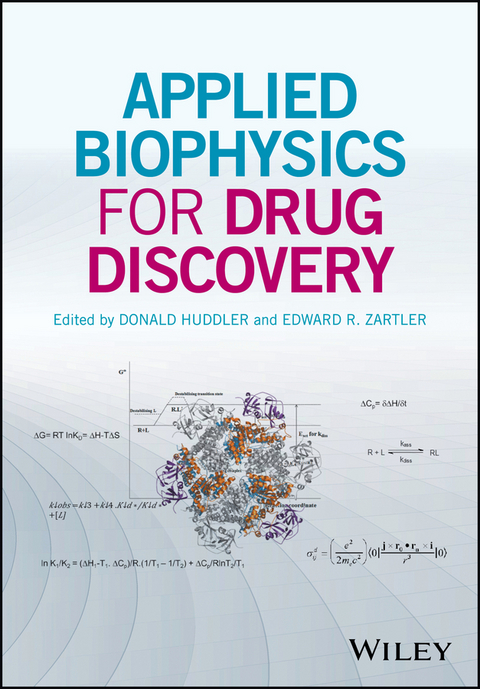
Applied Biophysics for Drug Discovery is a guide to new techniques and approaches to identifying and characterizing small molecules in early drug discovery. Biophysical methods are reasserting their utility in drug discovery and through a combination of the rise of fragment-based drug discovery and an increased focus on more nuanced characterisation of small molecule binding, these methods are playing an increasing role in discovery campaigns.
This text emphasizes practical considerations for selecting and deploying core biophysical method, including but not limited to ITC, SPR, and both ligand-detected and protein-detected NMR.
Topics covered include:
• Design considerations in biophysical-based lead screening
• Thermodynamic characterization of protein-compound interactions
• Characterizing targets and screening reagents with HDX-MS
• Microscale thermophoresis methods (MST)
• Screening with Weak Affinity Chromatography
• Methods to assess compound residence time
• 1D-NMR methods for hit identification
• Protein-based NMR methods for SAR development
• Industry case studies integrating multiple biophysical methods
This text is ideal for academic investigators and industry scientists planning hit characterization campaigns or designing and optimizing screening strategies.
Donald Huddler, Widener University Delaware Law School, Wilmington, USA.
Edward R. Zartler is Chief Scientific Officer at Quantum Tessera Consulting, LLC, USA.
Applied Biophysics for Drug Discovery is a guide to new techniques and approaches to identifying and characterizing small molecules in early drug discovery. Biophysical methods are reasserting their utility in drug discovery and through a combination of the rise of fragment-based drug discovery and an increased focus on more nuanced characterisation of small molecule binding, these methods are playing an increasing role in discovery campaigns. This text emphasizes practical considerations for selecting and deploying core biophysical method, including but not limited to ITC, SPR, and both ligand-detected and protein-detected NMR. Topics covered include: Design considerations in biophysical-based lead screening Thermodynamic characterization of protein-compound interactions Characterizing targets and screening reagents with HDX-MS Microscale thermophoresis methods (MST) Screening with Weak Affinity Chromatography Methods to assess compound residence time 1D-NMR methods for hit identification Protein-based NMR methods for SAR development Industry case studies integrating multiple biophysical methods This text is ideal for academic investigators and industry scientists planning hit characterization campaigns or designing and optimizing screening strategies.
Donald Huddler, Widener University Delaware Law School, Wilmington, USA. Edward R. Zartler is Chief Scientific Officer at Quantum Tessera Consulting, LLC, USA.
List of Contributors
1. Introduction
Donald Huddler
2. Thermodynamics in Drug Discovery
OBrienMarkova&Holdgate
3. Tailoring Hit Identification and Qualification Methods for Targeting Protein-Protein Interactions
Björn Walse, Andrew P. Turnbull, Susan M. Boyd
4. HYDROGEN DEUTERIUM EXCHANGE MASS SPECTROMETRY IN DRUG DISCOVERY
Thorleif Lavold, Roman Zubarev and Juan Astorga-Wells
5. MICROSCALE THERMOPHORESIS IN DRUG DISCOVERY
Tanja Bartoschik, Melanie Maschberger, Alessandra Feoli, Timon André, Philipp Baaske, Stefan Duhr and Dennis Breitsprecher
6. SPR Screening - Applying the new generation of SPR hardware
Kartik Narayan and Steve Carroll
7. Weak Affinity Chromatography (WAC)
Sten Ohlson* and Minh-Dao Duong-Thi
8. 1D NMR Methods for Hit Identification
Mary J Harner, Guille Metzler, Caroline A Fanslau, Luciano Mueller, William J Metzler
9. Protein-Based NMR Methods Applied to Drug Discovery
Alessio Bortoluzzi, Alessio Ciulli
10. Applications of Ligand and Protein-observed NMR in Discovery
Isabelle Krimm
Conclusion
11. Using Biophysical Methods to Optimize Compound Residence Time
G. A. Holdgate, P. Rawlins, M. Bista, C. J. Stubbs
12. Applying biophysical and biochemical methods to the discovery of allosteric modulators of the AAA ATPase p97
Stacie L. Bulfer and Michelle R. Arkin
13. Driving Drug Discovery with Biophysical Information - Application to Staphylococcus aureus Dihydrofolate Reductase (DHFR)
Parag Sahasrabudhe, Veerabahu Shanmugasundaram, Mark Flanagan, Kris A. Borzilleri, Holly Heaslet, Anil Rane, Alex McColl, Tim Subashi, George Karam, Ron Sarver, Melissa Harris, Boris A. Chrunyk, Chakrapani Subramanyam, Thomas V. Magee, Kelly Fahnoe, Brian Lacey, Henry Putz, J. Richard Miller, Jaehyun Cho, Arthur Palmer III and Jane M. Withka
14. Assembly of fragment screening libraries: Property and diversity analysis
Bradley C. Doak, Craig J. Morton, Jamie S. Simpson & Martin J. Scanlon
Index
1
Introduction
Donald Huddler*
Computational and Structural Chemistry, GlaxoSmithKline plc, Collegeville, PA, USA,
Over the last two decades, biophysics has reemerged as a core discipline in drug discovery. Many may argue that biophysical methods never truly left discovery, but all will note the renewed present importance and central role of such methods. This reemergence is driven by three primary forces: the birth of fragment‐based drug discovery schemes, the recognition of and desire to mitigate artifacts in traditional biochemical screening, and a desire to accelerate the transition from first‐in‐class to best‐in‐class molecules by focusing on hit and lead kinetics. Each of these strategies or goals requires various information‐rich biophysical methods to experimentally execute. This text aims to summarize some of the key methods emerging from these three broad enterprises. First, though, it will map the contours of these three drivers of biophysics’ reemergence and link them to the chapters that follow.
Fragment‐based drug discovery and fragment‐based lead discovery are slightly different names for the same discovery approach: using a library of relatively small compounds to probe the surface of a target protein for binding sites. Fragment‐based discovery approaches are animated by the information theory‐based idea that relatively simple, small compounds sample chemical space more effectively than larger, more complex molecules [1, 2]. In practice, this approach drives one to develop low complexity screening libraries [3, 4]; consequently, the binding interactions with target proteins are generally very weak. Weak interactions require sensitive methods to unambiguously detect the binding event [5]. In simple bimolecular binding, the concentration of the complex is driven by the concentration of the ligand; this drives many scientists to screen their fragment libraries at relatively high concentrations. Effective screening methods must both be able to detect relatively weak interactions in the context of relatively high compound concentrations; several biophysical methods are well suited for this demanding screening campaign [6]. Various NMR approaches have been successfully applied to identify and characterize weak small molecule–protein interactions [7]. This text explores both traditional protein‐detected NMR [8] approaches in Chapters 9 and 10 and nontraditional NMR [9, 10] approaches in Chapter 8. Both approaches have merit and are usefully applicable in partially overlapping circumstances. Surface plasmon resonance (SPR) [11, 12] and microscale thermophoresis (MST) [13] have also been successfully deployed in fragment screening campaigns to detect weak interactions. Chapters 5 and 6 explore applications of MST and SPR beyond fragment‐based discovery, respectively.
A second force driving the reemergence of biophysical methods in drug discovery has been the desire to identify and eliminate high‐throughput screening hits that operate through uninteresting nuisance mechanisms. Brian Schoichet recognized and characterized some commonly observed nuisance phenomena; many of these nuisance mechanism enzymatic assay hits had weak micromolar activities and showed either a flat or highly irregular SAR [14]. Schoichet’s team determined that the aberrant behavior in biochemical screening assays was driven by poor solubility resulting in compound aggregate formation. These compound aggregates, present in extremely low concentration, serve as protein sinks, adsorbing most of the target protein, yielding what appeared to be detectable but weak inhibition [15]. His team demonstrated that many of these aggregation‐based inhibitors could be culled from screening hits by comparing activity in an assay with no or very low detergent to a high detergent assay condition. Compounds that lose activity in the high detergent assay were likely to be uninteresting nuisance hits.
Several biophysical methods complement the differential detergent biochemical assay [16]. In the biochemical assay approach, the presence of aggregates is inferred, whereas in the biophysical approaches, the aggregates are directly detected. SPR is uniquely suited such direct detection of nuisance behavior in a buffer matched to the original biochemical screening buffer [17]. Aggregated compounds generate complex binding responses that are not simple 1 : 1 interactions but rather reflect the partitioning of the aggregated compound between the free buffer and the protein captured on the sensor chip. Aggregated compounds also show complex binding to the sensor surface with no target protein captured, providing a simple, parallel means to detect nonideal interactions in real time during library screening. Hit validation workflows now commonly employ SPR, mass spectrometry, and other biophysical methods to remove nuisance mechanism hits [18].
A third trend driving the reemergence of biophysics in drug discovery is the desire to optimize kinetic or thermodynamic properties with an aim to rapidly progress from a first‐in‐class compound to a best‐in‐class compound. When comparing a first‐in‐class compound to a best‐in‐class compound, the best‐in‐class molecule generally has high selectivity for the pharmacologic target and consequently a lengthy residence time with that target [19]. Detailed understanding of compound binding kinetics [20] and inhibitory mechanism leads to better candidates with properties more like an ideal best‐in‐class compound [21]. SPR allows real‐time analysis of binding kinetics [22]; streamlined experimental approaches allow rapid compound sorting based on kinetic parameters [23]. Combining thermodynamic data with affinity and kinetic data further characterizes the intermolecular interactions, enabling detailed SAR and further compound optimization [24]. This idea is explored and different methods applied inform interaction quality in Chapters 2, 4, 7, and 11.
The text concludes with a case study in Chapter 14 that joins many of the methods and concepts discussed in earlier chapters. The Pfizer research team used a combination of traditional biochemical analysis, focused structural information derived from NMR, SPR kinetics, and NMR dynamics to optimize a Staphylococcus aureus DHFR inhibitor. Data from no one method assured success; it was the conjunction of data from the several biophysical techniques that enabled their focused, hypothesis‐driven prospective library design that ultimately yielded novel, nonacid cell‐active inhibitors. Importantly, the dynamics and kinetic data incorporated common resistance mutations, informing the library design and ultimately the candidate compounds. This discovery case study exemplifies the fully integrated discovery approach where data‐rich biophysical techniques continually inform discovery. This approach enables research teams to target transient protein conformations, protein–protein interaction surfaces, or complex enzyme targets—all examples of targets that have met will have little success with traditional high‐throughput enzymatic screening [25].
This text is a survey of contemporary biophysical methods in drug discovery. Biophysical methods report on intermolecular interactions directly with rich detail; these methods naturally complement traditional high‐throughput screening [26, 27], particularly when attacking irregular, nonenzymatic [28, 29], or membrane protein [30, 31] targets.
References
- 1. Leach, A. R. and Hann, M. M. Molecular complexity and fragment‐based drug discovery: ten years on. Curr. Opin. Chem. Biol. 15:489–496 (2011).
- 2. Hann, M. M., Leach, A. R., and Harper, G. Molecular complexity and its impact on the probability of finding leads for drug discovery. J. Chem. Inf. Comput. Sci. 41:856–864 (2001).
- 3. Boyd, S. M., Turnbull, A. P., and Walse, B. Fragment library design considerations. WIREs Comput. Mol. Sci. 2:868–885 (2012).
- 4. Lau, W. F., Withka, J. M., Hepworth, D., Magee, T. V., Du, Y. J., Bakken, G. A., et al. Design of a multi‐purpose fragment screening library using molecular complexity and orthogonal diversity metrics. J. Comput. Aided Mol. Des. 25:621 (2011).
- 5. Mashalidis, E. H., Sledz, P., Lang, S., and Abell, C. A three‐stage biophysical screening cascade for fragment‐based drug discovery. Nat. Protoc. 8:2309–2324 (2013).
- 6. Joseph‐McCarthy, D., Campbell, A. J., Kern, G., and Moustakas, D. Fragment‐based lead discovery and design. J. Chem. Inf. Model. 54:693–704 (2014).
- 7. Kim, H. Y. and Wyss, D. F. NMR screening in fragment‐based drug design: a practical guide. Methods Mol. Biol. 1263:197–208 (2015).
- 8. Dias, D. M. and Ciulli, A. NMR approaches in structure‐based lead discovery: recent developments and new frontiers for targeting multi‐protein complexes. Prog. Biophys. Mol. Biol. 116:101–112 (2014).
- 9. Pilger, J., Mazur, A., Monecke, P., Schreuder, H., Elshorst, B., Bartoschek, S., et al. A combination of spin diffusion methods for the determination of protein‐ligand complex structural ensembles. Angew. Chem. 54:6511–6515 (2015).
- 10. Cala, O. and Krimm, I. Ligand‐orientation based fragment selection in STD NMR screening....
| Erscheint lt. Verlag | 14.7.2017 |
|---|---|
| Sprache | englisch |
| Themenwelt | Naturwissenschaften ► Physik / Astronomie ► Angewandte Physik |
| Technik ► Maschinenbau | |
| Schlagworte | 1D-NMR methods • applied biophysics • biochemical high throughput screening • biochemical screening • biophysical-based lead screening • biophysical direct binding assays • biophysical methods • Biophysics • Biophysik • Chemie • Chemistry • compound residence time • discovery campaigns • discovery methods • drug discovery • Fragment-Based Drug Discovery • HDX-MS • hit characterization campaigns • Hit identification • ITC • lead screening • ligand-detected NMR • Medical Science • Medizin • microscale thermophoresis methods • MST • Pharmaceutical & Medicinal Chemistry • Pharmacology & Pharmaceutical Medicine • Pharmakologie • Pharmakologie u. Pharmazeutische Medizin • Pharmazeutische u. Medizinische Chemie • Physics • Physik • protein-based NMR methods • protein-compound interactions • protein-detected NMR • Protein-Ligand Interactions • SAR development • screening reagents • screening strategies • small molecule binding • small molecules • SPR • Thermodynamic Characterization • Weak Affinity Chromatography • Wirkstoffforschung |
| ISBN-10 | 1-119-09950-1 / 1119099501 |
| ISBN-13 | 978-1-119-09950-5 / 9781119099505 |
| Informationen gemäß Produktsicherheitsverordnung (GPSR) | |
| Haben Sie eine Frage zum Produkt? |
 EPUB (Adobe DRM)
Kopierschutz: Adobe-DRM
Adobe-DRM ist ein Kopierschutz, der das eBook vor Mißbrauch schützen soll. Dabei wird das eBook bereits beim Download auf Ihre persönliche Adobe-ID autorisiert. Lesen können Sie das eBook dann nur auf den Geräten, welche ebenfalls auf Ihre Adobe-ID registriert sind.
Details zum Adobe-DRM
Dateiformat: EPUB (Electronic Publication)
EPUB ist ein offener Standard für eBooks und eignet sich besonders zur Darstellung von Belletristik und Sachbüchern. Der Fließtext wird dynamisch an die Display- und Schriftgröße angepasst. Auch für mobile Lesegeräte ist EPUB daher gut geeignet.
Systemvoraussetzungen:
PC/Mac: Mit einem PC oder Mac können Sie dieses eBook lesen. Sie benötigen eine
eReader: Dieses eBook kann mit (fast) allen eBook-Readern gelesen werden. Mit dem amazon-Kindle ist es aber nicht kompatibel.
Smartphone/Tablet: Egal ob Apple oder Android, dieses eBook können Sie lesen. Sie benötigen eine
Geräteliste und zusätzliche Hinweise
Buying eBooks from abroad
For tax law reasons we can sell eBooks just within Germany and Switzerland. Regrettably we cannot fulfill eBook-orders from other countries.


