Pastoral land management (eBook)
298 Seiten
Publishdrive (Verlag)
978-1-911412-39-7 (ISBN)
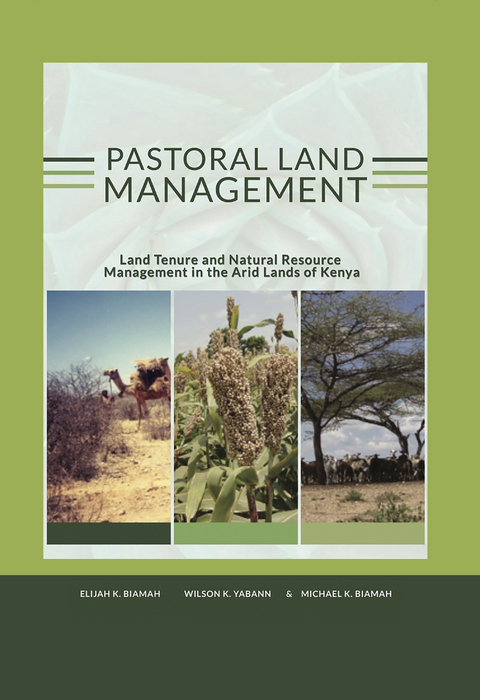
In the arid lands of Kenya, the social structure system associated with traditional pastoralism has evolved useful mechanisms for achieving sustainable resource utilization within fragile dryland environments. The sustainability of traditional pastoralism in Kenya is no longer feasible due to the increasing pressure on a shrinking resource base. This uncertainty with the sustainability of this traditional life style, calls for a radical shift in thinking from traditional to commercial pastoralism. Commercial pastoralism allows for the emergence of dynamic pastoralism which adapts quickly to technological changes and evolving market conditions in a fast changing pastoral environment. Whereas this futuristic form of pastoralism must recognize pastoral communities as legal entities and accord them the rights of control and disposal or transfer, it should also bestow the rights of access and use on individual pastoralists. The individualization of the right of land disposal or transfer in non-enlightened pastoral communities has led to the emergence of destitution and poverty in pastoral areas of Kenya. This book publication provides valuable information on emerging issues and options on pastoral land management in Kenya. It is based on a three year study on Land Tenure and Natural Resource Management in the Arid Lands of Kenya. It also does provide the requisite information for the formulation of a policy and legal framework on sustainable pastoral land management in Kenya.
In the arid lands of Kenya, the social structure system associated with traditional pastoralism has evolved useful mechanisms for achieving sustainable resource utilization within fragile dryland environments. The sustainability of traditional pastoralism in Kenya is no longer feasible due to the increasing pressure on a shrinking resource base. This uncertainty with the sustainability of this traditional life style, calls for a radical shift in thinking from traditional to commercial pastoralism. Commercial pastoralism allows for the emergence of dynamic pastoralism which adapts quickly to technological changes and evolving market conditions in a fast changing pastoral environment. Whereas this futuristic form of pastoralism must recognize pastoral communities as legal entities and accord them the rights of control and disposal or transfer, it should also bestow the rights of access and use on individual pastoralists. The individualization of the right of land disposal or transfer in non-enlightened pastoral communities has led to the emergence of destitution and poverty in pastoral areas of Kenya. This book publication provides valuable information on emerging issues and options on pastoral land management in Kenya. It is based on a three year study on Land Tenure and Natural Resource Management in the Arid Lands of Kenya. It also does provide the requisite information for the formulation of a policy and legal framework on sustainable pastoral land management in Kenya.
Chapter One
1.Pastoral Land Management in Kenya
1.1Background of Pastoralism
1.1.1Pastoralism and Pastoral Lands
Pastoralism is the most predominant form of livelihood for arid lands communities in Kenya. Pastoral communities in Kenya belong to closely knit tribal groups with a history of conflicts over pasture and cattle rustling. The people are predominantly semi-nomadic or nomadic pastoralists with a recent emergence of sedentarized agropastoralists. The ability of pastoral communities to survive through periods of drought has been highly dependent on their capacity to spread their risks, to move on to new areas of grazing as resources are depleted (mobility and tracking), and to take advantage of highly diverse dryland environments (riverine woodlands, hilltop forests), and dispersed watering points. Extensive seasonal movements in response to scarcity or abundance of resources have featured prominently as part of pastoral survival strategies.
Pastoral land use patterns are predicated upon risk spreading and highly flexible mechanisms such as mobility, communal land ownership, multiple herd species (herd diversity), herd separation or splitting. These mechanisms are both ecologically and socioeconomically viable options in the adaptive and survival strategies of nomadic pastoralists. Nomadic pastoralism in Kenya is epicyclical and based on an intricate information base generated locally and passed through generations. This indigenous knowledge base is dynamic and ever changing through indigenous creativity and innovation. Whereas conventional range management would opt for an adjustment in livestock numbers according to the existing land resource base, nomadic pastoralists would prefer to seek access to natural resources needed to sustain their livestock elsewhere rather than reduce their herd size. This strategy involves seasonal migration of both humans and livestock between distinct wet and dry season grazing areas. This opportunistic process of herd mobility and tracking is a logical and tactical strategy of access to non-exclusive tenure.
All pastoral communities have a traditional and cultural attachment to land. Land is sacred and most pastoral communities believe in equal rights for all land based resources. This ecosystem can only be destroyed when deeply rooted traditional views about land are either violated or ignored.
1.1.2Customary Pastoral Land Tenure
Among the pastoral communities in Kenya, there is the fusion of property rights of the community and those of the individual, which is the traditional hallmark of traditional African land tenure. Under traditional pastoralism, there is co-existence or equilibrium between the right of the individual and that of the community. Whereas it is the community that owns the land and have traditional rights of control, use and disposal of land, individual members of the community have the right of access and possesionary rights (through occupation) over the same piece of land. In traditional pastoralism, access to valued resources (e.g water, salt licks and key production areas reserved for dry season grazing such as wetlands and highlands) was regulated seasonally and spatially.
Customary pastoral land tenure is still considered as a social institution through which a series of rights, duties and obligations between individuals and communities are tackled. Customary pastoral land tenure involves all aspects of pastoralists livelihoods including access, control and use of land based resources. Communal ownership of pastoral resources has guaranteed unlimited access but also ensured some informal control of movements. Equal access to available natural resources by all households has maintained social equity amongst pastoral households and hence checking the advent of pauperism. In the past, poverty was a rare occurrence in pastoral households. However, factors such as drought, insecurity, land alienation and human and livestock population increase have affected the livestock based wealth of pastoralists and increased their vulnerability to famine and poverty.
Customary pastoral land tenure and production systems have ensured that all pastoral households have equal chances for survival. Hence traditional pastoralists have a high socio-economic standard of living and general welfare. The equal access system explains why there are no poor households among pastoral communities compared to sedentarized agro-pastoralist communities.
Changes in pastoral land tenure especially through land alienation (e.g creation of livestock ranches, grazing blocks, national parks and game reserves, and wheat farms in key production areas) have led to disruptions in the pastoralists lifestyle and hence the beginning of poverty and misery. Alongside this collapse of the system, the recurrence of drought; decline in range resource productivity; increasing sedentarization onto pastoral land; increase in human population; famine; land use conflicts; displacements and death have become widespread due to the scarcity of resources and the dire need to survive. And as mobility has decreased and resource use cycle shortened, territorial claims have become more specific as is the case now among many pastoral communities in Kenya.
Amidst these interventions, pastoralists norms, institutions, rules, beliefs and practices for sustainable resource use are no longer tenable because of historical factors which now explain their present situation. Most have been dissolved or declared repugnant to modernity. Traditional values are being lost by the younger generation who now go to school. This western type of education is not appropriate to the needs of pastoralists and their environment. Thus the children who are currently attending school are highly unlikely to maintain the nomadic pastoral lifestyle of their predecessors. Instead they would opt to sedentarize in established centres where infrastructural facilities are available.
Furthermore, this predicament is heightened by another development, that of increasing livestock and human population against an ever shrinking or at best constant resource base. This development largely explains the emergence of famine among pastoral communities and the growth of livestock-less households and accompanying human misery. The emergence of this class of people (e.g “mei or meiywon” among the Pokot; koole among the Boran and ngikebotok among the Turkana) confirms these changes that are occurring in pastoralist environments.
1.1.3Traditional Pastoral Resource Utilization
Pastoral production systems demand a detailed knowledge of the environment to establish an annual cycle of efficient resource utilization. Longterm productivity and sustainability of pastoral production systems is largely a function of sound environmental management. Thus traditional pastoral resource utilization is predicated upon risk spreading and highly flexible mechanisms such as mobility, communal land ownership, herd diversity, herd separation or splitting. These mechanisms are both ecologically and socio-economically viable options in the adaption and survival of pastoralists.
In the last two to three decades in the arid lands of Kenya, the human support capacity of pastoralism has undergone some tremendous decline due to extrenuous influences (e.g displacement from heightened insecurity, land alienation through creation of protected areas such as national parks, forest zones and game reserves) that have constrained its risk spreading mechanisms. The impact of these influences (e.g by increased sedentarization) manifests itself through ecological degradation. These degradation trends of environmental resources in pastoral systems inadvertently leads to reduced economic productivity of pastoral households and ultimately to social disintegration.
The realization of some sound range resource management and sustainable pastoral production in communal rangelands calls for the restoration of traditional authority structures and socio-cultural mechanisms for regulating access, control, use and management of both grazing and water resources.
Current legal statutes stipulate that land and land-based resources in the whole of the arid lands of Kenya belong to the government. They are state lands and are held in trust by local county councils. Such legislation on land tenure and property rights are a disservice to sound range resource management because of the following reasons: no rationally thinking human being will protect resources that have no security of tenure; and that land belonging to the government has freedom of access and use at any time to all pastoral communities. Pastoral groups consider this freedom of access to land as being in their favour during prolonged drought periods. What belongs to all belongs to nobody, and resources owned in such a context will be inevitably be utilized in a manner that precipitates the “tragedy of the commons”. This then goes back and creates a situation that comes closely to Hardin’s Tragedy of Commons paradigm. However, such a condition would not operate if traditional structures are restored.
1.1.4Ecological Productivity in Pastoral Areas
In order to sustain if not improve the ecological productivity of pastoral lands, the focus of any resource utilization and conservation efforts must consider the following: (1) Understand and appreciate production goals of pastoralists such as subsistence milk production and contingency meat production; (2) Recognize and consider operational ecological and socio-economic forces that underlie survival strategies of pastoralists(e.g. herd diversity;...
| Erscheint lt. Verlag | 14.7.2017 |
|---|---|
| Sprache | englisch |
| Themenwelt | Naturwissenschaften ► Geowissenschaften ► Geologie |
| Technik | |
| Weitere Fachgebiete ► Land- / Forstwirtschaft / Fischerei | |
| Schlagworte | land management • Land Tenure • natural resource management • Pastoralism |
| ISBN-10 | 1-911412-39-6 / 1911412396 |
| ISBN-13 | 978-1-911412-39-7 / 9781911412397 |
| Informationen gemäß Produktsicherheitsverordnung (GPSR) | |
| Haben Sie eine Frage zum Produkt? |
 EPUB (Adobe DRM)
Größe: 8,3 MB
Kopierschutz: Adobe-DRM
Adobe-DRM ist ein Kopierschutz, der das eBook vor Mißbrauch schützen soll. Dabei wird das eBook bereits beim Download auf Ihre persönliche Adobe-ID autorisiert. Lesen können Sie das eBook dann nur auf den Geräten, welche ebenfalls auf Ihre Adobe-ID registriert sind.
Details zum Adobe-DRM
Dateiformat: EPUB (Electronic Publication)
EPUB ist ein offener Standard für eBooks und eignet sich besonders zur Darstellung von Belletristik und Sachbüchern. Der Fließtext wird dynamisch an die Display- und Schriftgröße angepasst. Auch für mobile Lesegeräte ist EPUB daher gut geeignet.
Systemvoraussetzungen:
PC/Mac: Mit einem PC oder Mac können Sie dieses eBook lesen. Sie benötigen eine
eReader: Dieses eBook kann mit (fast) allen eBook-Readern gelesen werden. Mit dem amazon-Kindle ist es aber nicht kompatibel.
Smartphone/Tablet: Egal ob Apple oder Android, dieses eBook können Sie lesen. Sie benötigen eine
Geräteliste und zusätzliche Hinweise
Buying eBooks from abroad
For tax law reasons we can sell eBooks just within Germany and Switzerland. Regrettably we cannot fulfill eBook-orders from other countries.
EPUB (Ohne DRM)Digital Rights Management: ohne DRM
Dieses eBook enthält kein DRM oder Kopierschutz. Eine Weitergabe an Dritte ist jedoch rechtlich nicht zulässig, weil Sie beim Kauf nur die Rechte an der persönlichen Nutzung erwerben.
Dateiformat: EPUB (Electronic Publication)
EPUB ist ein offener Standard für eBooks und eignet sich besonders zur Darstellung von Belletristik und Sachbüchern. Der Fließtext wird dynamisch an die Display- und Schriftgröße angepasst. Auch für mobile Lesegeräte ist EPUB daher gut geeignet.
Systemvoraussetzungen:
PC/Mac: Mit einem PC oder Mac können Sie dieses eBook lesen. Sie benötigen dafür die kostenlose Software Adobe Digital Editions.
eReader: Dieses eBook kann mit (fast) allen eBook-Readern gelesen werden. Mit dem amazon-Kindle ist es aber nicht kompatibel.
Smartphone/Tablet: Egal ob Apple oder Android, dieses eBook können Sie lesen. Sie benötigen dafür eine kostenlose App.
Geräteliste und zusätzliche Hinweise
Buying eBooks from abroad
For tax law reasons we can sell eBooks just within Germany and Switzerland. Regrettably we cannot fulfill eBook-orders from other countries.
aus dem Bereich