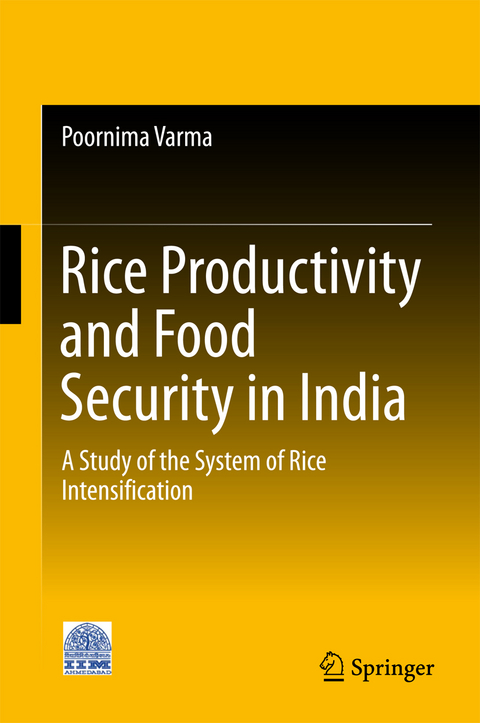
Rice Productivity and Food Security in India (eBook)
XXIII, 168 Seiten
Springer Singapore (Verlag)
978-981-10-3692-7 (ISBN)
This book contributes to the adoption of agricultural technology in general and to literature on the System of Rice Intensification (SRI) in particular by identifying the factors that influence the decision to adopt SRI and examining SRI's impact on household income and yield. The study also discusses the importance of SRI in achieving higher rice productivity and food security. Conducted on behalf of the Government of India's Ministry of Agriculture from October 2014 to March 2016, the study collected detailed and extensive household-level data.
As the second largest producer and consumer, India plays an important role in the global rice economy. Food security in India has been traditionally defined as having a sufficient supply of rice at an affordable price. However, in recent years rice cultivation in India has suffered from several interrelated problems. Increased yields achieved during the green revolution period and with the help of input-intensive methods involving high water and fertiliser use are now showing signs of stagnation and concomitant environmental problems due to salinisation and waterlogging of fields. Water resources are also limited; as such, water for irrigation must contend with increasing industrial and urban needs.As a result of all these factors, rice farmers have experienced a downturn in productivity growth. Since increasing the area of rice cultivation is not feasible, the additional production has to be achieved using less land, less water and fewer additional inputs. The new intensification methods for rice cultivation known as the System of Rice Intensification (SRI), which originated in Madagascar, offer a promising systemic approach to enhancing rice production at affordable costs by simultaneously reducing input requirements and causing less harm to the environment. The SRI approach is expected to enhance yield and substantially reduce water and other input requirements by altering plant, soil, water and nutrient management practices. With SRI taking firm root in India, the book examines and analyses the adoption and the economic impact of SRI in three major rice producing States of India: Karnataka, Madhya Pradesh and Orissa.
Poornima Varma is an Assistant Professor at the Centre for Management in Agriculture (CMA) of the Indian Institute of Management Ahmedabad (IIMA). She holds a PhD in economics from the Centre for Economic Studies and Planning at Jawaharlal Nehru University, New Delhi. She was a recipient of a US Fulbright scholarship in 2006 and was subsequently a visiting research scholar at the Department of Economics of the University of Massachusetts, Amherst, USA from 2007 to 2008. Prior to joining the IIMA she worked as an Assistant Professor at the Department of Policy Studies of TERI University, New Delhi. She has also worked with the Centre for WTO Studies (CWS) of the Indian Institute of Foreign Trade (IIFT) and the Indian Council for Research on International Economic Relations (ICRIER). Her work chiefly focuses on international trade, agriculture, environment and the adoption of agricultural technologies. She has extensively published in top peer-reviewed journals for agricultural and applied economics.
This book contributes to the adoption of agricultural technology in general and to literature on the System of Rice Intensification (SRI) in particular by identifying the factors that influence the decision to adopt SRI and examining SRI's impact on household income and yield. The study also discusses the importance of SRI in achieving higher rice productivity and food security. Conducted on behalf of the Government of India's Ministry of Agriculture from October 2014 to March 2016, the study collected detailed and extensive household-level data. As the second largest producer and consumer, India plays an important role in the global rice economy. Food security in India has been traditionally defined as having a sufficient supply of rice at an affordable price. However, in recent years rice cultivation in India has suffered from several interrelated problems. Increased yields achieved during the green revolution period and with the help of input-intensive methods involving high water and fertiliser use are now showing signs of stagnation and concomitant environmental problems due to salinisation and waterlogging of fields. Water resources are also limited; as such, water for irrigation must contend with increasing industrial and urban needs. As a result of all these factors, rice farmers have experienced a downturn in productivity growth. Since increasing the area of rice cultivation is not feasible, the additional production has to be achieved using less land, less water and fewer additional inputs. The new intensification methods for rice cultivation known as the System of Rice Intensification (SRI), which originated in Madagascar, offer a promising systemic approach to enhancing rice production at affordable costs by simultaneously reducing input requirements and causing less harm to the environment. The SRI approach is expected to enhance yield and substantially reduce water and other input requirements by altering plant, soil, waterand nutrient management practices. With SRI taking firm root in India, the book examines and analyses the adoption and the economic impact of SRI in three major rice producing States of India: Karnataka, Madhya Pradesh and Orissa.
Poornima Varma is an Assistant Professor at the Centre for Management in Agriculture (CMA) of the Indian Institute of Management Ahmedabad (IIMA). She holds a PhD in economics from the Centre for Economic Studies and Planning at Jawaharlal Nehru University, New Delhi. She was a recipient of a US Fulbright scholarship in 2006 and was subsequently a visiting research scholar at the Department of Economics of the University of Massachusetts, Amherst, USA from 2007 to 2008. Prior to joining the IIMA she worked as an Assistant Professor at the Department of Policy Studies of TERI University, New Delhi. She has also worked with the Centre for WTO Studies (CWS) of the Indian Institute of Foreign Trade (IIFT) and the Indian Council for Research on International Economic Relations (ICRIER). Her work chiefly focuses on international trade, agriculture, environment and the adoption of agricultural technologies. She has extensively published in top peer-reviewed journals for agricultural and applied economics.
Introduction.- An Overview of Rice Economy.- The need for Sustainable Agricultural Practices.- The System of Rice Intensification (SRI).- National Food Security Mission and SRI.- An Overview of SRI Adoption and Socio-Economic Profile of the Households.- Depth and Intensity of SRI Adoption.- Adoption of Multiple SRI Practices.- Impact of SRI Adoption on Rice Yield and Household Income.- Conclusion and Policy Implications.
| Erscheint lt. Verlag | 11.7.2017 |
|---|---|
| Zusatzinfo | XXIII, 168 p. 38 illus. in color. |
| Verlagsort | Singapore |
| Sprache | englisch |
| Themenwelt | Technik |
| Wirtschaft ► Volkswirtschaftslehre | |
| Weitere Fachgebiete ► Land- / Forstwirtschaft / Fischerei | |
| Schlagworte | Agricultural Technology Adoption • food security • Household income • rice production • Rice Productivity • Rice Yield • system of rice intensification |
| ISBN-10 | 981-10-3692-6 / 9811036926 |
| ISBN-13 | 978-981-10-3692-7 / 9789811036927 |
| Informationen gemäß Produktsicherheitsverordnung (GPSR) | |
| Haben Sie eine Frage zum Produkt? |
 PDF (Wasserzeichen)
DRM: Digitales Wasserzeichen
Dieses eBook enthält ein digitales Wasserzeichen und ist damit für Sie personalisiert. Bei einer missbräuchlichen Weitergabe des eBooks an Dritte ist eine Rückverfolgung an die Quelle möglich.
Dateiformat: PDF (Portable Document Format)
Mit einem festen Seitenlayout eignet sich die PDF besonders für Fachbücher mit Spalten, Tabellen und Abbildungen. Eine PDF kann auf fast allen Geräten angezeigt werden, ist aber für kleine Displays (Smartphone, eReader) nur eingeschränkt geeignet.
Systemvoraussetzungen:
PC/Mac: Mit einem PC oder Mac können Sie dieses eBook lesen. Sie benötigen dafür einen PDF-Viewer - z.B. den Adobe Reader oder Adobe Digital Editions.
eReader: Dieses eBook kann mit (fast) allen eBook-Readern gelesen werden. Mit dem amazon-Kindle ist es aber nicht kompatibel.
Smartphone/Tablet: Egal ob Apple oder Android, dieses eBook können Sie lesen. Sie benötigen dafür einen PDF-Viewer - z.B. die kostenlose Adobe Digital Editions-App.
Buying eBooks from abroad
For tax law reasons we can sell eBooks just within Germany and Switzerland. Regrettably we cannot fulfill eBook-orders from other countries.
aus dem Bereich