The Active Image (eBook)
317 Seiten
Springer International Publishing (Verlag)
978-3-319-56466-1 (ISBN)
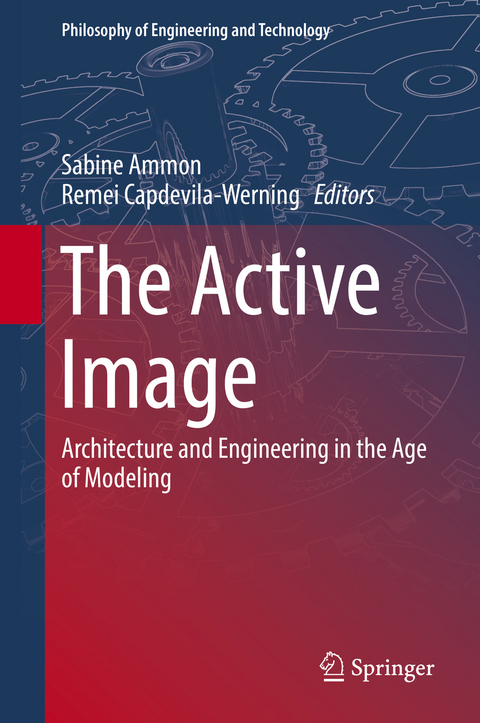
The “active image” refers to the operative nature of images, thus capturing the vast array of “actions” that images perform. This volume features essays that present a new approach to image theory. It explores the many ways images become active in architecture and engineering design processes and how, in the age of computer-based modeling, images play an indispensable role.
The contributors examine different types of images, be they pictures, sketches, renderings, maps, plans, and photographs; be they analog or digital, planar or three-dimensional, ephemeral, realistic or imaginary. Their essays investigate how images serve as means of representing, as tools for thinking and reasoning, as ways of imagining the inexistent, as means of communicating and conveying information and how images may also perform functions and have an agency in their own.
The essays discuss the role of images from the perspective of philosophy, theory and history of architecture, history of science, media theory, cognitive sciences, design studies, and visual studies, offering a multidisciplinary approach to imagery and showing the various methodologies and interpretations in current research. In addition, they offer valuable insight to better understand how images operate and function in the arts and sciences in general.
Sabine Ammon works at the Berlin University of Technology as a Marie Skłodowska-Curie Fellow, funded by the European Union, and acts as spokesperson of the interdisciplinary research group “Dynamics of Knowledge in Engineering Sciences”. She received her Ph.D. from Berlin University of Technology. She works mainly in epistemology, philosophy of engineering science and technology, image theory, and design ethics.Remei Capdevila-Werning is Director of Education and Public Programs at El Museo del Barrio in New York. She received her Ph.D. from the Universitat Autònoma de Barcelona. She has taught at Fairfield University and the School of Visual Arts. Her research interests include analytical aesthetics and epistemology, philosophy of art, architecture and historic preservation.
Chapter 1: Reinhold Martin, Points of Departure: Notes Toward a Reversible History of Architectural Visualization.Chapter 2: Daniel Cardoso Llach, Architecture and the Structured Image: Software Simulations as Infrastructures for Building Production.Chapter 3: Remei Capdevila-Werning, Architectural Drawings as Symbols: A Goodmanian Account of Epistemic Practices in the Design Process.Chapter 4: Gabriela Goldschmidt, Manual Sketching: Why is it Still Relevant?.Chapter 5: Irene Mittelberg, Thomas H. Schmitz, Hannah Groninger, Operative Manufacts: Gestures as Immediate Sketches in the Early Stages of the Design Process.Chapter 6: Rivka Oxman, The Role of the Image in Digital Design: Processing the Image versus Imaging the Process.Chapter 7: Nathalie Bredella, Visualization Techniques and Computational Design Strategies: Reflecting on the Milieu and Agency of Digital Tools in 1990s Architecture.Chapter 8: Sabine Ammon, Image-based Epistemic Strategies in Modeling: Designing Architecture after the Digital Turn.Chapter 9: Alice Comi, Suha Jaradat, Jennifer Whyte, Constructing Shared Vision in Design Practice: Material Mediation in Professional Work between Architects and Engineers.Chapter 10: Mehul Bhatt, Carl Schultz, People-Centered Visuospatial Cognition. Next-generation Architectural Design Systems and their Role in Conception, Computing, and Communication.Chapter 11: Johannes Lenhard, License to Explore: How Images Work in Simulation Modeling.Chapter 12: Doris Hallama, On Fuzziness and Relationships: Abstraction and Illustrative Visualization in Snow Avalanche Control Planning.
| Erscheint lt. Verlag | 10.7.2017 |
|---|---|
| Reihe/Serie | Philosophy of Engineering and Technology | Philosophy of Engineering and Technology |
| Zusatzinfo | X, 317 p. 127 illus. |
| Verlagsort | Cham |
| Sprache | englisch |
| Themenwelt | Geisteswissenschaften ► Philosophie ► Erkenntnistheorie / Wissenschaftstheorie |
| Technik ► Architektur | |
| Schlagworte | cognitive sciences images • design studies images • diachronic images • epistemology images • history of images • image modeling digital • images architecture • images computer based modeling • images computerization • images engineering design • images mathematization • images modeling • images simulation • IMAGE THEORY • imagining the inexistnet • media theory images • philosophy of images • synchronic images • visual studies images • Visual Thinking and Reasoning |
| ISBN-10 | 3-319-56466-8 / 3319564668 |
| ISBN-13 | 978-3-319-56466-1 / 9783319564661 |
| Informationen gemäß Produktsicherheitsverordnung (GPSR) | |
| Haben Sie eine Frage zum Produkt? |
 PDF (Wasserzeichen)
DRM: Digitales Wasserzeichen
Dieses eBook enthält ein digitales Wasserzeichen und ist damit für Sie personalisiert. Bei einer missbräuchlichen Weitergabe des eBooks an Dritte ist eine Rückverfolgung an die Quelle möglich.
Dateiformat: PDF (Portable Document Format)
Mit einem festen Seitenlayout eignet sich die PDF besonders für Fachbücher mit Spalten, Tabellen und Abbildungen. Eine PDF kann auf fast allen Geräten angezeigt werden, ist aber für kleine Displays (Smartphone, eReader) nur eingeschränkt geeignet.
Systemvoraussetzungen:
PC/Mac: Mit einem PC oder Mac können Sie dieses eBook lesen. Sie benötigen dafür einen PDF-Viewer - z.B. den Adobe Reader oder Adobe Digital Editions.
eReader: Dieses eBook kann mit (fast) allen eBook-Readern gelesen werden. Mit dem amazon-Kindle ist es aber nicht kompatibel.
Smartphone/Tablet: Egal ob Apple oder Android, dieses eBook können Sie lesen. Sie benötigen dafür einen PDF-Viewer - z.B. die kostenlose Adobe Digital Editions-App.
Buying eBooks from abroad
For tax law reasons we can sell eBooks just within Germany and Switzerland. Regrettably we cannot fulfill eBook-orders from other countries.
aus dem Bereich