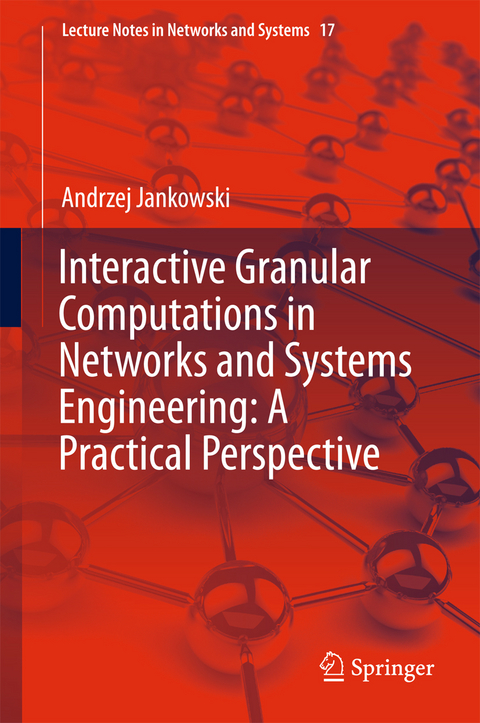
Interactive Granular Computations in Networks and Systems Engineering: A Practical Perspective (eBook)
XLIII, 654 Seiten
Springer International Publishing (Verlag)
978-3-319-57627-5 (ISBN)
The book outlines selected projects conducted under the supervision of the author. Moreover, it discusses significant relations between Interactive Granular Computing (IGrC) and numerous dynamically developing scientific domains worldwide, along with features characteristic of the author's approach to IGrC. The results presented are a continuation and elaboration of various aspects of Wisdom Technology, initiated and developed in cooperation with Professor Andrzej Skowron.
Based on the empirical findings from these projects, the author explores the following areas:(b) generalizing computing models of complex adaptive systems (CAS) (in particular, natural computing models) by constructing an interactive granular computing (IGrC) model of networks of interrelated interacting complex granules (c-granules), belonging to a single agent and/or to a group of agents;
(c) developing methodologies based on the IGrC model to minimize the negative consequences of the TPGP.
The book introduces approaches to the above issues, using the proposed IGrC model. In particular, the IGrC model refers to the key mechanisms used to control the processes related to the implementation of CSE projects.
One of the main aims was to develop a mechanism of IGrC control over computations that model a project's implementation processes to maximize the chances of its success, while at the same time minimizing the emerging risks. In this regard, the IGrC control is usually performed by means of properly selected and enforced (among project participants) project principles. These principles constitute examples of c-granules, expressed by complex vague concepts (represented by c-granules too). The c-granules evolve with time (in particular, the meaning of the concepts is also subject of change). This methodology is illustrated using project principles applied by the author during the implementation of the POLTAX, AlgoTradix, Merix, and Excavio projects outlined in the book.
Andrzej Jankowski received his PhD from Warsaw University where he worked about 20 years being involved in pioneering research on the logical structures (especially algebraic approach to knowledge representation and reasoning structures based on topos theory and evolution of hierarchies of metalogics). For three years he worked as a visiting professor in the Department of Computer Science at the University of North Carolina at Charlotte, USA. He is one of the founders and organizers of Polish-Japanese Institute of Information Technology. He has the unique experience in managing complex IT and R&D projects (e.g., Bank of America, Ford, GM, PKN ORLEN, and Ministry of Finance in Poland). Andrzej Jankowski has about 70 scientific publications and he is coauthor of two patents in Artificial Intelligence, which are cited in patents of such corporations as: IBM, Google, Microsoft, Yahoo!, Hewlett-Packard, Oracle, Matsushita Electric, NEC, Fuji, Xerox, Canon, Boeing, Sony, Accenture, and Red Hut. In cooperation with professor Andrzej Skowron, he proposed a new paradigm in AI technology, known as the 'Wisdom Technology' (WisTech).
Andrzej Jankowski received his PhD from Warsaw University where he worked about 20 years being involved in pioneering research on the logical structures (especially algebraic approach to knowledge representation and reasoning structures based on topos theory and evolution of hierarchies of metalogics). For three years he worked as a visiting professor in the Department of Computer Science at the University of North Carolina at Charlotte, USA. He is one of the founders and organizers of Polish-Japanese Institute of Information Technology. He has the unique experience in managing complex IT and R&D projects (e.g., Bank of America, Ford, GM, PKN ORLEN, and Ministry of Finance in Poland). Andrzej Jankowski has about 70 scientific publications and he is coauthor of two patents in Artificial Intelligence, which are cited in patents of such corporations as: IBM, Google, Microsoft, Yahoo!, Hewlett-Packard, Oracle, Matsushita Electric, NEC, Fuji, Xerox, Canon, Boeing, Sony, Accenture, and Red Hut. In cooperation with professor Andrzej Skowron, he proposed a new paradigm in AI technology, known as the “Wisdom Technology” (WisTech).
Research Motivations.- Research Objectives and Selected Approaches.- Challenges of WisTech (based on IGrC) for CAS Modeling, Controlling, and Monitoring.- Main Overview of Results.- Guide to the Contents of the Book.- The Concept of Complex System.- Examples of Complex Systems.- Concept of Complex Systems Engineering (CSE).- CSE Practice: CSE Crisis.- CSE Theory: Some Approaches.- TPGP: The Concept of the Theory - Practice Gap Problem.
| Erscheint lt. Verlag | 25.6.2017 |
|---|---|
| Reihe/Serie | Lecture Notes in Networks and Systems | Lecture Notes in Networks and Systems |
| Zusatzinfo | XLIII, 654 p. 137 illus., 102 illus. in color. |
| Verlagsort | Cham |
| Sprache | englisch |
| Themenwelt | Technik |
| Schlagworte | Complex Adaptive Systems • Complexity • Complex Systems • Interactive Granular computations • Networks Engineering • Systems Engineering |
| ISBN-10 | 3-319-57627-5 / 3319576275 |
| ISBN-13 | 978-3-319-57627-5 / 9783319576275 |
| Informationen gemäß Produktsicherheitsverordnung (GPSR) | |
| Haben Sie eine Frage zum Produkt? |
 PDF (Wasserzeichen)
DRM: Digitales Wasserzeichen
Dieses eBook enthält ein digitales Wasserzeichen und ist damit für Sie personalisiert. Bei einer missbräuchlichen Weitergabe des eBooks an Dritte ist eine Rückverfolgung an die Quelle möglich.
Dateiformat: PDF (Portable Document Format)
Mit einem festen Seitenlayout eignet sich die PDF besonders für Fachbücher mit Spalten, Tabellen und Abbildungen. Eine PDF kann auf fast allen Geräten angezeigt werden, ist aber für kleine Displays (Smartphone, eReader) nur eingeschränkt geeignet.
Systemvoraussetzungen:
PC/Mac: Mit einem PC oder Mac können Sie dieses eBook lesen. Sie benötigen dafür einen PDF-Viewer - z.B. den Adobe Reader oder Adobe Digital Editions.
eReader: Dieses eBook kann mit (fast) allen eBook-Readern gelesen werden. Mit dem amazon-Kindle ist es aber nicht kompatibel.
Smartphone/Tablet: Egal ob Apple oder Android, dieses eBook können Sie lesen. Sie benötigen dafür einen PDF-Viewer - z.B. die kostenlose Adobe Digital Editions-App.
Buying eBooks from abroad
For tax law reasons we can sell eBooks just within Germany and Switzerland. Regrettably we cannot fulfill eBook-orders from other countries.
aus dem Bereich