
Magnetic Nanomaterials (eBook)
Wiley-VCH Verlag GmbH & Co. KGaA
978-3-527-80324-8 (ISBN)
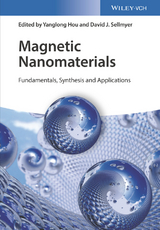
By allowing researchers to get to the forefront developments related to magnetic nanomaterials in various disciplines, this is invaluable reading for the nano, magnetic, energy, medical, and environmental communities.
Dr. Yanglong Hou is a Chang Jiang Chair Professor of Materials Science at Peking University (PKU). His research interests include the design and chemical synthesis of magnetic nanoparticles and graphene-based nanocomposites, and their applications in biomedicine and energy. He earned his Ph.D. degree from Harbin Institute of Technology in 2000. After postdoctoral research at Peking University, the University of Tokyo and Brown University, he joined PKU as an associate professor in December 2007, and was promoted to Professor in 2012. He has published over 110 papers in peer-reviewed scientific journals and has received numerous scientific awards, including the CCS-RSC Young Chemist and the JSPS Fellow award. David J. Sellmyer received B.S. and Ph.D. degrees in Physics from the University of Illinois and Michigan State University, respectively. He was an Assistant and Associate Professor of Materials Science and Engineering at MIT before moving to the University of Nebraska where he became Chair of Physics, and presently George Holmes University Distinguished Professor. He is the founding Director of the Nebraska Center for Materials and Nano-science and the Nebraska Nanoscale Facility, a site of the NSF National Nanotechnology Coordinated Infrastructure. He has authored or edited more than 650 publications, and is a Fellow of the American Physical Society and American Association for the Advancement of Science.
PART I. Fundamental
OVERVIEW OF MAGNETIC NANOMATERIALS
Introduction
Classification of Typical Magnetic Nanomaterials
Characterization of Magnetic Nanomaterials
MAGNETISM OF NANOMATERIALS
Introduction
Magnetism and Spintronics
Magnetic Properties of Magnetic Nanomaterials
Magnetization Process
Magnetic Anisotropy
PART II. Synthesis
OVERVIEW OF SYNTHESIS OF MAGNETIC NANOMATERIALS
Introduction
General Synthesis Mechanism of Magnetic Nanomaterials
SYNTHESIS OF SOFT MAGNETIC NANOMATERIALS AND ALLOYS
Introduction
Metal
Metals Oxides
Metal Carbides, Nitrides
Alloys and Beyond
Conclusions and Perspectives
SYNTHESIS OF RARE EARTH PERMANENT NANOCOMPOSITE MAGNETS
Introduction
SmCox-Based Magnets
NdFeB-Based Magnets
Conclusions and Perspectives
SYNTHESIS OF RARE EARTH FREE PERMANENT MAGNETS
Introduction
FeNx
MnB
Others
Conclusions and Perspectives
SYNTHESIS OF MAGNETIC CHALCOGENIDES
Introduction
Synthesis
Properties
Conclusions and Perspectives
SYNTHESIS OF TYPICAL MAGNETIC NANOSTRUCTURES
Introduction
Synthesis of Hollow/Porous Magnetic Nanoparticles
ORGANIZED ENSEMBLES OF MAGNETIC NANOMATERIALS
Introduction
Essential Conditions for Ordered Structures
Self-Assembly Method of Magnetic Nanomaterials
PART III. Applications
MAGNETIC NANOMATERIALS FOR BIOTECHNOLOGY
Introduction
Magnetic Nanomaterials for Biosensors
Magnetic Nanomaterials for Bioseparation
Conclusions and Perspectives
MAGNETIC NANOMATERIALS FOR DIAGNOSTICS
Introduction
Biocompatibility of Magnetic Nanoparticles
Surface Functionalization of Magnetic Nanomaterials
Magnetic Resonance Imaging (MRI)
Magneto-Acoustic Tomography (MAT)
Magnetic Particle Imaging (MPI)
Multi-Modality Imaging
Conclusions and Perspectives
MAGNETIC NANOMATERIALS FOR THERAPY
Introduction
Imaging-Guided Therapy
Magnetic Hyperthermia
Targeted Drug and Gene Delivery
Conclusions and Perspectives
MAGNETIC NANOMATERIALS FOR DATA STORAGE
Introduction
Monodisperse Magnetic Nanoparticles
Magnetic Nanoparticle Assembly
Conclusions and Perspectives
MAGNETIC NANOMATERRIALS FOR ELECTROMAGNETIC WAVE-ABSORBING
Introduction
Advantage of Magnetic Absorbing Nanomaterials
Theoretical Research
Magnetic Absorbing Nanomaterials
Conclusions and Perspectives
MAGNETIC NANOMATERIALS FOR WATER REMEDIATION
Introduction
Magnetic Adsorption Nanomaterials and Mechanism
Removal of Toxic Metal Ions and Dye
| Erscheint lt. Verlag | 12.6.2017 |
|---|---|
| Sprache | englisch |
| Themenwelt | Naturwissenschaften ► Chemie |
| Technik ► Maschinenbau | |
| Technik ► Umwelttechnik / Biotechnologie | |
| Schlagworte | Applications • Biotechnologie • Biotechnologie i. d. Chemie • Biotechnology • Book • Chemie • Chemistry • Design • Developments • different fields • Forefront • Latest • Magnetic • magnetic materials • Magnetic nanomaterials • magnetische Materialien • Materials Science • Materialwissenschaften • Nanomaterial • nanomaterials • nanomedicine • Nanomedizin • nanoparticles • Nanotechnologie • nanotechnology • Physical • Preparation • Properties • Recent Advances • remediation • Research • Researchers • Storage |
| ISBN-10 | 3-527-80324-6 / 3527803246 |
| ISBN-13 | 978-3-527-80324-8 / 9783527803248 |
| Informationen gemäß Produktsicherheitsverordnung (GPSR) | |
| Haben Sie eine Frage zum Produkt? |
 PDF (Adobe DRM)
Kopierschutz: Adobe-DRM
Adobe-DRM ist ein Kopierschutz, der das eBook vor Mißbrauch schützen soll. Dabei wird das eBook bereits beim Download auf Ihre persönliche Adobe-ID autorisiert. Lesen können Sie das eBook dann nur auf den Geräten, welche ebenfalls auf Ihre Adobe-ID registriert sind.
Details zum Adobe-DRM
Dateiformat: PDF (Portable Document Format)
Mit einem festen Seitenlayout eignet sich die PDF besonders für Fachbücher mit Spalten, Tabellen und Abbildungen. Eine PDF kann auf fast allen Geräten angezeigt werden, ist aber für kleine Displays (Smartphone, eReader) nur eingeschränkt geeignet.
Systemvoraussetzungen:
PC/Mac: Mit einem PC oder Mac können Sie dieses eBook lesen. Sie benötigen eine
eReader: Dieses eBook kann mit (fast) allen eBook-Readern gelesen werden. Mit dem amazon-Kindle ist es aber nicht kompatibel.
Smartphone/Tablet: Egal ob Apple oder Android, dieses eBook können Sie lesen. Sie benötigen eine
Geräteliste und zusätzliche Hinweise
Buying eBooks from abroad
For tax law reasons we can sell eBooks just within Germany and Switzerland. Regrettably we cannot fulfill eBook-orders from other countries.
aus dem Bereich