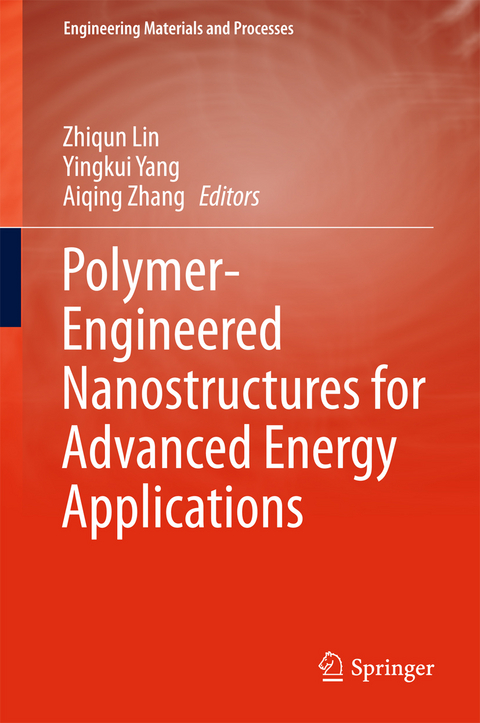
Polymer-Engineered Nanostructures for Advanced Energy Applications (eBook)
XXVI, 701 Seiten
Springer International Publishing (Verlag)
978-3-319-57003-7 (ISBN)
This book provides a comprehensive overview of engineering nanostructures mediated by functional polymers in combination with optimal synthesis and processing techniques. The focus is on polymer-engineered nanostructures for advanced energy applications.
It discusses a variety of polymers that function as precursors, templates, nano-reactors, surfactants, stabilizers, modifiers, dopants, and spacers for directing self-assembly, assisting organization, and templating growth of numerous diverse nanostructures.
It also presents a wide range of polymer processing techniques that enable the efficient design and optimal fabrication of nanostructured polymers, inorganics, and organic-inorganic nanocomposites using in-situ hybridization and/or ex-situ recombination methodologies.
Combining state-of-the-art knowledge from polymer-guided fabrication of advanced nanostructures and their unique properties, it especially highlights the new, cutting-edge breakthroughs, future horizons, and insights into such nanostructured materials in applications such as photovoltaics, fuel cells, thermoelectrics, piezoelectrics, ferroelectrics, batteries, supercapacitors, photocatalysis, and hydrogen generation and storage. It offers an instructive and approachable guide to polymer-engineered nanostructures for further development of advanced energy materials to meet ever-increasing global energy demands.
Interdisciplinary and broad perspectives from internationally respected contributors ensure this book serves as a valuable reference source for scientists, students, and engineers working in polymer science, renewable energy materials, materials engineering, chemistry, physics, surface/interface science, and nanotechnology. It is also suitable as a textbook for universities, institutes, and industrial institutions.
Dr. Zhiqun Lin is currently Professor of Materials Science and Engineering at the Georgia Institute of Technology. He received his Ph.D. in Polymer Science and Engineering from the University of Massachusetts, Amherst in 2002. He did his postdoctoral research at the University of Illinois at Urbana-Champaign. He joined the Department of Materials Science and Engineering at the Iowa State University as an assistant professor in 2004 and was promoted to associate professor in 2010. He moved to Georgia Institute of Technology in 2011 and became a professor in 2014. His research interests include polymer-based nanocomposites, block copolymers, polymer blends, conjugated polymers, functional nanocrystals of different architectures, solar cells (in particular, perovskite solar cells, organic-inorganic hybrid solar cells, and dye sensitized solar cells), lithium ion batteries, hydrogen generation, hierarchically structured and assembled materials, and surface and interfacial properties. He is an associate editor for the Journal of Materials Chemistry A and an editorial advisory board member for Nanoscale.
Dr. Yingkui Yang is currently a professor at the School of Chemistry and Materials Science at South-Central University for Nationalities, China. He completed his Ph.D. degree in Polymer Chemistry and Physics at Huazhong University of Science and Technology in 2007. He has worked as a research fellow, postdoctoral fellow, and visiting professor at City University of Hong Kong and Hong Kong Polytechnic University over the past decade. He was also a visiting scholar at the University of Sydney (2010-2011) and Georgia Institute of Technology (2014-2015). He joined the School of Materials Science and Engineering at Hubei University in 2007 and was promoted to full professor in 2013. He then moved to South-Central University for Nationalities in 2016. His current research interests include surface/interface engineering of nanostructures, polymer-templated nanostructures, polymer-based nanocomposites, graphitic nanocarbons (in particular, graphene and carbon nanotubes) and their nanohybrids for actuators, electrochemical energy, electronics, environmental materials, and dielectric applications.
Dr. Aiqing Zhang is currently working as professor and dean of the School of Chemistry and Materials Science at South-Central University for Nationalities, China. He obtained his B.Sc. (1983), M.Sc. (1990), and Ph.D. (1998) from Huazhong University of Science and Technology, China. He served as a postdoctoral fellow (2000-2001) at Chonbuk National University, Korea. He worked at Shanxi Mining Institute (currently merged into Taiyuan University of Technology) from 1983 to 1987 and Wuhan Automotive Polytechnic University (now merged with Wuhan University of Technology) from 1990 to 1994. He then moved to South-Central University for Nationalities in 1998, where became a full professor. His scientific interests focus on the rational design and optimal synthesis of functional polymer materials for photosensitive, low-dielectric, and catalytic applications.
Dr. Zhiqun Lin is currently Professor of Materials Science and Engineering at the Georgia Institute of Technology. He received his Ph.D. in Polymer Science and Engineering from the University of Massachusetts, Amherst in 2002. He did his postdoctoral research at the University of Illinois at Urbana-Champaign. He joined the Department of Materials Science and Engineering at the Iowa State University as an assistant professor in 2004 and was promoted to associate professor in 2010. He moved to Georgia Institute of Technology in 2011 and became a professor in 2014. His research interests include polymer-based nanocomposites, block copolymers, polymer blends, conjugated polymers, functional nanocrystals of different architectures, solar cells (in particular, perovskite solar cells, organic–inorganic hybrid solar cells, and dye sensitized solar cells), lithium ion batteries, hydrogen generation, hierarchically structured and assembled materials, and surface and interfacial properties. He is an associate editor for the Journal of Materials Chemistry A and an editorial advisory board member for Nanoscale. Dr. Yingkui Yang is currently a professor at the School of Chemistry and Materials Science at South-Central University for Nationalities, China. He completed his Ph.D. degree in Polymer Chemistry and Physics at Huazhong University of Science and Technology in 2007. He has worked as a research fellow, postdoctoral fellow, and visiting professor at City University of Hong Kong and Hong Kong Polytechnic University over the past decade. He was also a visiting scholar at the University of Sydney (2010–2011) and Georgia Institute of Technology (2014–2015). He joined the School of Materials Science and Engineering at Hubei University in 2007 and was promoted to full professor in 2013. He then moved to South-Central University for Nationalities in 2016. His current research interests include surface/interface engineering of nanostructures, polymer-templated nanostructures, polymer-based nanocomposites, graphitic nanocarbons (in particular, graphene and carbon nanotubes) and their nanohybrids for actuators, electrochemical energy, electronics, environmental materials, and dielectric applications. Dr. Aiqing Zhang is currently working as professor and dean of the School of Chemistry and Materials Science at South-Central University for Nationalities, China. He obtained his B.Sc. (1983), M.Sc. (1990), and Ph.D. (1998) from Huazhong University of Science and Technology, China. He served as a postdoctoral fellow (2000–2001) at Chonbuk National University, Korea. He worked at Shanxi Mining Institute (currently merged into Taiyuan University of Technology) from 1983 to 1987 and Wuhan Automotive Polytechnic University (now merged with Wuhan University of Technology) from 1990 to 1994. He then moved to South-Central University for Nationalities in 1998, where became a full professor. His scientific interests focus on the rational design and optimal synthesis of functional polymer materials for photosensitive, low-dielectric, and catalytic applications.
Preface 6
Acknowledgements 9
Contents 10
Editors and Contributors 12
Abbreviations 17
Engineering Nanostructures with Polymers 25
1 Engineering Ceramic Fiber Nanostructures Through Polymer-Mediated Electrospinning 26
Abstract 26
1.1 Introduction 26
1.2 Electrospinning: Fabrication of Inorganic Fibers 28
1.2.1 Solgel Method 28
1.2.2 Dispersion of Metal Oxide Particles 30
1.2.3 Gas–Solid Reaction 31
1.2.4 Emulsion Electrospinning 31
1.3 Ceramic and Metal Oxide Fibers with Controlled Structures 32
1.3.1 Unique Fiber Structures 32
1.3.2 Porous Fibrous Structures 35
1.3.3 Hollow Fibers 36
1.3.4 Controlled Assembly 38
1.3.5 Composite Fibers 39
1.3.6 Hierarchical Structures Based on Ceramic Fibers 41
1.4 Applications of Inorganic Fibers 44
1.4.1 Filtration 44
1.4.2 Sensors 45
1.4.3 Photocatalysis 46
1.4.4 Energy 47
1.5 Conclusions and Future Perspective 48
Acknowledgements 49
References 50
2 Polymer Microbead-Templated Nanostructures 54
Abstract 54
2.1 Introduction 55
2.2 Microbead Monolayer 55
2.2.1 Polymer Microbeads and Silica Microbeads 55
2.2.2 Microbead Monolayer and Multilayers 55
2.3 Fabricated Nanostructures 58
2.3.1 Templated Deposition 58
2.3.2 Combination with Annealing 62
2.3.3 Combination with Etching 63
2.4 Applications 66
2.4.1 Surface Plasmon of Templated Nanostructures 66
2.4.2 Identification of Hot spot Position 67
2.4.3 Single Molecule Detection 69
2.5 Summary 71
Acknowledgements 71
References 71
3 Nanopatterning of Functional Metallopolymers via Top-Down Approach 74
Abstract 74
3.1 Introduction 74
3.2 Top-Down Approaches 75
3.2.1 Direct-Write Electron-Beam Lithography (EBL) 76
3.2.2 UV-Photolithography 79
3.2.3 Nanosphere Lithography (NSL) 81
3.2.4 Nanoimprint Lithography (NIL) 87
3.3 Conclusions 89
Acknowledgements 90
References 90
4 Organic Porous Polymer Materials: Design, Preparation, and Applications 94
Abstract 94
4.1 Introduction 94
4.2 Covalent Organic Frameworks 96
4.2.1 Design and Synthesis 96
4.2.1.1 Design Principles 96
4.2.1.2 Synthetic Methods 99
4.2.1.3 Structural Studies 101
4.2.2 Application Exploration 105
4.2.2.1 Gas Storage 105
4.2.2.2 Heterogeneous Catalysis 107
4.2.2.3 Photoelectric Applications 107
4.2.3 Summary 109
4.3 Hypercrosslinked Polymers 110
4.3.1 Post-crosslinking Procedure 111
4.3.2 Direct One-Step Self-polycondensation 113
4.3.3 External Crosslinking Strategy 115
4.3.4 Summary 123
4.4 Conjugated Microporous Polymers 123
4.4.1 Synthesis and Modification 124
4.4.1.1 Synthesis Method 124
4.4.1.2 Modification 126
4.4.2 Control of Morphology 128
4.4.2.1 Template Strategy 128
4.4.2.2 Stepwise Method 129
4.4.3 Application 131
4.4.3.1 Absorbent and Gas Storage 131
4.4.3.2 Battery and Supercapacitors 131
4.4.3.3 Catalyst 132
4.4.3.4 Fluorescence Property and Sensor 132
4.4.3.5 Others 132
4.4.4 Summary 133
4.5 Polymers of Intrinsic Microporosity 133
4.5.1 Preparation of Polymers of Intrinsic Microporosity 133
4.5.2 Applications 139
4.5.2.1 Gas Permeability and Separations 139
4.5.2.2 Heterogeneous Catalysis 142
4.5.2.3 Hydrogen Storage 143
4.5.2.4 Other Applications 144
4.5.3 Limitation and Challenge of Development 144
4.6 Macroporous Polymers 145
4.6.1 Macroporous Polymer Synthesis in PolyHIPEs of W/O 147
4.6.2 HIPE of O/W 149
4.6.3 HIPE of CO2/Water 150
4.6.4 HIPE of Pickering Emulsion 154
4.6.5 Conclusions 156
4.7 Outlook and Perspective 157
Acknowledgements 158
References 158
5 Responsive Photonic Crystals with Tunable Structural Color 174
Abstract 174
5.1 Introduction 174
5.2 Fabrication of Responsive PCs 176
5.2.1 Fabrication of 1D Responsive PCs 176
5.2.1.1 Fabrication of 1D Responsive PCs by Spin-Coating 176
5.2.1.2 Fabrication of 1D Responsive PCs by Self-assembly of Block Copolymers (BCPs) 177
5.2.1.3 Fabrication of 1D Responsive PCs by Self-assembly of Magnetic NPs 177
5.2.2 Fabrication of 2D Responsive PCs 178
5.2.3 Fabrication of 3D Responsive PCs 179
5.2.3.1 Fabrication of Non-closely Packed 3D Responsive PCs 179
5.2.3.2 Fabrication of Inverse Opal 3D Responsive PCs 180
5.3 Sensing Applications of the Responsive PCs 180
5.3.1 Pressure Sensors 180
5.3.2 Temperature Sensors 182
5.3.3 Organic Solvent Sensors 184
5.3.4 pH and Ionic Sensors 185
5.3.5 Electric Field Sensor 185
5.3.6 Magnetic Field Sensor 187
5.3.7 Optical Sensor 189
5.3.8 Biomolecule Sensors 189
5.4 Summary and Outlook 190
Acknowledgments 191
References 191
6 Responsive Polymer Nanostructures 196
Abstract 196
6.1 Introduction 197
6.2 Thermoresponsive Polymer Nanostructures 199
6.2.1 Non-ionic Polymer Nanostructures 203
6.2.1.1 LCST-Type Polymer Nanostructures 203
Poly(N-substituted (meth)acrylamide)-Based Nanostructures 203
Poly(alkylene oxide)-Based Nanostructures 207
Lactam/Pyrrolidone/Pyrrolidine-Based Polymers 211
Poly(aminoalkyl methacrylate)-Based Nanostructures 212
POSS-Based Polymer Nanostructures 214
6.2.1.2 Non-ionic UCST-Type Polymers 215
6.2.1.3 Polymer Nanostructures in Water-Alcohol Cosolvent System 217
6.2.2 Ionic Polymer Nanostructures 219
6.2.2.1 Zwitterionic Polymer Nanostructures 222
6.2.2.2 Poly(Ionic Liquid) Nanostructures 225
6.3 pH-Responsive Polymer Nanostructures 229
6.3.1 Non-ionic Polymer Nanostructures 230
6.3.1.1 POSS-Based pH-Responsive Polymer Nanostructures 236
6.3.2 pH-Responsive Ionic Polymer Nanostructure 236
6.3.2.1 Zwitterionic Polymer Nanostructures 236
Polyampholytes 237
Polyzwitterion 238
Amino Acid-Based Zwitterionic Polymer 242
Poly(ionic liquid) Nanostructures 243
6.4 Light-Responsive Polymer Nanostructures 246
6.4.1 o-Nitrobenzyl Functional Group Containing Polymer Nanostructures 247
6.4.2 Azobenzene-Based Polymer Nanomaterials 254
6.4.3 Pyrenylmethyl Polymer-Based Nanomaterials 260
6.4.4 Spiropyran Polymer-Based Nanomaterials 261
6.4.5 Coumarin Containing Polymer Nanomaterials 263
6.5 Redox-Responsive Polymer Nanostructures 265
6.6 Glucose-Responsive Polymer Nanostructures 271
6.7 CO2 Responsive Polymer Nanostructures 274
6.8 Cyclodextrin Inclusion Complexation-Based Responsive Polymer Nanostructures 277
6.9 Mechano-responsive Polymers 281
6.10 Dual Stimuli-Responsive Polymer Nanomaterials 285
6.10.1 Temperature- and pH-Responsive Polymer Nanostructures 286
6.10.2 Temperature- and Light-Responsive Polymer Nanostructures 290
6.10.3 Redox- and pH-Responsive Polymer Nanostructures 294
6.11 Multiple Stimuli-Responsive Polymer Nanostructures 296
6.11.1 Temperature-, pH- and Light-Responsive Polymer Nanostructures 297
6.11.2 Light-, Redox-, and Temperature-Responsive Polymer Nanostructures 300
6.11.3 Temperature-, Enzyme-, and pH-Responsive Polymer Nanostructures 301
6.12 Responsive Polymer Materials in Advanced Energy Applications 303
6.13 Conclusions and Outlook 305
Acknowledgements 306
References 306
Nanostructured Materials for Energy Storage 328
7 Polymer- and Carbon-Based Nanofibres for Energy Storage 329
Abstract 329
7.1 Introduction 329
7.2 Fabrication Methods for Carbon-Based Nanofibres 331
7.2.1 History and Properties of Carbon Nanofibres 331
7.2.2 Chemical Vapour Deposition 332
7.2.3 Electrospinning 334
7.2.4 Controlled Freezing/Freeze-Drying 336
7.2.5 Nanofibrous Gels and Carbonization 338
7.3 Energy Storage Applications 340
7.3.1 Rechargeable Batteries 340
7.3.1.1 Li-Ion Batteries 340
7.3.1.2 Li-Air Batteries 343
7.3.1.3 Li-S Batteries 344
7.3.1.4 Na-Ion Batteries 344
7.3.2 Supercapacitors 346
7.3.2.1 Electric Double-Layer Capacitors (EDCLs) 347
7.3.2.2 Pseudocapacitors 348
7.3.2.3 Hybrid Capacitors (Asymmetric, Composite, Battery Type) 349
7.4 Conclusion and Outlook 350
Acknowledgements 351
References 351
8 Polymer/Graphene Composites for Energy Storage 358
Abstract 358
8.1 Introduction 358
8.2 Polymer/Graphene Composite 361
8.2.1 Electrode Material Selection 361
8.2.1.1 Carbon-Based Materials 361
8.2.1.2 Conducting Polymer Materials 362
Polyaniline 364
Polypyrrole 364
Polythiophene 365
8.2.2 Electrolytes 365
8.2.2.1 Aqueous-Based Electrolytes 366
8.2.2.2 Ionic Liquid-Based Electrolytes 367
8.2.2.3 Solid-State Electrolytes 369
8.3 Preparation of PANI Nanowires/Graphene Composites 371
8.3.1 Melamine-Assisted Synthesis of PANI/Graphene Composites 371
8.3.2 Graphene Film Cross-Linked Ordered PANI 372
8.3.3 Monolayer Graphene Cross-Linked Ordered PANI 374
8.4 Electrochemical Performance of Polymer/Graphene Composites as Battery Electrodes 375
8.5 Influence of Electrolyte on Performance 377
8.5.1 Organic Electrolytes 377
8.5.2 Solid Electrolytes 378
8.6 Conclusions 380
References 380
9 Conducting Polymers/Inorganic Nanohybrids for Energy Applications 386
Abstract 386
9.1 Introduction 386
9.2 Conducting Polymers 389
9.2.1 Activity of Conducting Polymers in EES 389
9.2.2 Preparation of Conducting Polymers 390
9.2.3 Intention of Conducting Polymer 396
9.2.4 Advantage and Disadvantage of Conducting Polymers 398
9.3 Conducting Polymers/Inorganic Nanohybrids for Electrical Energy Applications 400
9.3.1 Nanosized Polymer-Inorganic Hybrid Synthesis 401
9.3.2 Ex Situ and In Situ Approaches 404
9.3.3 Mechanical Methods 408
9.3.4 Blending Inorganic Nanoparticles into Polymer Matrix 410
9.3.5 Nanostructured Polymer with Inorganic Particles 412
9.3.6 Sol–Gel 415
9.3.7 Electrochemical and Chemical Deposition Methods 415
9.3.8 Diversity Methods 420
9.3.9 Challenges on Conducting Polymers/Inorganic Nanohybrid-based EES 423
9.4 Conclusions 424
References 425
10 Polymer-Derived Carbon/Inorganic Nanohybrids for Electrochemical Energy Storage and Conversion 439
Abstract 439
10.1 Introduction 439
10.2 General Synthesis 441
10.2.1 Direct Coating Polymers on Inorganics Followed by Carbonization 442
10.2.2 Post-introduction of Inorganics Into Polymer-Derived Carbon Nanostructures 443
10.2.3 In Situ Formation of Polymer-Derived Carbon/Inorganic Nanostructures 443
10.3 Electrocatalytic Hydrogen Evolution 443
10.3.1 Polymer-Derived Carbon/Inorganics as Noble-Metal-Free Electrocatalysts 446
10.3.1.1 MoS2-Based Nanocomposites 446
10.3.1.2 Carbide-Based Nanocomposites 450
10.3.1.3 Other Noble-Metal-Free Electrocatalysts 456
10.3.2 Some Particular Strategies Based on Polymer-Derivation to Fabricate Carbon/Inorganics Electrocatalysts 456
10.3.2.1 Electrospinning Followed by Controlled Pyrolysis 456
10.3.2.2 Controlled Evolution from Designed Metal-Organic Frameworks (MOFs) 460
10.4 Lithium Ion Batteries 469
10.4.1 Anode Materials 471
10.4.2 Cathode Materials 485
10.5 Conclusions 491
Acknowledgements 492
References 492
11 Tailoring Performance of Polymer Electrolytes Through Formulation Design 501
Abstract 501
11.1 Introduction 502
11.2 Polymer-Based Electrolytes 503
11.2.1 Mechanism of Li+ Motion in PEO-Based Polymer Electrolytes 504
11.2.2 Influence of Polymer Architecture 505
11.2.3 Influence of Polymer Morphology 506
11.3 Composite Polymer Electrolytes 508
11.3.1 Nanoparticle Effects on Conduction and Transference 508
11.3.2 Nanoparticle Effects on Mechanical Properties 510
11.4 Ternary Polymer Electrolytes 512
11.4.1 Polymer-Functionalized Nanoparticles 512
11.4.2 Ionic Liquid-Modified Nanoparticles 514
11.5 Quaternary Polymer Electrolytes 516
11.5.1 Organic Solvent Additives 516
11.5.2 Ionic Liquid Additives 519
11.6 Summary and Outlook 521
Acknowledgements 522
References 522
12 Polymer Nanocomposites Dielectrics for Energy Applications 531
Abstract 531
12.1 Introduction 531
12.2 Interface and Interfacial Polarization: The Theoretical Considerations 533
12.3 Modulation of the Filler/Polymer Interface: Surface Modification of Nanoparticles and Beyond 538
12.4 The Implications of Dielectric Anisotropy 542
12.5 Concomitant Enhancement of Dielectric Permittivity and Breakdown Strength 547
12.6 Considerations Beyond Energy Density: Thermal Stability 550
12.7 Conclusions 551
References 552
Nanostructured Materials for Energy Conversion 555
13 Flexible Piezoelectric and Pyroelectric Polymers and Nanocomposites for Energy Harvesting Applications 556
Abstract 556
13.1 Piezo- and Pyroelectric Polymers 556
13.1.1 Polyvinylidene Fluoride (PVDF) and Polymorphs 557
13.1.2 Copolymerization and Phase Transition 559
13.1.3 Processing Conditions and Influence on Curie Temperature 561
13.1.4 Dielectric Displacement (D)–Field (E) Properties 562
13.2 PVDF Nanocomposites 564
13.2.1 Nanoclay-Based Composites 566
13.2.2 Carbon Nanotube-Based Composites 567
13.2.3 Graphene in PVDF 569
13.2.4 Electrospinning of PVDF Nanocomposites 570
13.3 Conclusions 572
Acknowledgements 572
References 572
14 Nanostructured Polymers and Polymer/Inorganic Nanocomposites for Thermoelectric Applications 577
Abstract 577
14.1 Introduction 577
14.2 Polymer-Based TE Materials 579
14.3 0D Nanostructures of Polymer-Inorganic Nanocomposites 580
14.4 1D Nanostructure of Polymer-Inorganic Composites 582
14.5 2D Nanostructure of Polymer-Inorganic Composites 587
14.6 Summary and Perspective 590
References 591
15 Polymer-Inorganic Nanocomposites for Polymer Electrolyte Membrane Fuel Cells 595
Abstract 595
15.1 Introduction 596
15.2 Polymer-Inorganic Nanocomposites as Polymer Electrolyte Membranes in Hydrogen Fuel Cells 597
15.3 Polymer-Inorganic Nanocomposites as Polymer Electrolyte Membranes in Microbial Fuel Cells 604
15.4 Polymer-Inorganic Nanocomposites as Polymer Electrolyte Membranes in Direct Methanol Fuel Cells 610
15.5 Conclusions and Future Perspectives 618
References 619
16 Effects of Polymer-Packing Orientation on the Performances of Thin Film Transistors and Photovoltaic Cells 625
Abstract 625
16.1 Introduction 625
16.2 Molecular Design Strategies: Tuning the Polymer-Packing Orientations for High-performance OFETs 626
16.2.1 Introduction 626
16.2.2 Rational Polymer Main Chain Design Strategies 627
16.2.2.1 Effects of Backbone Regularity and Geometry 627
16.2.2.2 Effects of Polymer Backbone Coplanarity 630
16.2.3 Side Chain Engineering 631
16.3 Molecular Design Strategies: Tuning the Polymer-Packing Orientation for High-performance OPVs 635
16.3.1 Introduction 635
16.3.2 Effects of Molecular Weights 636
16.3.2.1 Effects of Halogenation 637
16.3.3 Side Chain Engineering 641
16.4 Conclusions 645
References 646
17 Design and Control of Nanostructures and Interfaces for Excitonic Solar Cells 652
Abstract 652
17.1 Introduction 652
17.2 Dye-sensitized Solar Cells (DSCs) 654
17.2.1 TiO2 Hierarchical Structures for DSCs 658
17.2.2 ZnO Hierarchical Structures for DSCs 661
17.2.3 SnO2 Hierarchical Structures for DSCs 664
17.3 Quantum Dot-sensitized Solar Cells (QDSCs) 666
17.3.1 Fabrication of QDs for QDSCs 667
17.3.2 TiO2 Hierarchical Structures for QDSCs 670
17.3.3 Nanostructured ZnO for QDSCs 672
17.3.3.1 1D Nanostructured ZnO for QDSC 672
17.3.3.2 Hierarchical Nanostructured ZnO for QDSCs 673
17.3.3.3 Surface Modification of ZnO for QDSCs 674
17.4 Perovskite Solar Cells (PSCs) 678
17.5 Inverted Organic Photovoltaic (OPVs) 680
17.5.1 Nanostructured TiO2 CBLs for OPVs 681
17.5.1.1 TiO2 Mesoporous Film 681
17.5.1.2 TiO2 Nanorod Array 683
17.5.2 Nanostructured ZnO CBLs for OPVs 685
17.5.2.1 ZnO Dense Layer 685
17.5.2.2 SrTiO3:ZnO Composite Layer 685
17.5.2.3 Ta2O5:ZnO Composite Layer 686
17.6 Concluding Remarks 689
References 689
18 Nanostructured Porous Polymers for Metal-Free Photocatalysis 697
Abstract 697
18.1 Introduction 697
18.2 Conjugated Microporous Polymers (CMPs) for Visible Light Photocatalysis 698
18.2.1 Singlet Oxygen Generation 698
18.2.2 Organic Transformation Reactions 699
18.2.3 Photocatalytic Water Splitting 705
18.3 Water-Compatible Conjugated Microporous Polymers for Visible Light-Driven Photocatalysis in Aqueous Medium 708
18.4 Macroporous Conjugated Polymers for Visible Light Photocatalysis 709
18.5 Non-conjugated Nanoporous Polymer Containing Organic Semiconductor Moieties 713
18.6 Conclusions 714
References 714
| Erscheint lt. Verlag | 16.6.2017 |
|---|---|
| Reihe/Serie | Engineering Materials and Processes | Engineering Materials and Processes |
| Zusatzinfo | XXVI, 701 p. 382 illus. |
| Verlagsort | Cham |
| Sprache | englisch |
| Themenwelt | Technik ► Maschinenbau |
| Schlagworte | Advanced Energy Materials • Engineering Nanostructures • Nanostructured Materials • Nanostructured Polymers • Polymer-engineered Nanostructures • Polymer Nanoreactor |
| ISBN-10 | 3-319-57003-X / 331957003X |
| ISBN-13 | 978-3-319-57003-7 / 9783319570037 |
| Informationen gemäß Produktsicherheitsverordnung (GPSR) | |
| Haben Sie eine Frage zum Produkt? |
 PDF (Wasserzeichen)
DRM: Digitales Wasserzeichen
Dieses eBook enthält ein digitales Wasserzeichen und ist damit für Sie personalisiert. Bei einer missbräuchlichen Weitergabe des eBooks an Dritte ist eine Rückverfolgung an die Quelle möglich.
Dateiformat: PDF (Portable Document Format)
Mit einem festen Seitenlayout eignet sich die PDF besonders für Fachbücher mit Spalten, Tabellen und Abbildungen. Eine PDF kann auf fast allen Geräten angezeigt werden, ist aber für kleine Displays (Smartphone, eReader) nur eingeschränkt geeignet.
Systemvoraussetzungen:
PC/Mac: Mit einem PC oder Mac können Sie dieses eBook lesen. Sie benötigen dafür einen PDF-Viewer - z.B. den Adobe Reader oder Adobe Digital Editions.
eReader: Dieses eBook kann mit (fast) allen eBook-Readern gelesen werden. Mit dem amazon-Kindle ist es aber nicht kompatibel.
Smartphone/Tablet: Egal ob Apple oder Android, dieses eBook können Sie lesen. Sie benötigen dafür einen PDF-Viewer - z.B. die kostenlose Adobe Digital Editions-App.
Buying eBooks from abroad
For tax law reasons we can sell eBooks just within Germany and Switzerland. Regrettably we cannot fulfill eBook-orders from other countries.
aus dem Bereich