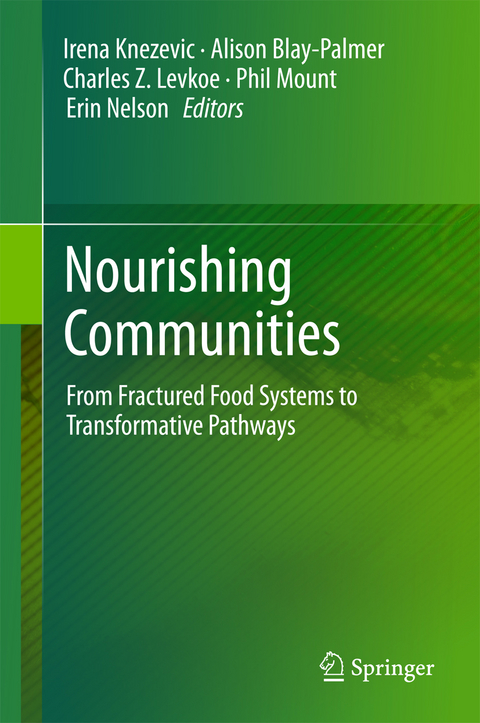
Nourishing Communities (eBook)
XXIII, 206 Seiten
Springer-Verlag
978-3-319-57000-6 (ISBN)
Nourishing Communities: From Fractured Food Systems to Transformative Pathways is the product of more than a decade of collaborative work by a network of scholars, community-based partners and practitioners interested in constructing more sustainable just food systems. Established in 2007, the Nourishing Communities research network aimed to foster direct connections between university- and community-based actors, and to draw on tools rooted in both theory and practice to support food system transformation. The organization's early work was based primarily in the province of Ontario, Canada, where it explored a wide range of sustainable food systems initiatives in an effort to better understand their successes, innovations and challenges, and make their experiences more accessible to a wider audience. Drawing on the varied backgrounds and areas of expertise of the network’s first members, the group has adopted an interdisciplinary approach, and collaborated closely with regionally-anchored community organizations, businesses, and government personnel representing the inter-related actors that comprise a food system.
Preface Introduction Section I: Need for TransformationsChapter 1 Connecting Food Access and Housing Security: Lessons from Peterborough, OntarioPatricia Ballamingie, Peter Andrée, Mary Anne Martin and Julie PilsonChapter 2 Strengthening the Backbone: Local Food, Foreign Labour and Social JusticeJanet MclaughlinChapter 3 Community Food Security in Pictou Landing First NationPictou Landing First Nation and Irena KnezevicChapter 4 The Us Experience in Planning for Community Food Systems: An Era of Advocacy, Awareness, and (Some) LearningSamina Raja, Subhashni Raj and Bartholomew RobertsSection II: Pathways to Transformation Chapter 5 Can Community-Based Initiatives Address the Conundrum Of Improving Household Food Access While Supporting Local Smallholder Farmer Livelihoods?Peter Andrée, Patricia Ballamingie, Stephen Piazza and Scott JarosiewiczChapter 6 Nourishing Learning Environments: School Food Gardens and Sustainable Food SystemsElizabeth Nowatschin, Karen Landman and Erin NelsonChapter 7 Using a Complexity Lens to Address Local Food Dilemmas in Northern Ontario: The Viability of Crowdsourcing and CrowdfundingMirella Stroink, Connie H. Nelson and Adam C. DavisChapter 8 The Local Food Policy Audit: Spanning the Civic-Political Agrifood DivideJill K. Clark, Caitlin Marquis and Samina RajaChapter 9 Supply Management as Food SovereigntyPhil MountChapter 10Navigating Spaces For Political Action: Victories And Compromises for Mexico’s Local Organic MovementErin Nelson and Laura Gómez TovarChapter 11 Communities of Food Practice: Regional Networks As Strategic Tools for Food Systems TransformationCharles Z. LevkoePostscript
| Erscheint lt. Verlag | 10.6.2017 |
|---|---|
| Zusatzinfo | XXIII, 206 p. 11 illus., 7 illus. in color. |
| Verlagsort | Cham |
| Sprache | englisch |
| Themenwelt | Sozialwissenschaften ► Pädagogik ► Sozialpädagogik |
| Sozialwissenschaften ► Politik / Verwaltung | |
| Technik | |
| Schlagworte | Community-based research • Democratic Citizenship • Ecological regeneration • participatory action research • Social Equity • Sustainable food systems |
| ISBN-10 | 3-319-57000-5 / 3319570005 |
| ISBN-13 | 978-3-319-57000-6 / 9783319570006 |
| Informationen gemäß Produktsicherheitsverordnung (GPSR) | |
| Haben Sie eine Frage zum Produkt? |
 PDF (Wasserzeichen)
DRM: Digitales Wasserzeichen
Dieses eBook enthält ein digitales Wasserzeichen und ist damit für Sie personalisiert. Bei einer missbräuchlichen Weitergabe des eBooks an Dritte ist eine Rückverfolgung an die Quelle möglich.
Dateiformat: PDF (Portable Document Format)
Mit einem festen Seitenlayout eignet sich die PDF besonders für Fachbücher mit Spalten, Tabellen und Abbildungen. Eine PDF kann auf fast allen Geräten angezeigt werden, ist aber für kleine Displays (Smartphone, eReader) nur eingeschränkt geeignet.
Systemvoraussetzungen:
PC/Mac: Mit einem PC oder Mac können Sie dieses eBook lesen. Sie benötigen dafür einen PDF-Viewer - z.B. den Adobe Reader oder Adobe Digital Editions.
eReader: Dieses eBook kann mit (fast) allen eBook-Readern gelesen werden. Mit dem amazon-Kindle ist es aber nicht kompatibel.
Smartphone/Tablet: Egal ob Apple oder Android, dieses eBook können Sie lesen. Sie benötigen dafür einen PDF-Viewer - z.B. die kostenlose Adobe Digital Editions-App.
Buying eBooks from abroad
For tax law reasons we can sell eBooks just within Germany and Switzerland. Regrettably we cannot fulfill eBook-orders from other countries.
aus dem Bereich