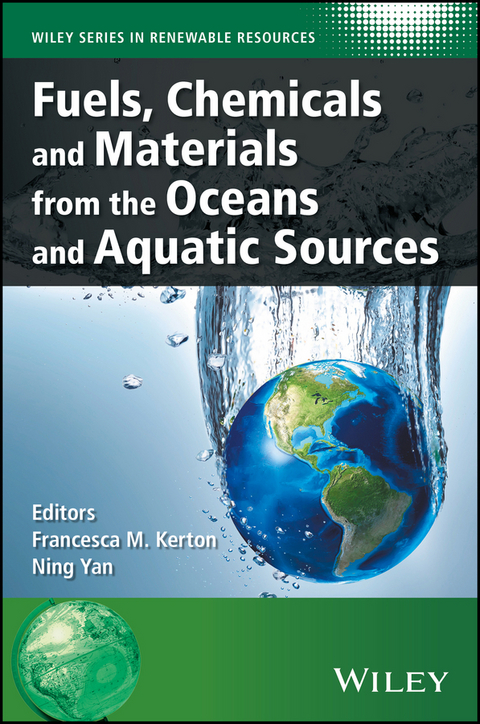
Fuels, Chemicals and Materials from the Oceans and Aquatic Sources (eBook)
John Wiley & Sons (Verlag)
978-1-119-11717-9 (ISBN)
Fuels, Chemicals and Materials from the Oceans and Aquatic Sources provides a holistic view of fuels, chemicals and materials from renewable sources in the oceans and other aquatic media. It presents established and recent results regarding the use of water-based biomass, both plants and animals,for value-added applications beyond food.
The book begins with an introductory chapter which provides an overview of ocean and aquatic sources for the production of chemicals and materials. Subsequent chapters focus on the use of various ocean bioresources and feedstocks, including microalgae, macroalgae, and waste from aquaculture and fishing industries, including fish oils, crustacean and mollusc shells.
Fuels, Chemicals and Materials from the Oceans and Aquatic Sources serves as a valuable reference for academic and industrial professionals working on the production of chemicals, materials and fuels from renewable feedstocks. It will also prove useful for researchers in the fields of green and sustainable chemistry, marine sciences and biotechnology.
Topics covered include:
• Production and conversion of green macroalgae
• Marine macroalgal biomass as an energy feedstock
• Microalgae bioproduction
• Bioproduction and utilization of chitin and chitosan
• Applications of mollusc shells
• Crude fish oil as a potential fuel
Editors
Francesca M. Kerton, Department of Chemistry, Memorial University of Newfoundland, Canada
Ning Yan, Department of Chemical and Biomolecular Engineering, National University of Singapore, Singapore
Series Editor
Christian Stevens, Faculty of Bioscience Engineering, Ghent University, Belgium
Fuels, Chemicals and Materials from the Oceans and Aquatic Sources provides a holistic view of fuels, chemicals and materials from renewable sources in the oceans and other aquatic media. It presents established and recent results regarding the use of water-based biomass, both plants and animals,for value-added applications beyond food. The book begins with an introductory chapter which provides an overview of ocean and aquatic sources for the production of chemicals and materials. Subsequent chapters focus on the use of various ocean bioresources and feedstocks, including microalgae, macroalgae, and waste from aquaculture and fishing industries, including fish oils, crustacean and mollusc shells. Fuels, Chemicals and Materials from the Oceans and Aquatic Sources serves as a valuable reference for academic and industrial professionals working on the production of chemicals, materials and fuels from renewable feedstocks. It will also prove useful for researchers in the fields of green and sustainable chemistry, marine sciences and biotechnology. Topics covered include: Production and conversion of green macroalgae Marine macroalgal biomass as an energy feedstock Microalgae bioproduction Bioproduction and utilization of chitin and chitosan Applications of mollusc shells Crude fish oil as a potential fuel
Editors Francesca M. Kerton, Department of Chemistry, Memorial University of Newfoundland, Canada Ning Yan, Department of Chemical and Biomolecular Engineering, National University of Singapore, Singapore Series Editor Christian Stevens, Faculty of Bioscience Engineering, Ghent University, Belgium
Cover 1
Title Page 5
Copyright 6
Contents 7
List of Contributors 13
Series Preface 15
Preface 17
Chapter 1 Overview of Ocean and Aquatic Sources for the Production of Chemicals and Materials 19
1.1 Introduction 19
1.2 Shellfish-Based Biomass 21
1.2.1 Crustacean Shells 21
1.2.2 Mollusc Shells 25
1.3 Finfish-Based Biomass 27
1.4 Plant-Based Biomass 30
1.5 Summary and Outlook 31
References 32
Chapter 2 Production and Conversion of Green Macroalgae (Ulva spp.) 37
2.1 Production of Ulva Biomass 37
2.1.1 Land-Based Tank Culture in Kochi 38
2.1.2 Improvement for More Intensive Culture 43
2.2 Conversion of Ulva Biomass 45
2.2.1 Microwave-Assisted Hydrothermal Reaction of Biomass 46
2.2.2 Microwave-Assisted Conversion of Ulva Biomass 47
2.3 Conclusions 54
References 54
Chapter 3 A New Wave of Research Interest in Marine Macroalgae for Chemicals and Fuels: Challenges and Potentials 61
3.1 Introduction 61
3.2 Macroalgal Feedstock for Chemicals 62
3.3 Marine Macroalgae as a Biorefinery Feedstock 63
3.4 Marine Macroalgal Biomass as an Energy Feedstock 64
3.4.1 Bioethanol 65
3.4.2 Biodiesel 66
3.4.3 Biobutanol 66
3.4.4 Bio-oil 73
3.5 Advances in Cultivation Technology 73
3.6 Marine Algal Cultivation for CO2 Sequestration 74
3.7 Opportunities, Challenges and Conclusions 75
References 76
Chapter 4 Kappaphycus alvarezii: A Potential Sustainable Resource for Fertilizers and Fuels 83
4.1 Introduction 83
4.2 Composition and Processing of Kappaphycus alvarezii 84
4.3 Simultaneous Production of Liquid Fertilizer (??????-Sap) and ??????-Carrageenan from Fresh Kappaphycus alvarezii Seaweed 86
4.4 ??????-Sap as Potential Plant Stimulant 87
4.5 Manipulation of ??????-Sap for Sustainable Biomass Intensification of Maize 89
4.6 Bioethanol Production from Kappaphycus alvarezii 90
4.6.1 Pretreatment of Freshly Harvested Biomass 92
4.6.2 Hydrolysis of the Dry Biomass to Obtain Fermentable Sugars 92
4.6.3 Pretreatment of Hydrolysate to Reduce the Concentration of Fermentation Inhibitory Components 92
4.6.4 Enzymatic Fermentation of the Hydrolysate to Yield Ethanol 94
4.6.5 Purification of Ethanol from Fermentation Broth 95
4.7 Fuel Intermediates and Useful Chemical from Kappaphycus alvarezii 95
4.8 Environmental Impact of Fuel and Fertilizers Production from Kappaphycus alvarezii 97
4.9 Conclusion and Future Prospect 97
Acknowledgement 97
References 98
Chapter 5 Microalgae Bioproduction - Feeds, Foods, Nutraceuticals, and Polymers 101
5.1 Introduction 101
5.2 Microalgae and Bioproduction Methods 103
5.2.1 Microalgae Groups Considered 103
5.2.2 Bioproduction of Microalgae - Methods 104
5.3 Microalgae Feedstock Products and Coproducts 112
5.3.1 Microalgae as Animal Feed 112
5.3.2 Microalgae as a Human Food Source 113
5.3.3 Microalgae in Nutraceuticals 114
5.3.4 Biopolymers from Microalgae 116
5.4 Conclusion - The Path Forward 120
Acknowledgments 121
References 121
Chapter 6 Innovations in Crustacean Processing: Bioproduction of Chitin and Its Derivatives 131
6.1 Introduction 131
6.2 Innovations in Crustacean Processing 133
6.2.1 Conventional Processing Technologies 133
6.2.2 Innovations in Crustacean Processing 140
6.3 Utilization of Marine By-Products 146
6.3.1 Processing Technologies for Crustacean By-Products 147
6.3.2 A Biorefinery Approach for Value-Chain Optimization of Crustacean Biomass Waste 148
6.4 Bioproduction of Chitin and Its Derivatives 150
6.4.1 Background 150
6.4.2 Isolation and Extraction of Chitin and Chitosan 152
6.4.3 Non-chemical Structural Modifications of Chitin and Chitosan 157
6.5 Conclusions 159
References 161
Chapter 7 Recent Progress in the Utilization of Chitin/Chitosan for Chemicals and Materials 169
7.1 Structure, Source and Properties of Chitin/Chitosan 169
7.2 Isolation and Purification of Chitin/Chitosan 171
7.3 Derivatives of Chitin/Chitosan 173
7.4 Utilization of Chitin/Chitosan for Chemicals and Materials 174
7.4.1 Utilization of Chitin/Chitosan for Chemicals 174
7.4.2 Utilization of Chitin/Chitosan for Materials 188
7.5 Closing Remark and Perspectives 197
References 198
Chapter 8 Characterization and Utilization of Waste Streams from Mollusc Aquaculture and Fishing Industries 207
8.1 Introduction 207
8.2 Processing and Characterization of Mollusc Shells 210
8.2.1 Processing Technologies 210
8.2.2 Characterization of Shells 213
8.3 Applications of Mollusc Shells 217
8.3.1 Soil Amendment 219
8.3.2 Treatment of Metal Contamination and Acid Mine Drainage 220
8.3.3 Phosphate Removal and Water Purification 226
8.3.4 Building Materials 230
8.3.5 Mollusc-Derived Calcium Oxide in Catalysis 237
8.4 Conclusions 242
References 243
Chapter 9 Fish Processing Waste Streams as a Feedstock for Fuels 247
9.1 Introduction 247
9.2 Fish Processing By-Product 248
9.3 Chemical and Physical Properties of Crude Fish Oil 249
9.3.1 Chemical Composition of Crude Fish Oil 251
9.4 Oil Recovery Processes and Parameters 254
9.4.1 Physical/Thermal Separation Processes 254
9.4.2 Chemical Extraction Processes 256
9.4.3 Biological/Chemical Hydrolysis and Fermentation 262
9.4.4 Purification 263
9.4.5 Preservation of Feedstock and the Recovered Oil 264
9.5 Fuel Properties of Crude and Refined Fish Oils 265
9.5.1 Rheological Properties 265
9.5.2 Chemical Properties Affecting Fuel Quality 266
9.5.3 Thermal Properties 267
9.5.4 Other Fuel Properties 268
9.6 Performance of Crude Fish Oil as a Fuel 269
9.7 Upgrading Marine Crude Bio-Oil 269
9.7.1 Types of Refined Fish Oil Products 270
9.7.2 Transesterification 273
9.7.3 Pyrolysis 276
9.7.4 Microemulsification 276
9.7.5 Alternative Processes 277
9.8 Emission Comparison for Bio-Oils 277
9.8.1 Crude Fish Oil 279
9.8.2 Fish Biodiesel 280
9.8.3 Biogas from Fish Waste 281
9.8.4 Fish Biofuels from Other Processes 282
9.9 Comparison of Crude Oil and Refined Oil Performance as a Fuel 283
9.10 Comparison of Fish Biofuels 286
9.11 Summary 286
References 287
Index 295
EULA 305
| Erscheint lt. Verlag | 22.5.2017 |
|---|---|
| Reihe/Serie | Wiley Series in Renewable Resource | Wiley Series in Renewable Resources |
| Sprache | englisch |
| Themenwelt | Naturwissenschaften ► Chemie ► Organische Chemie |
| Technik ► Elektrotechnik / Energietechnik | |
| Schlagworte | aquaculture waste • aquatic animals • aquatic chemicals • aquatic chemical sources • aquatic fuels • aquatic materials • aquatic material sources • aquatic media • Aquatic Plants • Biotechnologie • Biotechnologie i. d. Chemie • Biotechnology • Chemical Production • chemicals • Chemie • Chemistry • chitin bioproduction • chitosan bioproduction • crude fish oil • crustacean shells • earth sciences • energy feedstock • fishing industries waste • fish oil fuel • Fish oils • fuels • Geowissenschaften • Green chemistry • green macroalgae conversion • green macroalgae production • Grüne Chemie • macroalgae • marine macroalgal biomass • Marine Sciences • material production • microalgae • microalgae bioproduction • mollusc shells • Nachhaltige u. Grüne Chemie • ocean animals • ocean bioresources • ocean chemicals • ocean chemical sources • ocean feedstocks • ocean fuels • ocean Materials • ocean material sources • Oceanography & Paleoceanography • ocean plants • Oceans • Ozeanographie • Ozeanographie u. Paläozeanographie • Renewable feedstocks • renewable sources in the oceans • Sustainable chemistry • Sustainable Chemistry & Green Chemistry • water-based biomass |
| ISBN-10 | 1-119-11717-8 / 1119117178 |
| ISBN-13 | 978-1-119-11717-9 / 9781119117179 |
| Informationen gemäß Produktsicherheitsverordnung (GPSR) | |
| Haben Sie eine Frage zum Produkt? |
 PDF (Adobe DRM)
Kopierschutz: Adobe-DRM
Adobe-DRM ist ein Kopierschutz, der das eBook vor Mißbrauch schützen soll. Dabei wird das eBook bereits beim Download auf Ihre persönliche Adobe-ID autorisiert. Lesen können Sie das eBook dann nur auf den Geräten, welche ebenfalls auf Ihre Adobe-ID registriert sind.
Details zum Adobe-DRM
Dateiformat: PDF (Portable Document Format)
Mit einem festen Seitenlayout eignet sich die PDF besonders für Fachbücher mit Spalten, Tabellen und Abbildungen. Eine PDF kann auf fast allen Geräten angezeigt werden, ist aber für kleine Displays (Smartphone, eReader) nur eingeschränkt geeignet.
Systemvoraussetzungen:
PC/Mac: Mit einem PC oder Mac können Sie dieses eBook lesen. Sie benötigen eine
eReader: Dieses eBook kann mit (fast) allen eBook-Readern gelesen werden. Mit dem amazon-Kindle ist es aber nicht kompatibel.
Smartphone/Tablet: Egal ob Apple oder Android, dieses eBook können Sie lesen. Sie benötigen eine
Geräteliste und zusätzliche Hinweise
Buying eBooks from abroad
For tax law reasons we can sell eBooks just within Germany and Switzerland. Regrettably we cannot fulfill eBook-orders from other countries.
aus dem Bereich