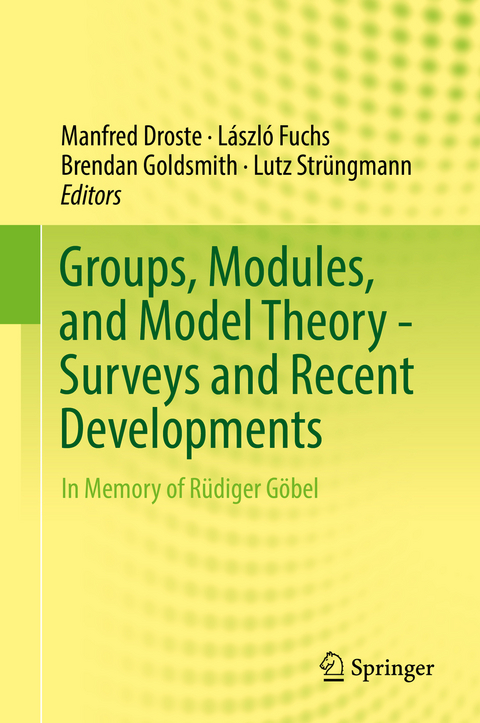
Groups, Modules, and Model Theory - Surveys and Recent Developments (eBook)
XXXIV, 475 Seiten
Springer International Publishing (Verlag)
978-3-319-51718-6 (ISBN)
Manfred Droste is Professor and Head of the Automata and Formal Languages Research Group in the Department of Computer Science at the University of Leipzig. His research interests include such theoretical computer science topics as automata theory, logic, algebraic models for concurrent systems, and domain theory, and such mathematical topics as model theory, automorphism groups, and ordered algebraic structures. He is editor of the Handbook of Weighted Automata.László Fuchs is the Evelyn and John G. Phillips Distinguished Professor Emeritus in Mathematics at Tulane University. He was awarded the Kossuth Prize in 1953 and is a foreign member of the Hungarian Academy of Sciences. His research interests include abelian groups, commutative domains and their modules. He is the author of numerous publications, including Abelian Groups (Springer Monographs in Mathematics). Brendan Goldsmith is Research Director at the School of Mathematical Sciences of the Dublin Institute of Technology. Formerly, he served as Head of the School of Mathematics and President of DIT. His research interests include group theory and generalizations, commutative algebra, associative rings and algebras, and mathematical logic.Lutz Strüngmann is Professor of Mathematics at the University of Duisberg-Essen. He has authored 56 publications since 1999 in the fields of group theory and generalizations, mathematical logic, commutative algebra and associative rings and algebras.
Preface 6
Contents 8
List of Contributors 11
Rüdiger Göbel—An Appreciation 14
References 18
Personal Comments 18
Students of Rüdiger Göbel 19
Books by Rüdiger Göbel 20
Books Edited by Rüdiger Göbel 20
Publication List of Rüdiger Göbel 21
Papers by Rüdiger Göbel `In Preparation' 31
Part I Survey Articles 32
Properties of Abelian Groups Determined by TheirEndomorphism Ring 33
1 Introduction 33
2 Adjoint Functors 35
3 Realization Theorems 39
4 Torsion-Free Abelian Groups 42
5 Applications 45
References 50
The Zero-Divisor Graph of a Commutative Semigroup: A Survey 53
1 Introduction 53
2 Examples of Zero-Divisor Graphs 55
3 Some Properties of the Zero-Divisor Graph G(S) 56
4 The Number of Zero-Divisor Semigroups 61
5 Other Results 65
References 66
A Remak-Krull-Schmidt Class of Torsion-Free Abelian Groups 70
1 Introduction 71
2 Matrices 74
3 Homocyclic ((1,n),pk)-Groups and Coordinate Matrices 74
4 Standard Coordinate Matrices 76
5 Indecomposable Groups in the Class of Homocyclic ((1,5),p3)-Groups 80
6 The Class of Homocyclic ((1,5),p3)-Groups is Bounded 83
References 97
Rigid ?1-Free Abelian Groups with Prescribed Factors and Their Role in the Theory of Cellular Covers 98
1 Introduction 98
2 Overview of Cellular Covers 100
3 Preliminaries 102
4 Rigid ?1-Free Groups with Rational Groups as Prescribed Factor 102
5 Rigid ?1-Free Groups with Large Prescribed Factor 104
5.1 Black Box 104
5.2 Rigid ?1-Free Groups with Large Prescribed Factors 105
References 109
Definable Valuations Induced by Definable Subgroups 111
1 Introduction 111
2 Preliminaries 112
3 The Valuation Ring OG Induced by a Subgroup G 115
4 Criteria for the Non-Triviality of OG 118
5 Criteria for the Definability of OG 121
6 OG for Prime Powers and Artin Schreier Groups 127
References 135
Groups of Automorphisms of Totally Ordered Sets: Techniques, Model Theory and Applications to Decision Problems 137
1 Introduction and Motivation 137
2 Introductory Examples 138
3 Ordering 139
4 Multiple Transitivity 140
5 Conjugacy 141
6 Applications to Decision Problems for Lattice-Ordered Groups 143
7 Structure Theory 147
8 Model Theory 149
9 Amalgamation for Right-Orderable Groups 153
10 Applications to Decision Problems for Right Orderable Groups 155
11 Sketch of the Proof of Theorem 10.9 158
12 A Model-Theoretic Consequence 160
References 161
Algebraic Entropies for Abelian Groups with Applications to the Structure of Their Endomorphism Rings: A Survey 163
1 Introduction 163
2 Preliminaries 166
2.1 The R[X]-Module Associated with an Endomorphism of an R-Module 166
2.2 Cyclic Z[X]-Modules 167
2.3 Trajectories and Partial Trajectories 168
2.4 Invariants and Length Functions 169
3 Algebraic Entropies for Abelian Groups 171
3.1 Definition of the Algebraic Entropies 171
3.2 The Addition Theorem 175
3.3 Algebraic Yuzvinski Formulas and Uniqueness Theorems 179
3.4 Adjoint Algebraic Entropy, Hopficity and Co-Hopficity 182
3.5 Ent-Singular Submodules and Ent-Singular Modules 186
4 Applications to the Structure of Endomorphism Rings 190
4.1 The Three Faces of Algebraic Entropies 190
4.2 Endomorphism Rings of p-Groups 192
4.3 Endomorphism Rings of Torsion-Free Groups 195
5 Concluding Remarks 199
References 200
On Subsets and Subgroups Defined by Commutators and Some Related Questions 203
1 Introduction 203
2 Commutators and the Commutator Subgroup 204
3 Subsets Defined by Commutator Identities 206
4 The Set of Autocommutators and the Autocommutator Subgroup 209
5 The Set of Autocommutators and the Autocommutator Subgroup in Infinite Abelian Groups 211
6 Autocommutators and the Autocommutator Subgroup in Torsion-Free Groups with Finite Automorphism Group 213
References 215
Recent Progress in Module Approximations 218
1 Introduction 218
2 Preliminaries 219
2.1 Module Approximations 219
2.2 Tilting Theory 222
3 Boundaries of the Approximation Theory 224
3.1 Locally T-Free Modules 224
3.2 Tree Modules 225
3.3 Locally T-Free Modules and Approximations 227
3.4 Very Flat and Locally Very Flat Modules 228
4 Tilting and Silting Theory 230
4.1 Tilting Classes Over Commutative Rings 230
4.2 Silting Modules and Classes 232
4.3 Saorín's Problem 234
References 235
Part II Research Articles 237
A Class of Pure Subgroups of the Specker Group 238
1 Introduction 238
2 Definition and Preliminary Results 239
3 Inessential Homomorphisms: A Splitting Theorem 243
4 A Ring-Realization Theorem 246
References 248
Countable 1-Transitive Trees 249
1 Introduction 250
2 Strategy for Classifying Countable 1-Transitive Trees 256
3 A Class of Lower 1-Transitive Coloured Linear Orders 260
3.1 Finding a Tree Corresponding to a Coloured Linear Order 260
3.2 Coding Trees 264
3.3 Decoding a Coding Tree 268
3.4 Colour Lower Isomorphism Classes 275
4 Cones Types in 1-Transitive Trees 276
5 The Characterization 280
6 The Construction 284
References 291
On Ore's Theorem and Universal Words for Permutationsand Injections of Infinite Sets 293
1 Introduction 293
2 Background 294
3 The Main Result 295
4 Ore's Theorem and Universal Words 297
References 299
An Extension of M. C. R. Butler's Theorem on Endomorphism Rings 300
1 Introduction 300
2 The Results 301
2.1 The Proof of Theorem 1.1 302
2.2 The Proof of Theorem 2.1 303
References 307
The Jacobson Radical's Role in Isomorphism Theorems for p-Adic Modules Extends to Topological Isomorphism 308
1 Introduction 308
2 Parallels Between Isomorphism Theorems and Jacobson Radical Isomorphism Theorems 310
2.1 Torsion or Torsion-Free Modules 311
2.2 Isomorphism Theorems for Mixed Modules 312
2.3 Setting Isomorphism Theorems for Mixed Modules in the Cotorsion Hull of the Torsion Submodule 314
3 Topological Isomorphism Using the Finite Topology 315
4 The Background for a Topological Jacobson Radical Isomorphism Theorem for Mixed Modules 317
4.1 Ideals of the Endomorphism Ring 317
4.2 Embedding into the Cotorsion Hull using the Jacobson Radical 319
5 The Topological Jacobson Radical Isomorphism Theorem 319
5.1 The Hull M0 090d"0362 MM0
5.2 The Proof of the Theorem 321
References 323
A Note on Hieronymi's Theorem: Every Definably Complete Structure Is Definably Baire 324
1 Introduction 324
2 Preliminaries 327
3 Proof of Lemma 1.8 329
3.1 A Counterexample: The Forest Hypothesis is Necessary 330
4 Proof of Theorem 1.3 331
5 Proof of Theorem 1.2 332
5.1 The Case n = 1 333
5.2 The Inductive Step 336
References 337
Cotorsion and Tor Pairs and Finitistic Dimensions over Commutative Rings 339
1 Introduction 339
2 Definitions and Notations 341
3 Cotorsion Modules 343
4 The Case Fw.dim(Q) =0 346
5 The Case f.dim(Q)=0 347
6 The Case F.dim(Q)=0 349
References 351
Permutation Groups Without Irreducible Elements 353
1 Permutation Groups Without Irreducible Elements 353
Reference 354
R-Hopfian and L-co-Hopfian Abelian Groups (with an Appendixby A.L.S. Corner on Near Automorphisms of an Abelian Group) 355
1 Introduction 355
2 Elementary Results 358
3 Torsion Groups 362
Appendix: Near Automorphisms of an Abelian Group 366
A.L.S. Corner, Late of Worcester College, Oxford 366
Introductory Remarks 366
The Main Result 367
References 371
On the Abelianization of Certain Topologist's Products 372
1 Introduction 372
2 Historical Perspective 373
3 Preliminaries 374
4 Proof of Theorem 1.1 376
References 378
Some Remarks on dp-Minimal Groups 380
1 Introduction 380
2 ?-Categorical dp-Minimal Groups 381
2.1 Introduction 381
2.2 What we Get From ?-Categoricity 382
2.3 Equivalent Conditions for Being Nilpotent-by-Finite 382
2.4 What we Get From dp-Minimality and NIP 384
2.5 Proof of the Main Result 385
2.6 Concluding Remarks 386
2.7 A Theorem on NIP Groups 388
3 f-Generic is the Same as Strongly f-Generic 389
References 392
Square Subgroups of Decomposable Rank Three Groups 394
1 Introduction 394
2 Notation and Preliminaries 395
3 Main Results 397
References 405
An Invariant on Primary Abelian Groups with Applicationsto Their Projective Dimensions 406
1 Introduction 406
References 418
The Valuation Difference Rank of a Quasi-Ordered Difference Field 419
1 Introduction 420
2 The Rank of a Quasi-Ordered Field 421
3 The Principal Rank via Equivalence Relations 425
4 The Difference Analogue of the Rank 427
5 The ?-Rank and Principal ?-Rank via Equivalence Relations 431
References 433
The Lattice of U-Sequences of an Abelian p-Group 435
1 Introduction 435
2 Constructing Suprema of U-Sequences 436
3 Distributivity 444
4 Non-reduced Groups 445
References 447
Strongly Non-Singular Rings and Morita Equivalence 449
1 Torsion-Freeness and Non-Singularity Under Morita Equivalence 449
References 454
The Class of (2, 3)-Groups with Homocyclic Regulator Quotient of Exponent p2 455
1 Introduction 455
2 Coordinate Matrices 457
3 Standard Coordinate Matrices 458
References 466
Unbounded Monotone Subgroups of the Baer–Specker Group 468
1 Preliminaries 469
2 The Result 470
3 Technical Preparation 471
4 Construction of a Monotone Group Which is Not Comfortable 473
5 Final Remarks 476
References 476
Clusterization of Correlation Functions 477
1 Introduction 477
1.1 Cluster and Vertex Operator Algebras 478
Appendix 478
1.2 Correlation Functions of Genus Zero and One Riemann Surfaces 479
2 Cluster Structure for a Vertex Operator Algebra Correlation Functions 480
References 482
Index 483
| Erscheint lt. Verlag | 2.6.2017 |
|---|---|
| Zusatzinfo | XXXIV, 475 p. 30 illus. |
| Verlagsort | Cham |
| Sprache | englisch |
| Themenwelt | Mathematik / Informatik ► Mathematik |
| Technik | |
| Schlagworte | Abelian Groups • algebra and model theory • group theory • Mathematical Logic • model Theory |
| ISBN-10 | 3-319-51718-X / 331951718X |
| ISBN-13 | 978-3-319-51718-6 / 9783319517186 |
| Informationen gemäß Produktsicherheitsverordnung (GPSR) | |
| Haben Sie eine Frage zum Produkt? |
 PDF (Wasserzeichen)
DRM: Digitales Wasserzeichen
Dieses eBook enthält ein digitales Wasserzeichen und ist damit für Sie personalisiert. Bei einer missbräuchlichen Weitergabe des eBooks an Dritte ist eine Rückverfolgung an die Quelle möglich.
Dateiformat: PDF (Portable Document Format)
Mit einem festen Seitenlayout eignet sich die PDF besonders für Fachbücher mit Spalten, Tabellen und Abbildungen. Eine PDF kann auf fast allen Geräten angezeigt werden, ist aber für kleine Displays (Smartphone, eReader) nur eingeschränkt geeignet.
Systemvoraussetzungen:
PC/Mac: Mit einem PC oder Mac können Sie dieses eBook lesen. Sie benötigen dafür einen PDF-Viewer - z.B. den Adobe Reader oder Adobe Digital Editions.
eReader: Dieses eBook kann mit (fast) allen eBook-Readern gelesen werden. Mit dem amazon-Kindle ist es aber nicht kompatibel.
Smartphone/Tablet: Egal ob Apple oder Android, dieses eBook können Sie lesen. Sie benötigen dafür einen PDF-Viewer - z.B. die kostenlose Adobe Digital Editions-App.
Buying eBooks from abroad
For tax law reasons we can sell eBooks just within Germany and Switzerland. Regrettably we cannot fulfill eBook-orders from other countries.
aus dem Bereich