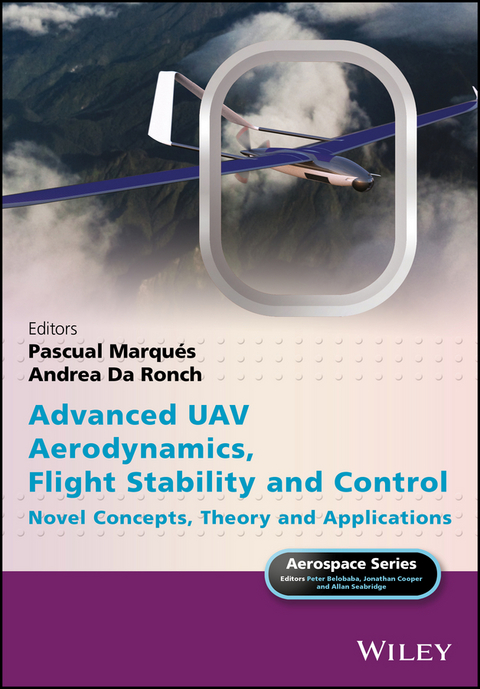
Advanced UAV Aerodynamics, Flight Stability and Control (eBook)
John Wiley & Sons (Verlag)
978-1-118-92871-4 (ISBN)
Comprehensively covers emerging aerospace technologies
Advanced UAV aerodynamics, flight stability and control: Novel concepts, theory and applications presents emerging aerospace technologies in the rapidly growing field of unmanned aircraft engineering. Leading scientists, researchers and inventors describe the findings and innovations accomplished in current research programs and industry applications throughout the world. Topics included cover a wide range of new aerodynamics concepts and their applications for real world fixed-wing (airplanes), rotary wing (helicopter) and quad-rotor aircraft.
The book begins with two introductory chapters that address fundamental principles of aerodynamics and flight stability and form a knowledge base for the student of Aerospace Engineering. The book then covers aerodynamics of fixed wing, rotary wing and hybrid unmanned aircraft, before introducing aspects of aircraft flight stability and control.
Key features:
- Sound technical level and inclusion of high-quality experimental and numerical data.
- Direct application of the aerodynamic technologies and flight stability and control principles described in the book in the development of real-world novel unmanned aircraft concepts.
- Written by world-class academics, engineers, researchers and inventors from prestigious institutions and industry.
The book provides up-to-date information in the field of Aerospace Engineering for university students and lecturers, aerodynamics researchers, aerospace engineers, aircraft designers and manufacturers.
Dr. Pascual Marqués, President of Marques Aviation Ltd., UK holds an MPhil and a PhD degree in Engineering Mechanics. At Marques Aviation, Dr. Marqués oversees the design, R&D, and manufacturing of the MA THOR unmanned aircraft series. His research interests lie in the fields of Aerodynamics at low Reynolds numbers and Flight Stability. His research projects involve the implementation of theoretical aerodynamics. Wing aerodynamic efficiency in UAVs is optimized by adjustment of wing planform and Oswald efficiency, incorporation of flow control devices, modification of tip vortex configuration, and application of optimized geometric and/or aerodynamic twist. Flight stability is enhanced using principles of aeroelasticity, adaptive wing technology, and automated flight control. Dr. Marqués is the Editor-in-Chief of the International Journal of Unmanned Systems Engineering, and Chair of the World Congress on Unmanned Systems Engineering and the International Aerospace Engineering Conference.
Dr. Andrea Da Ronch, University of Southampton, UK
Alongside the academic position at the University of Southampton, Dr Andrea Da Ronch is seconded to Airbus Operations Ltd through a Royal Academic of Engineering grant. He is also a visiting academic at Beihang University (Beijing, China) and at Pontif??cia Universidade Católica do Rio Grande do Sul (Porto Alegre, Brazil). His research interests are in CFD methods for aeroelasticity and flight dynamics, and in the development of nonlinear model reduction techniques for large computational models. The impact of his research activities has a significant international visibility within the aeroelastic and aircraft design communities, reflecting his key role in the development of a number of software tools. The initial involvement with the 'Next generation Conceptual Aero-Structural Sizing' (NeoCASS) has now been superseded by an active role in the development of the 'Computerised Environment for Aircraft Synthesis and Integrated Optimisation Methods' (CEASIOM) software, considered as one of the world's most advanced tools for multi-fidelity integrated aircraft design.
Comprehensively covers emerging aerospace technologies Advanced UAV aerodynamics, flight stability and control: Novel concepts, theory and applications presents emerging aerospace technologies in the rapidly growing field of unmanned aircraft engineering. Leading scientists, researchers and inventors describe the findings and innovations accomplished in current research programs and industry applications throughout the world. Topics included cover a wide range of new aerodynamics concepts and their applications for real world fixed-wing (airplanes), rotary wing (helicopter) and quad-rotor aircraft. The book begins with two introductory chapters that address fundamental principles of aerodynamics and flight stability and form a knowledge base for the student of Aerospace Engineering. The book then covers aerodynamics of fixed wing, rotary wing and hybrid unmanned aircraft, before introducing aspects of aircraft flight stability and control. Key features: Sound technical level and inclusion of high-quality experimental and numerical data. Direct application of the aerodynamic technologies and flight stability and control principles described in the book in the development of real-world novel unmanned aircraft concepts. Written by world-class academics, engineers, researchers and inventors from prestigious institutions and industry. The book provides up-to-date information in the field of Aerospace Engineering for university students and lecturers, aerodynamics researchers, aerospace engineers, aircraft designers and manufacturers.
Dr. Pascual Marqués, President of Marques Aviation Ltd., UK holds an MPhil and a PhD degree in Engineering Mechanics. At Marques Aviation, Dr. Marqués oversees the design, R&D, and manufacturing of the MA THOR unmanned aircraft series. His research interests lie in the fields of Aerodynamics at low Reynolds numbers and Flight Stability. His research projects involve the implementation of theoretical aerodynamics. Wing aerodynamic efficiency in UAVs is optimized by adjustment of wing planform and Oswald efficiency, incorporation of flow control devices, modification of tip vortex configuration, and application of optimized geometric and/or aerodynamic twist. Flight stability is enhanced using principles of aeroelasticity, adaptive wing technology, and automated flight control. Dr. Marqués is the Editor-in-Chief of the International Journal of Unmanned Systems Engineering, and Chair of the World Congress on Unmanned Systems Engineering and the International Aerospace Engineering Conference. Dr. Andrea Da Ronch, University of Southampton, UK Alongside the academic position at the University of Southampton, Dr Andrea Da Ronch is seconded to Airbus Operations Ltd through a Royal Academic of Engineering grant. He is also a visiting academic at Beihang University (Beijing, China) and at Pontif??cia Universidade Católica do Rio Grande do Sul (Porto Alegre, Brazil). His research interests are in CFD methods for aeroelasticity and flight dynamics, and in the development of nonlinear model reduction techniques for large computational models. The impact of his research activities has a significant international visibility within the aeroelastic and aircraft design communities, reflecting his key role in the development of a number of software tools. The initial involvement with the "Next generation Conceptual Aero-Structural Sizing" (NeoCASS) has now been superseded by an active role in the development of the "Computerised Environment for Aircraft Synthesis and Integrated Optimisation Methods" (CEASIOM) software, considered as one of the world's most advanced tools for multi-fidelity integrated aircraft design.
Title Page 5
Copyright Page 6
Contents 9
List of Contributors 13
Series Preface 15
Preface 17
Companion Website 19
Chapter 1 Advanced UAV Aerodynamics, Flight Stability and Control:: An Introduction 21
1.1 Unmanned Aircraft Aerodynamics 21
1.2 UAV Flight Stability and Control 40
Chapter 2 Aerodynamics of UAV Configurations 51
2.1 Introduction 51
2.2 Emerging Technologies in UAV Aerodynamics 51
2.3 Aerodynamics and Stealth Compromises 52
2.4 Rotor Blade Tip Aerodynamics 53
2.5 Flight Dynamics of Canard Aircraft 55
2.6 Aerodynamics of the UCAV 1303 Delta?wing Configuration 60
2.7 Flow Structure Modification using Plasma Actuators 62
2.8 Conclusion 64
References 64
Part I Novel Concepts in Unmanned Aircraft Aerodynamics 67
1.1 Fixed-wing (airplanes) 67
Chapter 3 Aerodynamic Performance Analysis of Three Different Unmanned Re-entry Vehicles 69
3.1 Introduction 69
3.2 Vehicle Description 82
3.3 Flight Scenario and Flow?regime Assessment 84
3.4 Rarefied and Transitional Regimes 87
3.5 Viscous-interaction Regime 87
3.6 High-temperature Real-gas Regime 88
3.7 Laminar-to-turbulent Transition Assessment 91
3.8 Design Approach and Tools 98
3.9 Aerodynamic Characterization 112
3.10 Low-order Methods Aerodynamic Results 120
3.11 CFD-based Aerodynamic Results 137
References 158
Chapter 4 Nonlinear Reduced-order Aeroservoelastic Analysis of Very Flexible Aircraft 163
4.1 Introduction 164
4.2 Large Coupled Computational Models 167
4.3 Coupled Reduced-order Models 177
4.4 Control System Design 187
4.5 Conclusion 196
4.6 Exercises 197
References 197
Chapter 5 Unmanned Aircraft Wind Tunnel Testing 201
5.1 Introduction 201
5.2 The Diana UAV Project 202
5.3 Experimental Facility 203
5.4 Force and Moment Measurements 203
5.5 Wind Tunnel and CFD Comparisons 212
5.6 Flow Visualization 215
5.7 Summary and Conclusions 218
Acknowledgments 219
References 219
Chapter 6 Chord-dominated Ground-effect Aerodynamics of Fixed-wing UAVs 221
6.1 Introduction 221
6.2 Categories of Ground Effect 222
6.3 Chord-dominated Static Ground Effect 223
6.4 Chord-dominated Dynamic Ground Effect 248
6.5 Chord-dominated Mutational Ground Effect 260
Acknowledgments 273
References 273
1.2 Rotary-wing (helicopter) 275
Chapter 7 Dynamics Modelling and System Identification of Small Unmanned Helicopters 277
7.1 Introduction 277
7.2 Model Development 279
7.3 System Identification 289
7.4 Basic Control Design 298
7.5 Conclusion 301
Bibliography 301
Chapter 8 Aerodynamic Derivative Calculation Using Radial Basis Function Neural Networks 303
8.1 Introduction 303
8.2 Helicopter Aerodynamic Derivatives 305
8.3 Radial Basis Function Neural Networks 307
8.4 The Delta Method 308
8.5 Parameter Estimation Using Simulated Data 311
8.6 Parameter Estimation Using Flight Data 317
8.7 Delta Method with Flight Data 318
8.8 Summary 324
Acknowledgements 325
References 325
Chapter 9 Helicopter BERP Tip: Literature Review of Helicopter Blade Shape Optimisation Methods 329
9.1 Introduction 329
9.2 Literature Review 330
9.3 Summary 357
Bibliography 357
Chapter 10 Framework for the Optimisation of a Helicopter Rotor Blade with an Approximate BERP Tip: Numerical Methods and Application 365
10.1 Introduction 365
10.2 Numerical Methods 366
10.3 Optimisation Method 368
10.4 Parameterisation Technique 390
10.5 Grid and Geometry Generation 394
10.6 Flight Conditions 395
10.7 Hover Results 396
10.8 Forward Flight Results 399
10.9 Planform Optimisation 405
10.10 Summary and Conclusions 413
Bibliography 416
Chapter 11 Active Blade Twist in Rotary UAVs using Smart Actuation 419
11.1 Introduction 419
11.2 Actuation Concepts 422
11.3 Integral Twist Actuation 429
11.4 Summary 436
References 438
1.3 Hybrid Aircraft 441
Chapter 12 Hybrid Aircraft Aerodynamics and Aerodynamic Design Considerations of Hover-to-Dash Convertible UAVs 443
12.1 Why Hover-to-Dash Conversion is Important 443
12.2 Aircraft Mission Profiles and Sizing Chart Structure 448
12.3 Convertible Coleopter Design, Wind Tunnel and Flight Testing 451
12.4 Future: Convertible QuadCopter Design and Flight Testing 460
12.5 The Extreme: Hover-to-Supersonic Dash Aircraft 461
References 464
PART II Novel Concepts in Unmanned Aircraft Flight Stability and Control 467
2.1 Fixed-wing (airplanes) 467
Chapter 13 Closed-loop Active Flow Control for UAVs 469
13.1 Introduction 469
13.2 Objectives 470
13.3 Actuators 470
13.4 Linear System 473
13.5 Plant Model Identification 474
13.6 Controller Architecture 478
13.7 Conclusions 481
Acknowledgement 482
References 482
Chapter 14 Autonomous Gust Alleviation in UAVs 485
14.1 Introduction 485
14.2 The Composite Spar 486
14.3 The Energy-harvesting and Storage Component 495
14.4 Reduced Energy Control Law 498
14.5 Gust Modelling 499
14.6 Experimental Validation 502
14.7 Performance 504
14.8 Other Considerations 508
14.9 Summary and Discussion 511
Acknowledgement 512
References 512
Chapter 15 Virtual Flight Simulation using Computational Fluid Dynamics 515
15.1 Introduction 515
15.2 Aerodynamic Model for Flight Simulation 525
15.3 Generation of Tabular Aerodynamic Model 534
15.4 Time-accurate CFD for Flight Simulations 555
15.5 Conclusions 563
References 563
Chapter 16 Flow Structure Modification Using Plasma Actuation for Enhanced UAV Flight Control 567
16.1 Introduction 567
16.2 Aerodynamic Flow Control 569
16.3 Plasma Actuators 570
16.4 Dielectric Barrier Discharge 573
16.5 Experimental Setup 581
16.6 Results and Analysis 586
16.7 Conclusions 593
Acknowledgments 593
References 593
Chapter 17 Constrained Motion Planning and Trajectory Optimization for Unmanned Aerial Vehicles 597
17.1 Introduction 597
17.2 UAV Dynamics and Internal Constraints 599
17.3 Environmental Constraints 609
17.4 Off-line CMP 612
17.5 Real-time CMP 615
17.6 Variable Objective CMP 622
17.7 Summary and Conclusions 627
References 629
Chapter 18 Autonomous Space Navigation Using Nonlinear Filters with MEMS Technology 633
18.1 Introduction and Problem Statement 633
18.2 Concurrent Orbit and Attitude Determination 634
18.3 Concurrent Attitude and System Identification 653
18.4 Summary and Conclusions 662
References 663
Chapter 19 Adaptive Fault-tolerant Attitude Control for Spacecraft Under Loss of Actuator Effectiveness 665
19.1 Introduction 665
19.2 Mathematical Model of Flexible Spacecraft and Problem Formulation 667
19.3 Adaptive Backstepping Fault-Tolerant Controller Design 668
19.4 Numerical Simulations 676
19.5 Conclusion 682
References 684
2.2 Quad-rotor Aircraft 687
Chapter 20 Novel Concepts in Multi-rotor VTOL UAV Dynamics and Stability 689
20.1 Introduction 689
20.2 Multi-rotors 691
20.3 Novel Quad-rotor Concepts 699
20.4 Conclusions 713
References 714
Further reading 714
Chapter 21 System Identification and Flight Control of an Unmanned Quadrotor 715
21.1 Introduction 715
21.2 Quadrotor System and Experimental Infrastructure Overview 716
21.3 System Identification Using CIFER 723
21.4 Flight Testing 725
21.5 System Identification Results and Discussion 729
21.6 Controller Modeling and Validation 737
21.7 Controller Optimization in CONDUIT 739
21.8 Conclusion 746
References 747
Index 749
Supplemental Images 775
EULA 787
| Erscheint lt. Verlag | 19.4.2017 |
|---|---|
| Reihe/Serie | Aerospace Series | Aerospace Series (PEP) |
| Mitarbeit |
Herausgeber (Serie): Peter Belobaba, Jonathan Cooper, Allan Seabridge |
| Sprache | englisch |
| Themenwelt | Technik ► Fahrzeugbau / Schiffbau |
| Technik ► Luft- / Raumfahrttechnik | |
| Technik ► Maschinenbau | |
| Schlagworte | aerodynamics • Aerodynamik • Aeronautic & Aerospace Engineering • Aero-servo-elasticity • Control • Electrical & Electronics Engineering • Elektrotechnik u. Elektronik • Gust alleviation • Luft- u. Raumfahrttechnik • Maschinenbau • Maschinenbau - Entwurf • mechanical engineering • Mechanical Engineering - Design • Optimization • quadrotor • Rotor blade • spacecraft • Systems Engineering & Management • Systemtechnik • Systemtechnik u. -management • UAV • unmanned |
| ISBN-10 | 1-118-92871-7 / 1118928717 |
| ISBN-13 | 978-1-118-92871-4 / 9781118928714 |
| Informationen gemäß Produktsicherheitsverordnung (GPSR) | |
| Haben Sie eine Frage zum Produkt? |
 PDF (Adobe DRM)
Kopierschutz: Adobe-DRM
Adobe-DRM ist ein Kopierschutz, der das eBook vor Mißbrauch schützen soll. Dabei wird das eBook bereits beim Download auf Ihre persönliche Adobe-ID autorisiert. Lesen können Sie das eBook dann nur auf den Geräten, welche ebenfalls auf Ihre Adobe-ID registriert sind.
Details zum Adobe-DRM
Dateiformat: PDF (Portable Document Format)
Mit einem festen Seitenlayout eignet sich die PDF besonders für Fachbücher mit Spalten, Tabellen und Abbildungen. Eine PDF kann auf fast allen Geräten angezeigt werden, ist aber für kleine Displays (Smartphone, eReader) nur eingeschränkt geeignet.
Systemvoraussetzungen:
PC/Mac: Mit einem PC oder Mac können Sie dieses eBook lesen. Sie benötigen eine
eReader: Dieses eBook kann mit (fast) allen eBook-Readern gelesen werden. Mit dem amazon-Kindle ist es aber nicht kompatibel.
Smartphone/Tablet: Egal ob Apple oder Android, dieses eBook können Sie lesen. Sie benötigen eine
Geräteliste und zusätzliche Hinweise
Buying eBooks from abroad
For tax law reasons we can sell eBooks just within Germany and Switzerland. Regrettably we cannot fulfill eBook-orders from other countries.
aus dem Bereich