Time-Series Prediction and Applications (eBook)
242 Seiten
Springer International Publishing (Verlag)
978-3-319-54597-4 (ISBN)
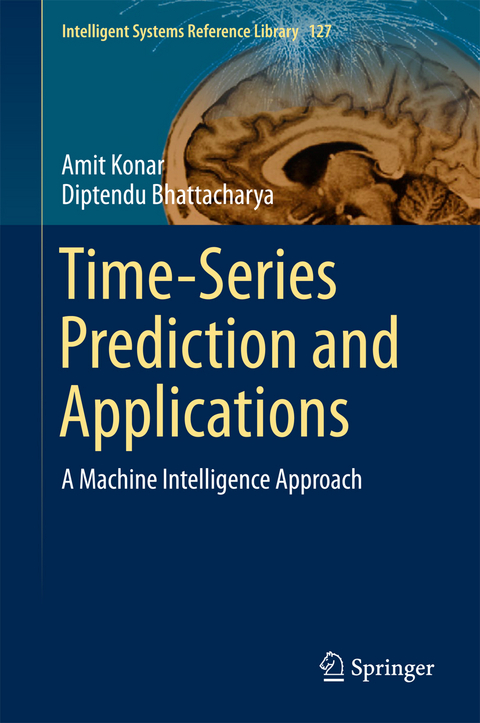
This book presents machine learning and type-2 fuzzy sets for the prediction of time-series with a particular focus on business forecasting applications. It also proposes new uncertainty management techniques in an economic time-series using type-2 fuzzy sets for prediction of the time-series at a given time point from its preceding value in fluctuating business environments. It employs machine learning to determine repetitively occurring similar structural patterns in the time-series and uses stochastic automaton to predict the most probabilistic structure at a given partition of the time-series. Such predictions help in determining probabilistic moves in a stock index time-series
Primarily written for graduate students and researchers in computer science, the book is equally useful for researchers/professionals in business intelligence and stock index prediction. A background of undergraduate level mathematics is presumed, although not mandatory, for most of the sections. Exercises with tips are provided at the end of each chapter to the readers’ ability and understanding of the topics covered.
Preface 7
Acknowledgements 11
Contents 12
About the Authors 15
1 An Introduction to Time-Series Prediction 17
Abstract 17
1.1 Defining Time-Series 17
1.2 Importance of Time-Series Prediction 18
1.3 Hindrances in Economic Time-Series Prediction 19
1.4 Machine Learning Approach to Time-Series Prediction 20
1.5 Scope of Machine Learning in Time-Series Prediction 22
1.6 Sources of Uncertainty in a Time-Series 27
1.7 Scope of Uncertainty Management by Fuzzy Sets 28
1.8 Fuzzy Time-Series 31
1.8.1 Partitioning of Fuzzy Time-Series 33
1.8.2 Fuzzification of a Time-Series 35
1.9 Time-Series Prediction Using Fuzzy Reasoning 38
1.10 Single and Multi-Factored Time-Series Prediction 42
1.11 Scope of the Book 44
1.12 Summary 45
References 48
2 Self-adaptive Interval Type-2 Fuzzy Set Induced Stock Index Prediction 54
Abstract 54
2.1 Introduction 55
2.2 Preliminaries 59
2.3 Proposed Approach 60
2.3.1 Training Phase 62
2.3.1.1 Partitioning of Main Factor Close Prices into p Intervals of Equal Length 64
2.3.1.2 Construction of IT2 or Type-1 Fuzzy Sets as Appropriate for Each Interval of Close Price 65
2.3.1.3 Fuzzy Prediction Rule (FPR) Construction for Consecutive {/varvec c(t) } s 67
2.3.1.4 Grouping of IT2/T1 Fuzzy Implications for Individual Main Factor Variation {/varvec V_{M}^{d} } (t) 68
2.3.1.5 Computing Composite Secondary Variation Series (CSVS) and Its Partitioning 69
2.3.1.6 Determining Secondary to Main Factor Variation Mapping 70
2.3.2 Prediction Phase 71
2.3.3 Prediction with Self-adaptive IT2/T1 MFs 74
2.4 Experiments 75
2.4.1 Experimental Platform 76
2.4.2 Experimental Modality and Results 76
2.4.2.1 Policies Adopted 76
2.4.2.2 MF Selection 77
2.4.2.3 Adaptation Cycle 77
2.4.2.4 Varying d 80
2.5 Performance Analysis 80
2.6 Conclusion 82
2.7 Exercises 83
Appendix 2.1 90
Appendix 2.2: Source Codes of the Programs 97
References 115
3 Handling Main and Secondary Factors in the Antecedent for Type-2 Fuzzy Stock Prediction 119
Abstract 119
3.1 Introduction 119
3.2 Preliminaries 121
3.3 Proposed Approach 123
3.3.1 Method-I: Prediction Using Classical IT2FS 124
3.3.2 Method-II: Secondary Factor Induced IT2 Approach 126
3.3.3 Method-III: Prediction in Absence of Sufficient Data Points 128
3.3.4 Method-IV: Adaptation of Membership Function in Method III to Handle Dynamic Behaviour of Time-Series [47–52] 134
3.4 Experiments 135
3.4.1 Experimental Platform 135
3.4.2 Experimental Modality and Results 136
3.5 Conclusion 141
Appendix 3.1: Differential Evolution Algorithm [36, 48–50] 141
References 143
4 Learning Structures in an Economic Time-Series for Forecasting Applications 147
Abstract 147
4.1 Introduction 147
4.2 Related Work 150
4.3 DBSCAN Clustering—An Overview 151
4.4 Slope-Sensitive Natural Segmentation 153
4.4.1 Definitions 154
4.4.2 The SSNS Algorithm 157
4.5 Multi-level Clustering of Segmented Time-Blocks 159
4.5.1 Pre-processing of Temporal Segments 159
4.5.2 Principles of Multi-level DBSCAN Clustering 160
4.5.3 The Multi-level DBSCAN Clustering Algorithm 162
4.6 Knowledge Representation Using Dynamic Stochastic Automaton 163
4.6.1 Construction of Dynamic Stochastic Automaton (DSA) 166
4.6.2 Forecasting Using the Dynamic Stochastic Automaton 168
4.7 Computational Complexity 170
4.8 Prediction Experiments and Results 172
4.9 Performance Analysis 173
4.10 Conclusion 176
Appendix 4.1: Source Codes of the Programs 177
References 201
5 Grouping of First-Order Transition Rules for Time-Series Prediction by Fuzzy-Induced Neural Regression 203
Abstract 203
5.1 Introduction 203
5.2 Preliminaries 207
5.2.1 Fuzzy Sets and Time-Series Partitioning 207
5.2.2 Back-Propagation Algorithm 208
5.2.3 Radial Basis Function (RBF) Networks 209
5.3 First-Order Transition Rule Based NN Model 210
5.4 Fuzzy Rule Based NN Model 215
5.5 Experiments and Results 218
5.5.1 Experiment 1: Sunspot Time-Series Prediction 218
5.5.2 Experiment 2: TAIEX Close-Price Prediction 223
5.6 Conclusion 227
Appendix 5.1: Source Codes of the Programs 230
References 246
6 Conclusions 248
6.1 Conclusions 248
6.2 Future Research Directions 249
Index 250
| Erscheint lt. Verlag | 25.3.2017 |
|---|---|
| Reihe/Serie | Intelligent Systems Reference Library | Intelligent Systems Reference Library |
| Zusatzinfo | XVIII, 242 p. 69 illus., 13 illus. in color. |
| Verlagsort | Cham |
| Sprache | englisch |
| Themenwelt | Informatik ► Theorie / Studium ► Künstliche Intelligenz / Robotik |
| Mathematik / Informatik ► Mathematik | |
| Technik ► Bauwesen | |
| Schlagworte | Computational Intelligence • Intelligent Systems • machine learning • Time series prediction • Type-2 Fuzzy Sets |
| ISBN-10 | 3-319-54597-3 / 3319545973 |
| ISBN-13 | 978-3-319-54597-4 / 9783319545974 |
| Informationen gemäß Produktsicherheitsverordnung (GPSR) | |
| Haben Sie eine Frage zum Produkt? |
 PDF (Wasserzeichen)
DRM: Digitales Wasserzeichen
Dieses eBook enthält ein digitales Wasserzeichen und ist damit für Sie personalisiert. Bei einer missbräuchlichen Weitergabe des eBooks an Dritte ist eine Rückverfolgung an die Quelle möglich.
Dateiformat: PDF (Portable Document Format)
Mit einem festen Seitenlayout eignet sich die PDF besonders für Fachbücher mit Spalten, Tabellen und Abbildungen. Eine PDF kann auf fast allen Geräten angezeigt werden, ist aber für kleine Displays (Smartphone, eReader) nur eingeschränkt geeignet.
Systemvoraussetzungen:
PC/Mac: Mit einem PC oder Mac können Sie dieses eBook lesen. Sie benötigen dafür einen PDF-Viewer - z.B. den Adobe Reader oder Adobe Digital Editions.
eReader: Dieses eBook kann mit (fast) allen eBook-Readern gelesen werden. Mit dem amazon-Kindle ist es aber nicht kompatibel.
Smartphone/Tablet: Egal ob Apple oder Android, dieses eBook können Sie lesen. Sie benötigen dafür einen PDF-Viewer - z.B. die kostenlose Adobe Digital Editions-App.
Buying eBooks from abroad
For tax law reasons we can sell eBooks just within Germany and Switzerland. Regrettably we cannot fulfill eBook-orders from other countries.
aus dem Bereich