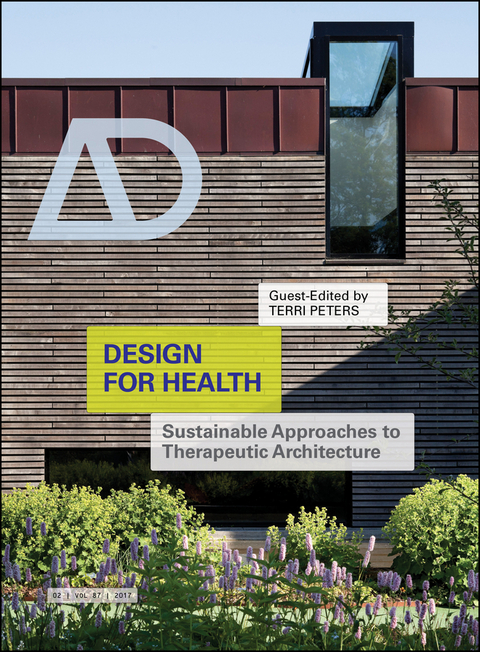
Design for Health (eBook)
John Wiley & Sons (Verlag)
978-1-119-16214-8 (ISBN)
Design for Health: Sustainable Approaches to Therapeutic Architecture Guest-Edited by Terri Peters
This issue of AD seeks out innovative and varied sustainable architectural responses to designing for health, such as:
- integrating sensory gardens and landscapes into the care environment;
- specifying local materials and passive technologies;
- and reinvigorating aging postwar facilities.
Contributors include: Anne-Marie Adams, Sean Ahlquist, Giuseppe Boscherini, Robin Guenther, Charles Jencks, Richard Mazuch, Stephen Verderber,
Featured architects: 100% Interior, Arup, C.F. Møller, Lyons, MASS Design Group, Mongomery Sisam Architects, Penoyre & Prasad
Terri Peters is a Canadian architect, writer and researcher now based in Toronto, who previously lived and worked in Denmark and the UK for 12 years. She has a broad network of multi-disciplinary collaborators, relating to sustainability research, building transformation, health and wellbeing, as well as the employment of new technologies. She is a Post-Doctoral researcher at the University of Toronto, investigating the relationship between sustainable architecture and health, particularly analysing how architectural design can improve patient wellbeing in residential care environments. She has organised conferences, served on discussion panels and award juries, and made presentations to various international construction industry and research institutions. She is the editor of two recent publications: Experimental Green Strategies: Redefining Ecological Design Research, AD (Wiley, 2011) and Inside Smartgeometry: Expanding the Architectural Possibilities of Computational Design (Wiley 2013).
Design for Health: Sustainable Approaches to Therapeutic Architecture Guest-Edited by Terri PetersThis issue of AD seeks out innovative and varied sustainable architectural responses to designing for health, such as: integrating sensory gardens and landscapes into the care environment; specifying local materials and passive technologies; and reinvigorating aging postwar facilities. Contributors include: Anne-Marie Adams, Sean Ahlquist, Giuseppe Boscherini, Robin Guenther, Charles Jencks, Richard Mazuch, Stephen Verderber, Featured architects: 100% Interior, Arup, C.F. M ller, Lyons, MASS Design Group, Mongomery Sisam Architects, Penoyre & Prasad
Terri Peters is a Canadian architect, writer and researcher now based in Toronto, who previously lived and worked in Denmark and the UK for 12 years. She has a broad network of multi-disciplinary collaborators, relating to sustainability research, building transformation, health and wellbeing, as well as the employment of new technologies. She is a Post-Doctoral researcher at the University of Toronto, investigating the relationship between sustainable architecture and health, particularly analysing how architectural design can improve patient wellbeing in residential care environments. She has organised conferences, served on discussion panels and award juries, and made presentations to various international construction industry and research institutions. She is the editor of two recent publications: Experimental Green Strategies: Redefining Ecological Design Research, AD (Wiley, 2011) and Inside Smartgeometry: Expanding the Architectural Possibilities of Computational Design (Wiley 2013).
Cover 1
Title Page 3
Contents 4
Copyright Page 6
About the Guest–Editor 7
Introduction: Interconnected Approaches to Sustainable Architecture 8
Expanding the Definition of Sustainable Design 10
Ambitious Energy Performance and Patient-Oriented Care 10
New Communications Technologies 13
Emotionally Supportive Spaces 13
Architecture as Therapy 13
Scales of Intervention 14
Salutogenic and Sensory Architecture 14
New Roles for Architects 15
More Ambitious Environmental Design 17
Notes 17
Decoding Modern Hospitals: An Architectural History 18
Mall Hospitals 21
Technology-Driven Hospital Design 23
Recoding Modern Hospitals 25
Notes 25
Superarchitecture: Building for Better Health 26
Regreening for Wellbeing 28
Future Buildings Must Be Superarchitecture 28
The Extra Benefits of Climate Adaptation 29
Biophilic Design for Natural Ecosystems and Human Wellbeing 30
Daylight and Wellness 30
Superarchitecture: Design as Therapy 33
Notes 33
Lean, Green and Healthy: Landscape and Health 34
Landscape and Urbanism as Design Drivers 36
Efficiency Through Architectural Quality 37
In the Image of the City 37
A Completely New Approach 39
The Big Picture 43
Notes 43
Salutogenic and Biophilic Design as Therapeutic Approaches to Sustainable Architecture 44
The Salutogenic Home of Tomorrow 45
New Technologies for Salutogenic Design 45
Biophilic Design 46
Design for Wellness: A Five-Year Forward View for Healthy New Towns 46
Sense-Sensitive Design 48
Meeting the Challenge 49
Notes 49
Environmentally Smart Design: Designing for Social Wellbeing Across the City and in the Workplace 50
Carbon, Cars and Chronic Disease 53
Urban Interventions 53
Reconfiguring Suburbia 54
Healthy Offices 54
The Way Forward 57
Notes 57
Humanist Principles, Sustainable Design and Salutogenics: A New Form of Healthcare Architecture 58
Early Exemplars 61
The Medico-Centric Hospital 61
Contesting the Type 62
A New Era of Salutogenic Design 64
An Optimistic Path 67
Notes 67
Maggie’s Architecture: The Deep Affinities Between Architecture and Health 68
Haven and Risk 72
Speculative Conclusion 75
Postscript: Sustainability of Engagement 77
Notes 77
Healthy Patient Rooms in Hospitals: Emotional Wellbeing Naturally 78
Smart Materials 80
Maternity Unit, Elisabeth Hospital, Essen, Germany 81
Rems-Murr Hospital, Winnenden, Germany 83
Natural Design 83
Note 83
Can Architecture Heal?: Buildings as Instruments of Health 84
Form Follows Facts 87
Butaro Doctors’ Share Housing, Burera, Rwanda 87
Maternity Waiting Village, Kasungu, Malawi 88
GHESKIO Cholera Treatment Centre, Port-Au-Prince, Haiti 90
Designing for Measurable Outcomes 91
Notes 91
Multisensory Architecture: The Dynamic Interplay of Environment, Movement and Social Function 92
Behaviour and Environment 94
Interventions for ASD 97
Movement, Social Behaviour and Dynamic Systems Theory 97
Sensory Playscapes 98
The Role of Multisensory Architectures 101
Notes 101
Architects as First Responders: Portable Healthcare Architecture in a Climate-Altered World 102
Five Variants: Transportables for Health 104
Sustainable Healthcare Architecture and Portability 109
Notes 109
A Sense of Coherence: Supporting the Healing Process 110
Design Heals 110
A Sensory Experience 110
The Nature Connection 112
Social to Private Progression 112
Health-Promoting Lifestyle Centres 113
Space as Sustainable Therapy 115
Notes 115
Cultivating the ‘In-Between’: Humanising the Modern Healthcare Experience 116
The Search for an Alternative Paradigm in Healthcare Design 116
The Spaces In-Between: The Porch, the Courtyard and the Gallery 117
Therapy in a Grove of White Pines 118
Embracing a Treasured Park 120
A House in a Garden in the City 122
A Holistic Approach to Healthcare Planning 123
Notes 123
Regenerative Agents: Patient-Focused Architectures 124
The Environment as Healer 125
The Evolution of Therapeutic Environments 126
New QEII Hospital, Welwyn Garden City 126
Guy’s Tower External Retrofit, London 128
Sir Ludwig Guttmann Health & Wellbeing Centre, London
Regenerative Agents 129
Notes 129
Counterpoint Transforming Hospitals: Building Restorative Healthcare 130
What is Health in the 21st Century? 132
Resilience 133
Healthcare as the New Civic Architecture 134
The Path Forward 135
Contributors 136
What is Architectural Design? 138
Forthcoming Titles 139
Back Cover 140
EULA 141
"Serves as a timely, topical and thought-provoking reminder of the potential of our industry to significantly and tangibly improve the quality of people's lives through better buildings." (The NBS, July 2017)
| Erscheint lt. Verlag | 6.4.2017 |
|---|---|
| Reihe/Serie | Architectural Design |
| Architectural Design | Architectural Design |
| Mitarbeit |
Gast Herausgeber: Terri Peters |
| Sprache | englisch |
| Themenwelt | Technik ► Architektur |
| Schlagworte | Abundance • ACCESS • Anxiety • architectural theory • Architecture • Architektur • Architektur / Theorie • Areas • Bauentwurf • Between • Building Design • clinics • Daylight • Experience • Influence • Medical • patients outcomes • Physical • proven • qualities • reduction • relate • sensory • Spiritual • surroundings • uncluttered |
| ISBN-10 | 1-119-16214-9 / 1119162149 |
| ISBN-13 | 978-1-119-16214-8 / 9781119162148 |
| Informationen gemäß Produktsicherheitsverordnung (GPSR) | |
| Haben Sie eine Frage zum Produkt? |
 PDF (Adobe DRM)
Kopierschutz: Adobe-DRM
Adobe-DRM ist ein Kopierschutz, der das eBook vor Mißbrauch schützen soll. Dabei wird das eBook bereits beim Download auf Ihre persönliche Adobe-ID autorisiert. Lesen können Sie das eBook dann nur auf den Geräten, welche ebenfalls auf Ihre Adobe-ID registriert sind.
Details zum Adobe-DRM
Dateiformat: PDF (Portable Document Format)
Mit einem festen Seitenlayout eignet sich die PDF besonders für Fachbücher mit Spalten, Tabellen und Abbildungen. Eine PDF kann auf fast allen Geräten angezeigt werden, ist aber für kleine Displays (Smartphone, eReader) nur eingeschränkt geeignet.
Systemvoraussetzungen:
PC/Mac: Mit einem PC oder Mac können Sie dieses eBook lesen. Sie benötigen eine
eReader: Dieses eBook kann mit (fast) allen eBook-Readern gelesen werden. Mit dem amazon-Kindle ist es aber nicht kompatibel.
Smartphone/Tablet: Egal ob Apple oder Android, dieses eBook können Sie lesen. Sie benötigen eine
Geräteliste und zusätzliche Hinweise
Buying eBooks from abroad
For tax law reasons we can sell eBooks just within Germany and Switzerland. Regrettably we cannot fulfill eBook-orders from other countries.
aus dem Bereich