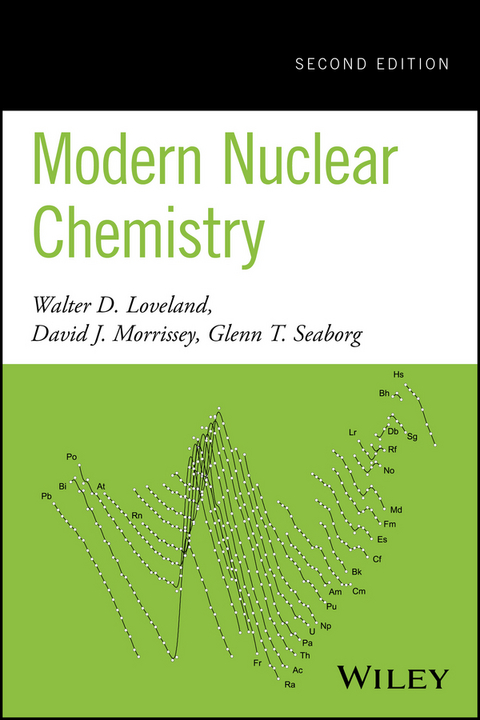
Modern Nuclear Chemistry (eBook)
John Wiley & Sons (Verlag)
978-1-119-32838-4 (ISBN)
• Provides up-to-date coverage of the latest research and examines the theoretical and practical aspects of nuclear and radiochemistry
• Presents the basic physical principles of nuclear and radiochemistry in a succinct fashion, requiring no basic knowledge of quantum mechanics
• Adds discussion of math tools and simulations to demonstrate various phenomena, new chapters on Nuclear Medicine, Nuclear Forensics and Particle Physics, and updates to all other chapters
• Includes additional in-chapter sample problems with solutions to help students
• Reviews of 1st edition: '... an authoritative, comprehensive but succinct, state-of-the-art textbook ....' (The Chemical Educator) and '...an excellent resource for libraries and laboratories supporting programs requiring familiarity with nuclear processes ...' (CHOICE)
WALTER D. LOVELAND, PhD, is a professor of chemistry at Oregon State University, USA.
DAVID J. MORRISSEY, PhD, is a professor of chemistry and associate director of the National Superconducting Cyclotron Laboratory at Michigan State University, USA.
GLENN T. SEABORG, PhD (deceased), was a professor of chemistry at the University of California, Berkeley, and cofounder and chairman of the Lawrence Hall of Science, USA. He is credited with discovering 10 new elements, including plutonium and one that now bears his name, seaborgium. In 1951, Dr. Seaborg and his colleague, Edwin McMillan, were awarded the Nobel Prize in Chemistry for research into transuranium elements.
Written by established experts in the field, this book features in-depth discussions of proven scientific principles, current trends, and applications of nuclear chemistry to the sciences and engineering. Provides up-to-date coverage of the latest research and examines the theoretical and practical aspects of nuclear and radiochemistry Presents the basic physical principles of nuclear and radiochemistry in a succinct fashion, requiring no basic knowledge of quantum mechanics Adds discussion of math tools and simulations to demonstrate various phenomena, new chapters on Nuclear Medicine, Nuclear Forensics and Particle Physics, and updates to all other chapters Includes additional in-chapter sample problems with solutions to help students Reviews of 1st edition: "e;... an authoritative, comprehensive but succinct, state-of-the-art textbook ...."e; (The Chemical Educator) and "e;...an excellent resource for libraries and laboratories supporting programs requiring familiarity with nuclear processes ..."e; (CHOICE)
WALTER D. LOVELAND, PhD, is a professor of chemistry at Oregon State University, USA. DAVID J. MORRISSEY, PhD, is a professor of chemistry and associate director of the National Superconducting Cyclotron Laboratory at Michigan State University, USA. GLENN T. SEABORG, PhD (deceased), was a professor of chemistry at the University of California, Berkeley, and cofounder and chairman of the Lawrence Hall of Science, USA. He is credited with discovering 10 new elements, including plutonium and one that now bears his name, seaborgium. In 1951, Dr. Seaborg and his colleague, Edwin McMillan, were awarded the Nobel Prize in Chemistry for research into transuranium elements.
Title Page 5
Copyright Page 6
Contents 7
Preface to the Second Edition 17
Preface to the First Edition 19
Chapter 1 Introductory Concepts 21
1.1 Introduction 21
1.2 The Excitement and Relevance of Nuclear Chemistry 22
1.3 The Atom 23
1.4 Atomic Processes 24
1.4.1 Ionization 25
1.4.2 X-Ray Emission 25
1.5 The Nucleus: Nomenclature 27
1.6 Properties of the Nucleus 28
1.7 Survey of Nuclear Decay Types 29
1.8 Modern Physical Concepts Needed in Nuclear Chemistry 32
1.8.1 Elementary Mechanics 33
1.8.2 RelativisticMechanics 34
1.8.3 de BroglieWavelength:Wave–Particle Duality 36
1.8.4 Heisenberg Uncertainty Principle 38
1.8.5 Units and Conversion Factors 39
Problems 39
Bibliography 41
Chapter 2 Nuclear Properties 45
2.1 Nuclear Masses 45
2.2 Terminology 48
2.3 Binding Energy Per Nucleon 49
2.4 Separation Energy Systematics 51
2.5 Abundance Systematics 52
2.6 Semiempirical Mass Equation 53
2.7 Nuclear Sizes and Shapes 59
2.8 Quantum Mechanical Properties 63
2.8.1 Nuclear Angular Momentum 63
2.9 Electric and Magnetic Moments 65
2.9.1 Magnetic Dipole Moment 65
2.9.2 Electric Quadrupole Moment 68
Problems 71
Bibliography 75
Chapter 3 Radioactive Decay Kinetics 77
3.1 Basic Decay Equations 77
3.2 Mixture of Two Independently Decaying Radionuclides 85
3.3 Radioactive Decay Equilibrium 86
3.4 Branching Decay 96
3.5 Radiation Dosage 97
3.6 Natural Radioactivity 99
3.6.1 General Information 99
3.6.2 Primordial Nuclei and the Uranium Decay Series 99
3.6.3 Cosmogenic Nuclei 101
3.6.4 Anthropogenic Nuclei 103
3.6.5 Health Effects of Natural Radiation 103
3.7 Radionuclide Dating 104
Problems 110
Bibliography 112
Chapter 4 Nuclear Medicine 113
4.1 Introduction 113
4.2 Radiopharmaceuticals 114
4.3 Imaging 116
4.4 99Tcm 118
4.5 PET 121
4.6 Other Imaging Techniques 123
4.7 Some Random Observations about the Physics of Imaging 124
4.8 Therapy 128
Problems 130
Bibliography 132
Chapter 5 Particle Physics and the Nuclear Force 133
5.1 Particle Physics 133
5.2 The Nuclear Force 137
5.3 Characteristics of the Strong Force 139
5.4 Charge Independence of Nuclear Forces 140
Problems 144
Bibliography 144
Chapter 6 Nuclear Structure 145
6.1 Introduction 145
6.2 Nuclear Potentials 147
6.3 Schematic Shell Model 149
6.4 Independent ParticleModel 161
6.5 CollectiveModel 163
6.6 Nilsson Model 169
6.7 Fermi Gas Model 172
Problems 181
Bibliography 184
Chapter 7 ?-Decay 187
7.1 Introduction 187
7.2 Energetics of ?????? Decay 189
7.3 Theory of ?????? Decay 193
7.4 Hindrance Factors 202
7.5 Heavy Particle Radioactivity 203
7.6 Proton Radioactivity 204
Problems 206
Bibliography 208
Chapter 8 ?-Decay 211
8.1 Introduction 211
8.2 Neutrino Hypothesis 212
8.3 Derivation of the Spectral Shape 216
8.4 Kurie Plots 219
8.5 ? Decay Rate Constant 220
8.6 Electron Capture Decay 226
8.7 Parity Nonconservation 227
8.8 Neutrinos Again 228
8.9 ?-Delayed Radioactivities 229
8.10 Double ?????? Decay 231
Problems 233
Bibliography 234
Chapter 9 ?-Ray Decay 237
9.1 Introduction 237
9.2 Energetics of ??????-Ray Decay 238
9.3 Classification of Decay Types 240
9.4 Electromagnetic Transition Rates 243
9.5 Internal Conversion 249
9.6 Angular Correlations 252
9.7 Mössbauer Effect 258
Problems 264
Bibliography 265
Chapter 10 Nuclear Reactions 267
10.1 Introduction 267
10.2 Energetics of Nuclear Reactions 268
10.3 Reaction Types and Mechanisms 272
10.4 Nuclear Reaction Cross Sections 273
10.5 Reaction Observables 284
10.6 Rutherford Scattering 284
10.7 Elastic (Diffractive) Scattering 288
10.8 Aside on the Optical Model 290
10.9 Direct Reactions 291
10.10 Compound Nuclear Reactions 293
10.11 Photonuclear Reactions 299
10.12 Heavy-Ion Reactions 301
10.12.1 Coulomb Excitation 304
10.12.2 Elastic Scattering 304
10.12.3 Fusion Reactions 304
10.12.4 Incomplete Fusion 308
10.12.5 Deep-Inelastic Scattering 309
10.13 High-Energy Nuclear Reactions 310
10.13.1 Spallation/Fragmentation Reactions 311
10.13.2 Reactions Induced by Radioactive Projectiles 315
10.13.3 Multifragmentation 316
10.13.4 Quark–Gluon Plasma 318
Problems 318
Bibliography 322
Chapter 11 Fission 325
11.1 Introduction 325
11.2 Probability of Fission 328
11.2.1 Liquid Drop Model 328
11.2.2 Shell Corrections 330
11.2.3 Spontaneous Fission 332
11.2.4 Spontaneously Fissioning Isomers 335
11.2.5 The Transition Nucleus 336
11.3 Dynamical Properties of Fission Fragments 343
11.4 Fission Product Distributions 347
11.4.1 Total Kinetic Energy (TKE) Release 347
11.4.2 Fission ProductMass Distribution 347
11.4.3 Fission Product Charge Distributions 350
11.5 Excitation Energy of Fission Fragments 353
Problems 357
Bibliography 358
Chapter 12 Nuclear Astrophysics 359
12.1 Introduction 359
12.2 Elemental and Isotopic Abundances 360
12.3 Primordial Nucleosynthesis 363
12.3.1 Stellar Evolution 367
12.4 Thermonuclear Reaction Rates 371
12.5 Stellar Nucleosynthesis 373
12.5.1 Introduction 373
12.5.2 Hydrogen Burning 373
12.5.3 Helium Burning 377
12.5.4 Synthesis of Nuclei with A < 60
12.5.5 Synthesis of Nuclei with A > 60
12.6 Solar Neutrino Problem 386
12.6.1 Introduction 386
12.6.2 Expected Solar Neutrino Sources, Energies, and Fluxes 387
12.6.3 Detection of Solar Neutrinos 389
12.6.4 The Solar Neutrino Problem 391
12.6.5 Solution to the Problem: Neutrino Oscillations 391
12.7 Synthesis of Li, Be, and B 393
Problems 395
Bibliography 396
Chapter 13 Reactors and Accelerators 399
13.1 Introduction 399
13.2 Nuclear Reactors 400
13.2.1 Neutron-Induced Reaction 400
13.2.2 Neutron-Induced Fission 403
13.2.3 Neutron Inventory 404
13.2.4 LightWater Reactors 406
13.2.5 The Oklo Phenomenon 411
13.3 Neutron Sources 412
13.4 Neutron Generators 412
13.5 Accelerators 413
13.5.1 Ion Sources 414
13.5.2 Electrostatic Machines 416
13.5.3 Linear Accelerators 420
13.5.4 Cyclotrons, Synchrotrons, and Rings 423
13.6 Charged-Particle Beam Transport and Analysis 430
13.7 Radioactive Ion Beams 435
13.8 NuclearWeapons 441
Problems 445
Bibliography 447
Chapter 14 The Transuranium Elements 449
14.1 Introduction 449
14.2 Limits of Stability 449
14.3 Element Synthesis 454
14.4 History of Transuranium Element Discovery 457
14.5 Superheavy Elements 469
14.6 Chemistry of the Transuranium Elements 473
14.7 Environmental Chemistry of the Transuranium Elements 481
Problems 488
Bibliography 489
Chapter 15 Nuclear Reactor Chemistry 493
15.1 Introduction 493
15.2 Fission Product Chemistry 495
15.3 Radiochemistry of Uranium 498
15.3.1 Uranium Isotopes 498
15.3.2 Metallic Uranium 498
15.3.3 Uranium Compounds 498
15.3.4 Uranium Solution Chemistry 499
15.4 The Nuclear Fuel Cycle: The Front End 500
15.4.1 Mining andMilling 501
15.4.2 Refining and Chemical Conversion 503
15.4.3 Isotopic Enhancement 504
15.4.4 Fuel Fabrication 507
15.5 The Nuclear Fuel Cycle: The Back End 508
15.5.1 Properties of Spent Fuel 508
15.5.2 Fuel Reprocessing 510
15.6 RadioactiveWaste Disposal 513
15.6.1 Classifications of RadioactiveWaste 513
15.6.2 Waste Amounts and Associated Hazards 514
15.6.3 Storage and Disposal of NuclearWaste 516
15.6.4 Spent Nuclear Fuel 517
15.6.5 HLW 518
15.6.6 TransuranicWaste 519
15.6.7 Low-LevelWaste 519
15.6.8 Mill Tailings 520
15.6.9 Partitioning ofWaste 520
15.6.10 Transmutation ofWaste 521
15.7 Chemistry of Operating Reactors 524
15.7.1 Radiation Chemistry of Coolants 524
15.7.2 Corrosion 525
15.7.3 Coolant Activities 525
Problems 526
Bibliography 527
Chapter 16 Interaction of Radiation with Matter 529
16.1 Introduction 529
16.2 Heavy Charged Particles 532
16.2.1 Stopping Power 532
16.2.2 Range 541
16.3 Electrons 546
16.4 Electromagnetic Radiation 552
16.4.1 Photoelectric Effect 554
16.4.2 Compton Scattering 556
16.4.3 Pair Production 557
16.5 Neutrons 560
16.6 Radiation Exposure and Dosimetry 564
Problems 568
Bibliography 570
Chapter 17 Radiation Detectors 573
17.1 Introduction 573
17.1.1 Gas Ionization 574
17.1.2 Ionization in a Solid (Semiconductor Detectors) 574
17.1.3 Solid Scintillators 575
17.1.4 Liquid Scintillators 575
17.1.5 Nuclear Emulsions 575
17.2 Detectors Based on Collecting Ionization 576
17.2.1 Gas Ionization Detectors 577
17.2.2 Semiconductor Detectors (Solid State Ionization Chambers) 587
17.3 Scintillation Detectors 598
17.4 Nuclear Track Detectors 604
17.5 Neutron Detectors 605
17.6 Nuclear Electronics and Data Collection 607
17.7 Nuclear Statistics 609
17.7.1 Distributions of Data and Uncertainty 611
17.7.2 Rejection of Abnormal Data 617
17.7.3 Setting Upper LimitsWhen No Counts Are Observed 618
Problems 619
Bibliography 620
Chapter 18 Nuclear Analytical Methods 623
18.1 Introduction 623
18.2 Activation Analysis 623
18.2.1 Basic Description of the Method 623
18.2.2 Advantages and Disadvantages of Activation Analysis 625
18.2.3 Practical Considerations in Activation Analysis 627
18.2.4 Applications of Activation Analysis 631
18.3 PIXE 632
18.4 Rutherford Backscattering 635
18.5 AcceleratorMass Spectrometry (AMS) 639
18.6 Other Mass Spectrometric Techniques 640
Problems 641
Bibliography 643
Chapter 19 Radiochemical Techniques 645
19.1 Introduction 645
19.2 Unique Aspects of Radiochemistry 646
19.3 Availability of Radioactive Material 650
19.4 Targetry 652
19.5 Measuring Beam Intensity and Fluxes 657
19.6 Recoils, Evaporation Residues, and Heavy Residues 659
19.7 Radiochemical Separation Techniques 664
19.7.1 Precipitation 664
19.7.2 Solvent Extraction 665
19.7.3 Ion Exchange 668
19.7.4 Extraction Chromatography 670
19.7.5 Rapid Radiochemical Separations 672
19.8 Low-Level Measurement Techniques 673
19.8.1 Blanks 674
19.8.2 Low-Level Counting: General Principles 674
19.8.3 Low-Level Counting: Details 675
19.8.4 Limits of Detection 678
Problems 679
Bibliography 680
Chapter 20 Nuclear Forensics 683
20.1 Introduction 683
20.1.1 Basic Principles of Forensic Analysis 686
20.2 Chronometry 690
20.3 NuclearWeapons and Their Debris 692
20.3.1 RDD or Dirty Bombs 692
20.3.2 Nuclear Explosions 694
20.4 Deducing Sources and Routes of Transmission 698
Problems 700
Bibliography 701
Appendix A Fundamental Constants and Conversion Factors 703
Appendix B NuclearWallet Cards 707
Appendix C Periodic Table of the Elements 731
Appendix D Alphabetical List of the Elements 733
Appendix E Elements of Quantum Mechanics 735
E.1 Wave Functions 735
E.2 Operators 736
E.3 The Schrödinger Equation 737
E.4 The Free Particle 738
E.5 Particle in a Box (One Dimension) 740
E.6 Harmonic Oscillator (One Dimensional) 742
E.8 Schrödinger Equation in Spherical Coordinates 746
E.9 Infinite SphericalWell 748
E.10 Angular Momentum 751
E.11 Parity 752
E.12 Quantum Statistics 753
Bibliography 755
Index 757
Supplemental Images 765
| Erscheint lt. Verlag | 21.3.2017 |
|---|---|
| Sprache | englisch |
| Themenwelt | Naturwissenschaften ► Chemie ► Physikalische Chemie |
| Technik | |
| Schlagworte | alpha decay • beta decay • Chemie • Chemistry • Energie • Energy • Gamma Decay • Kernenergie • Kern- u. Hochenergiephysik • Kern- u. Radiochemie • Nuclear & High Energy Physics • Nuclear and Radiochemistry • Nuclear chemistry,radiochemistry, Nuclear-Medicine • nuclear energy • nuclear forensic study • Particle physics • Physics • Physik • Physikalische Chemie • radiation detectors • Radioactive decay • Radiotracers • seaborgium plutonium |
| ISBN-10 | 1-119-32838-1 / 1119328381 |
| ISBN-13 | 978-1-119-32838-4 / 9781119328384 |
| Informationen gemäß Produktsicherheitsverordnung (GPSR) | |
| Haben Sie eine Frage zum Produkt? |
 PDF (Adobe DRM)
Kopierschutz: Adobe-DRM
Adobe-DRM ist ein Kopierschutz, der das eBook vor Mißbrauch schützen soll. Dabei wird das eBook bereits beim Download auf Ihre persönliche Adobe-ID autorisiert. Lesen können Sie das eBook dann nur auf den Geräten, welche ebenfalls auf Ihre Adobe-ID registriert sind.
Details zum Adobe-DRM
Dateiformat: PDF (Portable Document Format)
Mit einem festen Seitenlayout eignet sich die PDF besonders für Fachbücher mit Spalten, Tabellen und Abbildungen. Eine PDF kann auf fast allen Geräten angezeigt werden, ist aber für kleine Displays (Smartphone, eReader) nur eingeschränkt geeignet.
Systemvoraussetzungen:
PC/Mac: Mit einem PC oder Mac können Sie dieses eBook lesen. Sie benötigen eine
eReader: Dieses eBook kann mit (fast) allen eBook-Readern gelesen werden. Mit dem amazon-Kindle ist es aber nicht kompatibel.
Smartphone/Tablet: Egal ob Apple oder Android, dieses eBook können Sie lesen. Sie benötigen eine
Geräteliste und zusätzliche Hinweise
Buying eBooks from abroad
For tax law reasons we can sell eBooks just within Germany and Switzerland. Regrettably we cannot fulfill eBook-orders from other countries.
aus dem Bereich