Defect Structure and Properties of Nanomaterials (eBook)
410 Seiten
Elsevier Science (Verlag)
978-0-08-101918-4 (ISBN)
Jeno Gubicza is a Professor at Eotvos Lorand University in Budapest, Hungary. He received his PhD and Dr.habil degrees in 1997 and 2005, respectively. Prof. Gubicza's main research field is the study of microstructure of nanomaterials. He has published two books entitled 'Defect structure in nanomaterials” and 'X-ray line profile analysis in materials science” in 2012 and 2014, respectively. Prof. Gubicza was awarded the scientific title of Doctor of the Hungarian Academy of Sciences, the Schmid Rezso Prize of Roland Eotvos Physical Society and the Bolyai-plaquette of Hungarian Academy of Sciences. He has published more than 200 papers that have been cited more than 2700 times.
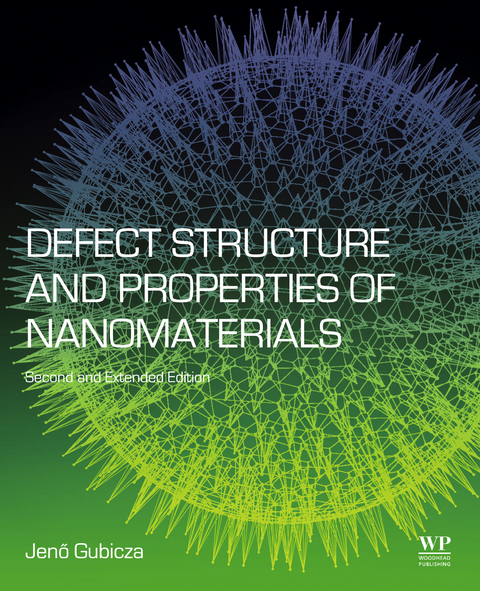
Defect Structure and Properties of Nanomaterials: Second and Extended Edition covers a wide range of nanomaterials including metals, alloys, ceramics, diamond, carbon nanotubes, and their composites. This new edition is fully revised and updated, covering important advances that have taken place in recent years. Nanostructured materials exhibit unique mechanical and physical properties compared with their coarse-grained counterparts, therefore these materials are currently a major focus in materials science. The production methods of nanomaterials affect the lattice defect structure (vacancies, dislocations, disclinations, stacking faults, twins, and grain boundaries) that has a major influence on their mechanical and physical properties. In this book, the production routes of nanomaterials are described in detail, and the relationships between the processing conditions and the resultant defect structure, as well as the defect-related properties (e.g. mechanical behavior, electrical resistance, diffusion, corrosion resistance, thermal stability, hydrogen storage capability, etc.) are reviewed. In particular, new processing methods of nanomaterials are described in the chapter dealing with the manufacturing procedures of nanostructured materials. New chapters on (i) the experimental methods for the study of lattice defects, (ii) the defect structure in nanodisperse particles, and (iii) the influence of lattice defects on electrical, corrosion, and diffusion properties are included, to further enhance what has become a leading reference for engineering, physics, and materials science audiences. - Provides a detailed overview of processing methods, defect structure, and defect-related mechanical and physical properties of nanomaterials- Covers a wide range of nanomaterials including metals, alloys, ceramics, diamond, carbon nanotubes, and their composites- Includes new chapters covering recent advances in both processing techniques and methods for the study of lattice defects- Provides valuable information that will help materials scientists and engineers highlight lattice defects and the related mechanical and physical properties
| Erscheint lt. Verlag | 5.3.2017 |
|---|---|
| Sprache | englisch |
| Themenwelt | Technik ► Maschinenbau |
| ISBN-10 | 0-08-101918-1 / 0081019181 |
| ISBN-13 | 978-0-08-101918-4 / 9780081019184 |
| Informationen gemäß Produktsicherheitsverordnung (GPSR) | |
| Haben Sie eine Frage zum Produkt? |
 EPUB (Adobe DRM)
Kopierschutz: Adobe-DRM
Adobe-DRM ist ein Kopierschutz, der das eBook vor Mißbrauch schützen soll. Dabei wird das eBook bereits beim Download auf Ihre persönliche Adobe-ID autorisiert. Lesen können Sie das eBook dann nur auf den Geräten, welche ebenfalls auf Ihre Adobe-ID registriert sind.
Details zum Adobe-DRM
Dateiformat: EPUB (Electronic Publication)
EPUB ist ein offener Standard für eBooks und eignet sich besonders zur Darstellung von Belletristik und Sachbüchern. Der Fließtext wird dynamisch an die Display- und Schriftgröße angepasst. Auch für mobile Lesegeräte ist EPUB daher gut geeignet.
Systemvoraussetzungen:
PC/Mac: Mit einem PC oder Mac können Sie dieses eBook lesen. Sie benötigen eine
eReader: Dieses eBook kann mit (fast) allen eBook-Readern gelesen werden. Mit dem amazon-Kindle ist es aber nicht kompatibel.
Smartphone/Tablet: Egal ob Apple oder Android, dieses eBook können Sie lesen. Sie benötigen eine
Geräteliste und zusätzliche Hinweise
Buying eBooks from abroad
For tax law reasons we can sell eBooks just within Germany and Switzerland. Regrettably we cannot fulfill eBook-orders from other countries.
aus dem Bereich