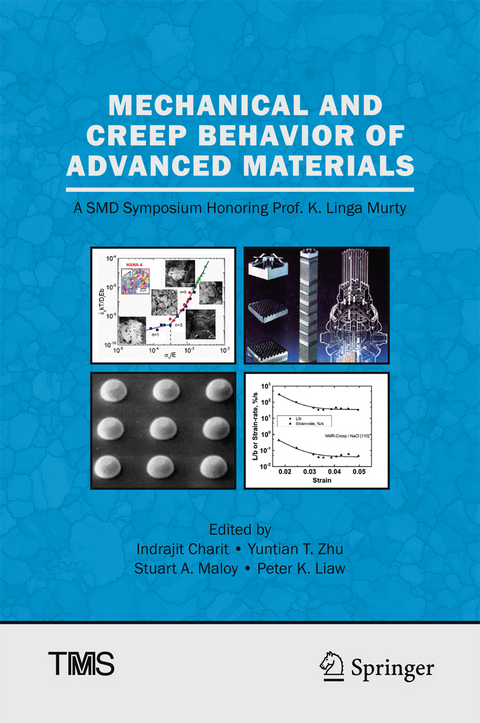
Mechanical and Creep Behavior of Advanced Materials (eBook)
XIX, 293 Seiten
Springer International Publishing (Verlag)
978-3-319-51097-2 (ISBN)
This collection commemorates the occasion of the honorary symposium that celebrated the 75th birthday and lifelong contributions of Professor K.L. Murty. The topics cover the present status and recent advances in research areas in which he made seminal contributions. The volume includes articles on a variety of topics such as high-temperature deformation behaviors of materials (elevated temperature creep, tensile, fatigue, superplasticity) and their micromechanistic interpretation, understanding mechanical behavior of HCP metals/alloys using crystallographic texture, radiation effects on deformation and creep of materials, mechanical behavior of nanostructured materials, fracture and fracture mechanisms, development and application of small-volume mechanical testing techniques, and general structure-property correlations.
The Minerals, Metals & Materials Society (TMS) is a member-driven international professional society dedicated to fostering the exchange of learning and ideas across the entire range of materials science and engineering, from minerals processing and primary metals production, to basic research and the advanced applications of materials. Included among its nearly 13,000 professional and student members are metallurgical and materials engineers, scientists, researchers, educators, and administrators from more than 70 countries on six continents.
The Minerals, Metals & Materials Society (TMS) is a member-driven international professional society dedicated to fostering the exchange of learning and ideas across the entire range of materials science and engineering, from minerals processing and primary metals production, to basic research and the advanced applications of materials. Included among its nearly 13,000 professional and student members are metallurgical and materials engineers, scientists, researchers, educators, and administrators from more than 70 countries on six continents.
Preface 5
Contents 11
About the Editors 14
Mechanical Anisotropy, Crystallographic Texture and Related Phenomena 19
1 Creep, Deformation and Fracture Studies of Materials for Various Technologies in the Nuclear Materials Research Group at NC State 20
Abstract 20
Introduction 20
Transitional Creep Mechanisms of Metals and Alloys 21
Synergistic Effects of Dynamic Strain Aging and Radiation Defects on Fracture 26
Dynamical Behavior of Point and Line Defects During Deformation Using Non-interactive NMR Techniques 29
Condition Monitoring of Structural Materials Using ABI 31
Neutron Irradiation Effects on Ultrafine Grained Steels 33
Summary 33
Acknowledgements 34
References 34
2 Anisotropic Biaxial Creep of Textured Nb-Modified Zircaloy-4 Tubing 36
Abstract 36
Introduction 37
Material and Experimental Procedure 38
Results and Discussion 40
Microstructure 40
Biaxial Creep Results 42
Evaluation of Creep Anisotropy Parameters 43
Creep Loci of the HANA-4 Alloy 45
Comparison of Current Experimental Creep Results with Other Alloys 46
Biaxial Anisotropic Creep Modeling Using Plasticity-CODF Model 47
Summary and Conclusions 48
Acknowledgement 48
References 48
3 Effect of Specimen Geometry, Orientation and Temperature on the Impact Toughness of Zr-2.5Nb Pressure Tube 50
Abstract 50
Introduction 50
Experimental 52
Material 52
Charpy V-Notch Specimens and Drop Tower Impact Test 52
Results and Discussion 53
Conclusions 57
References 57
4 Microstructure, Texture and Mechanical Properties of the 14YWT Nanostructured Ferritic Alloy NFA-1 59
Abstract 59
Introduction 60
Materials and Methods 60
NFA-1 Processing 60
Microstructural Characterization 61
Mechanical Characterization 62
Results and Discussion 62
Plate Microstructure and Texture 62
Micro-mechanisms and Mechanics of Microcracking 63
Microhardness and Tensile Properties 65
Fracture Toughness 66
A Brief Description of Other Important Results 68
Conclusions 69
Acknowledgements 69
References 70
High Temperature Creep of Materials 71
5 Fundamentals of Creep in Aluminum Over a Very Wide Temperature Range 72
Abstract 72
Steady-State Creep of Aluminum 72
Five Power-Law Creep 72
Power-Law Breakdown 74
Harper-Dorn Creep 76
Viscous Creep 78
Acknowledgements 78
References 79
6 Dislocation Cross-Slip Controlled Creep at High Stresses and Transitional Creep Mechanisms in Zircaloy-4 80
Abstract 80
Introduction 80
Materials and Experiments 81
Results and Discussion 82
Application to Dry Storage 88
Conclusions 90
Acknowledgements 91
References 91
7 Characterisation of Mechanical Properties Using Ball Indentation, Small Punch Creep and Impression Creep Methods 93
Abstract 93
Introduction 93
Impression Creep 94
Alloy Development Studies Using Impression Creep 95
Characterization of Creep Properties of Weld Joints 97
Heterogeneity of Deformation in Impression Creep 98
Small Punch Creep 99
Alloy Development Studies Using SPC 101
Ball Indentation 102
Indentation to Energy to Fracture 103
Ball Indentation Testing System 105
Ball Indentation Studies on Weld Joint 105
Evaluation of Impact Energy and Fracture Toughness 106
Summary 107
Acknowledgement 108
References 108
8 TerraPower HT9 Mechanical and Thermal Creep Properties 109
Abstract 109
Introduction 109
Experimental 110
Results and Discussion 111
Conclusion 115
References 116
9 Creep of Zirconium and Zirconium Alloys 117
Abstract 117
Introduction 117
Creep Behavior of Zirconium 118
Effects of Alloying 121
Conclusions 126
Acknowledgements 126
References 126
Mechanical Behavior of Nanocrystalline and Ultrafine-Grained Materials 129
10 Applying Conventional Creep Mechanisms to Ultrafine-Grained Materials 130
Abstract 130
Preamble 130
Introduction 131
High Temperature Creep Processes: The Role of Dislocation Climb, Viscous Glide and Breakdown 132
The Significance of Grain Boundary Sliding in Creep and Superplasticity 136
The Development of Ultrafine Grains Through Severe Plastic Deformation 139
Summary and Conclusions 141
Acknowledgements 142
References 142
11 On the Strain Rate Sensitive Characteristics of Nanocrystalline Aluminum Alloys 145
Abstract 145
Introduction 146
Strain Rate Sensitive Characteristics 148
Nanocrystalline Al 148
Nanocrystalline Al–Pb Alloys 149
Nanocrystalline Al–W Alloys 151
Nanocrystalline Al–Pb–W Alloys 151
Ultrafine-Grained Al–Zn Alloy 152
Nanocrystalline and Ultrafine-Grained Al–Mg Alloys 154
Nanocrystalline Cu–Al Alloy 155
Nanocrystalline Al–Fe Alloy 156
Summary and Conclusions 157
References 158
Materials for Nuclear Environments 161
12 Synergistic Effects of Neutron Irradiation and Interstitial Nitrogen on Strain Aging in Ferritic Steels 162
Abstract 162
Introduction 163
Experimental Aspects 165
Results and Discussion 166
A533B Steel 166
Alloy A516-Gr.70 167
Mild Steel 168
Summary and Conclusions 174
References 174
13 Irradiation Creep of Zr-Alloys 176
Abstract 176
Introduction 176
Creep of Zr-2.5Nb Pressure Tubing 177
Effect of Operating Conditions for a Given Microstructure 177
Effect of Microstructure for Normalised Operating Conditions 180
Effect of Impurities 184
Discussion 185
Conclusions 191
Acknowledgements 191
References 191
14 Effect of Mo and Bi Additions on the Microstructure of Zr–Cr–Fe Alloy After ?-Quenching 194
Abstract 194
Introduction 194
Experimental Procedures 196
Results and Discussions 196
Microstructure of Zr–Cr–Fe After ?-Quenching 196
The Effect of Mo and Bi on ? Lath Structure Within Zr–Cr–Fe Alloy 197
The Effect of Mo and Bi on Massive Structure Within Zr–Cr–Fe Alloy 200
Conclusion 202
Acknowledgements 202
References 202
Cyclic Mechanical Behavior of Materials 204
15 Cyclic Deformation Behavior of Modified 9Cr–1Mo Steel at Elevated Temperatures 205
Abstract 205
Introduction 205
Materials and Methods 206
Results and Discussion 207
Tensile Properties 207
Low Cycle Fatigue Behavior 210
Conclusion 215
References 215
16 Effects of Blade Curvature on Fatigue Life of Nickel-Based Single Crystal Structures with Film-Cooling Holes 217
Abstract 217
Introduction 217
Fatigue Damage Constitutive Model and Parameters 218
Finite Element Model 219
Simulation Results and Analysis 220
Conclusions 224
References 225
Structure-Property Relations and Fracture Behavior in Advanced Materials 226
17 Fundamental Discovery of Q-Phases and Direct Conversion of Carbon into Diamond and h-BN into c-BN 227
Abstract 227
Background Introduction 228
Results and Discussions 229
Direct Conversion of h-BN into c-BN 232
Summary 234
Acknowledgements 235
References 235
18 High Temperature Tensile Properties and Related Microstructural Evolution in Grade 92 Steel 237
Abstract 237
Introduction 238
Material and Experimental Procedure 239
Results and Discussion 240
Tensile Properties of the Investigated Samples 240
The Microstructural Characteristics of the Investigated Samples 241
Microstructural Evolution at Elevated Temperatures 243
The Non-deformed Microstructure in Grade 92 Steel 243
Deformed microstructure in Grade 92 steel 246
Conclusions 248
Acknowledgements 248
References 249
19 Surface Finish Effects on Fracture Behavior of Sn–4Ag–0.5Cu Solder Joints 251
Abstract 251
Introduction 252
Materials and Methods 252
Results 255
Discussion 257
Conclusions 258
Acknowledgements 258
References 258
20 Mechanical and Microstructural Effects of Thermal Aging on Cast Duplex Stainless Steels by Experiment and Finite Element Method 260
Abstract 260
Introduction 260
Materials and Methods 261
Materials 261
Mechanical Testing 262
Electron Microscopy and Atom Probe Tomography 263
Finite Element Method 263
Results and Discussion 263
Evolution of Mechanical Properties 263
Evolution of Microstructure 265
Nanoindentation and FEM of Unaged Steels 267
Summary 268
Acknowledgements 268
References 269
21 Understanding Microstructure and Mechanical Properties of Friction Stir Processed Aluminum-Bearing High-Chromium Ferritic Stainless Steel 270
Abstract 270
Introduction 270
Materials and Experimental Procedure 272
Material and Processing 272
Optical Microscopy and Microhardness 272
Transmission Electron Microscopy 273
Results and Discussion 273
Optical Microscopy and Microhardness Profile 273
Transmission Electron Microscopy 276
Conclusions 278
Acknowledgement 278
References 278
22 Digital Stress Imaging in Mesoscale Microstructure Dependent Deformation Visualized Using Nano-mechanical Raman Spectroscopy: Role of Initial Manufacturing Originated Residual Stresses 280
Abstract 280
Introduction 281
Method 281
Results and Discussion 282
Conclusion and Summary 284
References 285
23 Fracture Behavior and Grain Boundary Sliding During High-Temperature Low-Stress Deformation of AZ31 Magnesium Alloy 286
Abstract 286
Introduction 286
Experimental Procedure 287
Results and Discussion 288
Monkman-Grant Model 291
Conclusions 292
Acknowledgements 293
References 293
Author Index 295
Subject Index 297
| Erscheint lt. Verlag | 4.2.2017 |
|---|---|
| Reihe/Serie | The Minerals, Metals & Materials Series | The Minerals, Metals & Materials Series |
| Zusatzinfo | XIX, 293 p. 184 illus. |
| Verlagsort | Cham |
| Sprache | englisch |
| Themenwelt | Technik ► Maschinenbau |
| Schlagworte | Advanced materials • creep • mechanical behavior • micromechanisms of deformation and failure • Nanostructured Materials • nondestructive examination and testing • nuclear materials • radiation tolerance • texture |
| ISBN-10 | 3-319-51097-5 / 3319510975 |
| ISBN-13 | 978-3-319-51097-2 / 9783319510972 |
| Informationen gemäß Produktsicherheitsverordnung (GPSR) | |
| Haben Sie eine Frage zum Produkt? |
 PDF (Wasserzeichen)
DRM: Digitales Wasserzeichen
Dieses eBook enthält ein digitales Wasserzeichen und ist damit für Sie personalisiert. Bei einer missbräuchlichen Weitergabe des eBooks an Dritte ist eine Rückverfolgung an die Quelle möglich.
Dateiformat: PDF (Portable Document Format)
Mit einem festen Seitenlayout eignet sich die PDF besonders für Fachbücher mit Spalten, Tabellen und Abbildungen. Eine PDF kann auf fast allen Geräten angezeigt werden, ist aber für kleine Displays (Smartphone, eReader) nur eingeschränkt geeignet.
Systemvoraussetzungen:
PC/Mac: Mit einem PC oder Mac können Sie dieses eBook lesen. Sie benötigen dafür einen PDF-Viewer - z.B. den Adobe Reader oder Adobe Digital Editions.
eReader: Dieses eBook kann mit (fast) allen eBook-Readern gelesen werden. Mit dem amazon-Kindle ist es aber nicht kompatibel.
Smartphone/Tablet: Egal ob Apple oder Android, dieses eBook können Sie lesen. Sie benötigen dafür einen PDF-Viewer - z.B. die kostenlose Adobe Digital Editions-App.
Buying eBooks from abroad
For tax law reasons we can sell eBooks just within Germany and Switzerland. Regrettably we cannot fulfill eBook-orders from other countries.
aus dem Bereich