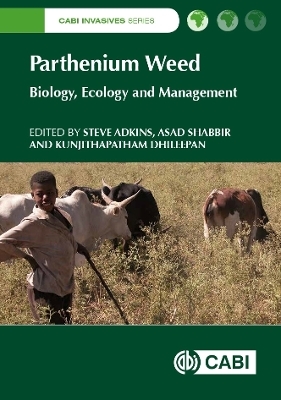
Parthenium Weed
CABI Publishing (Verlag)
978-1-78064-525-4 (ISBN)
This book explores the most important aspects of the biology, ecology and management of what is one of the world's worst weeds. Originally regarded as a major weed in Australia and India, Parthenium weed is now widespread in around 48 countries in Africa, Asia and the South Pacific, and has the potential to spread to new countries in Africa, Asia and Europe. This book, which is a collective effort by 27 members of the International Parthenium Weed Network, addresses research and knowledge gaps for different countries. It examines the weed's mode of spread, its impact on agricultural production, its effect on the environment and on human health, and its management using biological control, as well as cultural, physical and chemical approaches. It also considers the coordination of the weed's management, possible uses for Parthenium weed, its present distribution and how this is impacted by climate change. This book includes: A detailed analysis of Parthenium weed biology. Experiences with Parthenium weed worldwide. An explanation of practical management options. This book will be of interest to graduate students and researchers in universities and institutes, in the fields of plant ecology, botany, agriculture, conservation and restoration ecology.
Stephen W Adkins (Edited By) Professor Steve Adkins is Professor of Plant Physiology at The University of Queensland (UQ). He obtained a degree in Botany and Zoology from the University of London and a PhD in weed physiology from the University of Reading in England in 1981 and has served as a postdoctoral fellow at the University of Saskatchewan, Saskatoon in Canada (1981-84) and at Murdoch University, Perth, Australia (1984-88). He joined UQ in 1988 and has spent the last 30 years studying various tropical and subtropical crops and pastures, their weeds and the native plant community. Steve has held several leadership roles at UQ since 2010, including Deputy Director and Acting Director in the UQ Centre for Plant Architectural Informatics. In these roles, he has led initiatives that have improved teaching quality and the student experience, instituted guidelines and funding schemes for supporting the career development of RHD students and ECRs, and established several new cross-cutting research networks in collaboration with key external partners. He has served as Treasurer and for two terms as the President of the Asian-Pacific Weed Science Society. His research focus is tropical plants especially coconut, and conservation using ex situ seed banking and tissue culture. He has been a principle investigator and scientific advisor on more than 50 scientific projects worth more than $12 million. He has published more than 180 peer reviewed papers in international journals including Proceedings of the National Academy of Sciences, and supervised more than 50 research higher degree and 40 honours students to completion.
1: An Introduction to the ‘Demon Plant’ Parthenium Weed 2: Biology and Ecology 3: Spread 4: Interference and Impact of Parthenium Weed on Agriculture 5: Impacts on the Environment 6: Impact of Parthenium Weed on Human and Animal Health 7: Biological Control 8: Management: Physical, Cultural, Chemical 9: Coordination of Management 10: Parthenium Weed: Uses and Abuses 11: History and Management – Australia and Pacific 12: History and Management – Southern Asia 13: History and Management – East and South-east Asia 14: History and Management – Southern Africa and Western Indian Ocean Islands 15: History and Management – East and North Africa, and the Middle East 16: Conclusions
| Erscheinungsdatum | 09.02.2018 |
|---|---|
| Reihe/Serie | CABI Invasives Series |
| Co-Autor | Muhammad H Ali, Sally Allan |
| Mitarbeit |
Herausgeber (Serie): Kunjithapatham Dhileepan |
| Verlagsort | Wallingford |
| Sprache | englisch |
| Maße | 172 x 244 mm |
| Gewicht | 1000 g |
| Themenwelt | Sachbuch/Ratgeber ► Natur / Technik ► Natur / Ökologie |
| Naturwissenschaften ► Biologie ► Botanik | |
| Naturwissenschaften ► Biologie ► Ökologie / Naturschutz | |
| Technik | |
| Wirtschaft | |
| Weitere Fachgebiete ► Land- / Forstwirtschaft / Fischerei | |
| ISBN-10 | 1-78064-525-2 / 1780645252 |
| ISBN-13 | 978-1-78064-525-4 / 9781780645254 |
| Zustand | Neuware |
| Informationen gemäß Produktsicherheitsverordnung (GPSR) | |
| Haben Sie eine Frage zum Produkt? |
aus dem Bereich