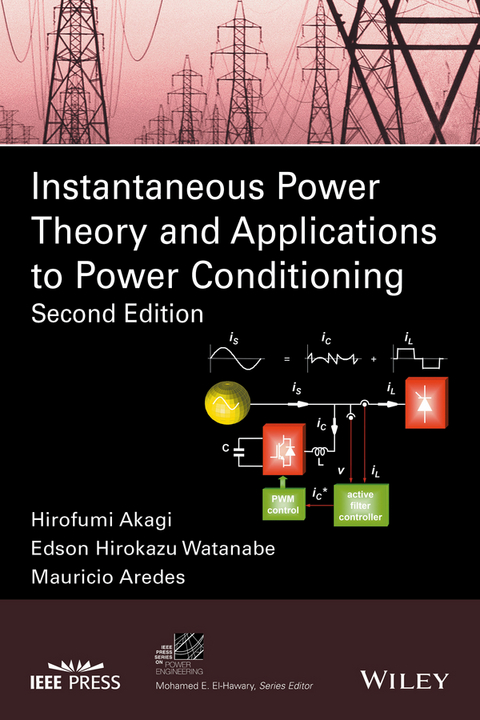
Instantaneous Power Theory and Applications to Power Conditioning (eBook)
John Wiley & Sons (Verlag)
9781119307204 (ISBN)
This book covers instantaneous power theory as well as the importance of design of shunt, series, and combined shunt-series power active filters and hybrid passive-active power filters
- Illustrates pioneering applications of the p-q theory to power conditioning, which highlights distinct differences from conventional theories
- Explores p-q-r theory to give a new method of analyzing the different powers in a three-phase circuit
- Provides exercises at the end of many chapters that are unique to the second edition
Hirofumi Akagi is a Professor in the department of electrical and electronic engineering at the Tokyo Institute of Technology. His research interest includes power conversion systems and its applications to industry, transportation, and utility. He has authored and coauthored some 120 IEEE Transactions papers and two invited papers published in Proceedings of the IEEE in 2001 and 2005. He was elected as an IEEE Fellow in 1996, a Distinguished Lecturer of the IEEE Power Electronics and Industry Applications Societies for 1998-1999. He received six IEEE Transactions prize paper awards, and 15 IEEE Industry Applications Society Committee prize paper awards. He is the recipient of the 2001 IEEE Power Electronics William E. Newell Award, the 2004 IEEE Industry Applications Society Outstanding Achievement Award, the 2008 IEEE Richard H. Kaufmann Technical Field Award, and the 2012 IEEE Power & Energy Society Nari Hingorani Custom Power Award. Dr. Akagi served as the President of the IEEE Power Electronics Society for 2007-2008. Since January 2015, he has been serving as the IEEE Division II Director.
Edson Hirokazu Watanabe is a Professor at COPPE/Federal University of Rio de Janeiro, where he teaches Power Electronics. His main fields of interests are converters analysis, modeling and design, active filters and FACTS technologies. Dr. Watanabe has more than 50 journal papers and more than 200 conference papers. He is a member of the IEE-Japan, The Brazilian Society for Automatic Control, The Brazilian Power Electronics Society, CIGRE and Power Engineering, Industry Applications and Power Electronics Societies of IEEE. In 2005, he was admitted to the National Order of Scientific Merit, Brazil. In 2013, he received the IEEE Power & Energy Society Nari Hingorani FACTS Award and became member of the National (Brazil) Academy of Engineering and in 2015 he was elected a member of the Brazilian Academy of Sciences.
Mauricio Aredes received the B.Sc. degree from UFF - Fluminense Federal University, Rio de Janeiro State in 1984, the M.Sc. degree in Electrical Engineering from UFRJ - Federal University of Rio de Janeiro in 1991, and the Dr.-Ing. degree (summa cum laude) from Technische Universität Berlin in 1996. In 1997, he became an Associate Professor at the Federal University of Rio de Janeiro, where he teaches Power Electronics. His main research area includes HVDC and FACTS systems, active filters, Custom Power, Renewable Energy Systems, and Power Quality Issues.
This book covers instantaneous power theory as well as the importance of design of shunt, series, and combined shunt-series power active filters and hybrid passive-active power filters Illustrates pioneering applications of the p-q theory to power conditioning, which highlights distinct differences from conventional theories Explores p-q-r theory to give a new method of analyzing the different powers in a three-phase circuit Provides exercises at the end of many chapters that are unique to the second edition
Hirofumi Akagi is a Professor in the department of electrical and electronic engineering at the Tokyo Institute of Technology. His research interest includes power conversion systems and its applications to industry, transportation, and utility. He has authored and coauthored some 120 IEEE Transactions papers and two invited papers published in Proceedings of the IEEE in 2001 and 2005. He was elected as an IEEE Fellow in 1996, a Distinguished Lecturer of the IEEE Power Electronics and Industry Applications Societies for 1998-1999. He received six IEEE Transactions prize paper awards, and 15 IEEE Industry Applications Society Committee prize paper awards. He is the recipient of the 2001 IEEE Power Electronics William E. Newell Award, the 2004 IEEE Industry Applications Society Outstanding Achievement Award, the 2008 IEEE Richard H. Kaufmann Technical Field Award, and the 2012 IEEE Power & Energy Society Nari Hingorani Custom Power Award. Dr. Akagi served as the President of the IEEE Power Electronics Society for 2007-2008. Since January 2015, he has been serving as the IEEE Division II Director. Edson Hirokazu Watanabe is a Professor at COPPE/Federal University of Rio de Janeiro, where he teaches Power Electronics. His main fields of interests are converters analysis, modeling and design, active filters and FACTS technologies. Dr. Watanabe has more than 50 journal papers and more than 200 conference papers. He is a member of the IEE-Japan, The Brazilian Society for Automatic Control, The Brazilian Power Electronics Society, CIGRE and Power Engineering, Industry Applications and Power Electronics Societies of IEEE. In 2005, he was admitted to the National Order of Scientific Merit, Brazil. In 2013, he received the IEEE Power & Energy Society Nari Hingorani FACTS Award and became member of the National (Brazil) Academy of Engineering and in 2015 he was elected a member of the Brazilian Academy of Sciences. Mauricio Aredes received the B.Sc. degree from UFF - Fluminense Federal University, Rio de Janeiro State in 1984, the M.Sc. degree in Electrical Engineering from UFRJ - Federal University of Rio de Janeiro in 1991, and the Dr.-Ing. degree (summa cum laude) from Technische Universität Berlin in 1996. In 1997, he became an Associate Professor at the Federal University of Rio de Janeiro, where he teaches Power Electronics. His main research area includes HVDC and FACTS systems, active filters, Custom Power, Renewable Energy Systems, and Power Quality Issues.
INSTANTANEOUS POWER THEORY AND APPLICATIONS TO POWER CONDITIONING 3
Contents 9
Preface 15
1 Introduction 17
1.1 Concepts and Evolution of Electric Power Theory 17
1.2 Applications of the P-q theory to Power Electronics Equipment 20
1.3 Harmonic Voltages in Power Systems 21
1.4 Identified and Unidentified Harmonic-Producing Loads 22
1.5 Harmonic Current and Voltage Sources 24
1.6 Basic Principles of Harmonic Compensation 25
1.7 Basic Principle of Power Flow Control 29
References 31
2 Electric Power Definitions: Background 33
2.1 Power Definitions Under Sinusoidal Conditions 34
2.2 Voltage and Current Phasors and Complex Impedance 36
2.3 Complex Power and Power Factor 37
2.4 Concepts of Power Under Nonsinusoidal Conditions: Conventional Approaches 38
2.4.1 Power Definitions by Budeanu 38
2.4.2 Power Definitions by Fryze 43
2.5 Electric Power in Three-Phase Systems 44
2.5.1 Classifications of Three-Phase Systems 44
2.5.2 Power in Balanced Three-Phase Systems 47
2.5.3 Power in Three-Phase Unbalanced Systems 49
2.6 Summary 50
2.7 Exercises 50
References 51
3 The Instantaneous Power Theory 53
3.1 Basis of the p-q Theory 53
3.1.1 Historical Background of the p-q Theory 54
3.1.2 The Clarke Transformation 55
3.1.3 Three-Phase Instantaneous Active Power in Terms of Clarke Components 59
3.1.4 The Instantaneous Powers of the p-q Theory 60
3.2 The p-q Theory in Three-Phase, Three-Wire Systems 60
3.2.1 Comparisons with the Conventional Theory 64
3.2.2 Use of the p-q Theory for Shunt Current Compensation 70
3.2.3 The Dual p-q Theory 79
3.3 The p-q Theory in Three-Phase, Four-Wire Systems 81
3.3.1 The Zero-Sequence Power in a Three-Phase Sinusoidal Voltage Source 83
3.3.2 Presence of Negative-Sequence Components 84
3.3.3 General Case Including Distortions and Imbalances in the Voltages and in the Currents 85
3.3.4 Physical Meanings of the Instantaneous Real, Imaginary, and Zero-Sequence Powers 90
3.3.5 Avoiding the Clarke Transformation in the p-q Theory 91
3.3.6 Modified p-q Theory 93
3.4 Instantaneous abc Theory 97
3.4.1 Active and Nonactive Current Calculation by Means of a Minimization Method 99
3.4.2 Generalized Fryze Currents Minimization Method 104
3.5 Comparisons Between The p-q Theory and The abc Theory 107
3.5.1 Selection of Power Components to be Compensated 111
3.6 The p-q-r Theory 113
3.7 Summary 120
3.8 Exercises 121
References 122
4 Shunt Active Filters 127
4.1 General Description of Shunt Active Filters 129
4.1.1 PWM Converters for Shunt Active Filters 130
4.1.2 Active Filter Controllers 131
4.2 Three-Phase, Three-Wire Shunt Active Filters 134
4.2.1 Active Filters for Constant Power Compensation 135
4.2.2 Active Filters for Sinusoidal Current Control 151
4.2.3 Active Filters for Current Minimization 161
4.2.4 Active Filters for Harmonic Damping 165
4.2.5 A Digital Controller 187
4.3 Three-Phase, Four-Wire Shunt Active Filters 196
4.3.1 Converter Topologies for Three-Phase, Four-Wire Systems 197
4.3.2 Dynamic Hysteresis-Band Current Controller 198
4.3.3 Active Filter dc Voltage Regulator 200
4.3.4 Optimal Power Flow Conditions 201
4.3.5 Constant Instantaneous Power Control Strategy 203
4.3.6 Sinusoidal Current Control Strategy 205
4.3.7 Performance Analysis and Parameter Optimization 208
4.4 Compensation Methods Based on the p-q-r Theory 220
4.4.1 Reference Power Control Method 222
4.4.2 Reference Current Control Method 227
4.4.3 Alternative Control Method 229
4.4.4 The Simplified Sinusoidal Source Current Strategy 231
4.5 Comparisons Between Control Methods Based on the p-q Theory and The p-q-r Theory 234
4.6 Shunt Selective Harmonic Compensation 240
4.7 Summary 247
4.8 Exercises 247
References 249
5 Hybrid and Series Active Filters 253
5.1 Basic Series Active Filter 253
5.2 Combined Series Active Filter and Shunt Passive Filter 255
5.2.1 Example of an Experimental System 258
5.2.2 Some Remarks about the Hybrid Filters 268
5.3 Series Active Filter Integrated with a Double-Series Diode Rectifier 269
5.3.1 The First-Generation Control Circuit 271
5.3.2 The Second-Generation Control Circuit 274
5.3.3 Stability Analysis and Characteristics Comparison 276
5.3.4 Design of a Switching-Ripple Filter 279
5.3.5 Experimental Results 282
5.4 Comparisons Between Hybrid and Pure Active Filters 284
5.4.1 Low-Voltage Transformerless Hybrid Active Filter 284
5.4.2 Low-Voltage, Transformerless, Pure Shunt Active Filter 287
5.4.3 Comparisons through Simulation Results 289
5.5 Hybrid Active Filters for Medium-Voltage Motor Drives 290
5.5.1 Hybrid Active Filter for a Three-Phase Six-Pulse Diode Rectifier 291
5.5.2 Hybrid Active Filter for a Three-Phase 12-Pulse Diode Rectifier 308
5.6 Summary 324
5.7 Exercises 325
References 326
6 Combined Series and Shunt Power Conditioners 329
6.1 The Unified Power Flow Controller 330
6.1.1 FACTS and UPFC Principles 331
6.1.2 A Controller Design for the UPFC 337
6.1.3 UPFC Approach Using a Shunt Multipulse Converter 344
6.2 The Unified Power Quality Conditioner 355
6.2.1 General Description of the UPQC 356
6.2.2 A Three-Phase, Four-Wire UPQC 358
6.2.3 The UPQC Combined with Passive Filters (the Hybrid UPQC) 386
6.3 The Universal Active Power Line Conditioner 402
6.3.1 General Description of the UPLC 402
6.3.2 The Controller of the UPLC 405
6.3.3 Performance of the UPLC 413
6.3.4 General Aspects 427
6.4 Combined Shunt-Series Filters for AC and DC Sides of Three-Phase Rectifiers 427
6.4.1 The Combined Shunt-Series Filter 430
6.4.2 Instantaneous Real and Imaginary Powers in the ac Source 431
6.4.3 The Instantaneous Power in the dc Side of the Rectifier 432
6.4.4 Comparison of Instantaneous Powers on the ac and dc Sides of the Rectifier 434
6.4.5 Control Algorithm of the Active Shunt-Series Filter 434
6.4.6 The Common dc Link 437
6.4.7 Digital Simulation 440
6.4.8 Experimental Results 442
6.5 Summary 443
6.6 Exercises 444
References 445
Index 447
IEEE Press Series on Power Engineering 467
EULA 471
| Erscheint lt. Verlag | 13.2.2017 |
|---|---|
| Reihe/Serie | IEEE Press Series on Power and Energy Systems |
| IEEE Press Series on Power Engineering | IEEE Press Series on Power Engineering |
| Sprache | englisch |
| Themenwelt | Technik ► Elektrotechnik / Energietechnik |
| Schlagworte | electric power systems • Elektrische Energietechnik • Energie • Energietechnik • Energy • FACTS (Flexible AC Transmission System) compensators • harmonic pollution • hybrid passive-active power filters • Instantaneous power theory • Power Conditioning • Power Quality • Power Technology & Power Engineering • p-q-r theory • p-q theory • Reactive Power Compensation • series power active filters • shunt power active filters • shunt-series power active filters • three-phase circuit |
| ISBN-13 | 9781119307204 / 9781119307204 |
| Informationen gemäß Produktsicherheitsverordnung (GPSR) | |
| Haben Sie eine Frage zum Produkt? |
 PDF (Adobe DRM)
Kopierschutz: Adobe-DRM
Adobe-DRM ist ein Kopierschutz, der das eBook vor Mißbrauch schützen soll. Dabei wird das eBook bereits beim Download auf Ihre persönliche Adobe-ID autorisiert. Lesen können Sie das eBook dann nur auf den Geräten, welche ebenfalls auf Ihre Adobe-ID registriert sind.
Details zum Adobe-DRM
Dateiformat: PDF (Portable Document Format)
Mit einem festen Seitenlayout eignet sich die PDF besonders für Fachbücher mit Spalten, Tabellen und Abbildungen. Eine PDF kann auf fast allen Geräten angezeigt werden, ist aber für kleine Displays (Smartphone, eReader) nur eingeschränkt geeignet.
Systemvoraussetzungen:
PC/Mac: Mit einem PC oder Mac können Sie dieses eBook lesen. Sie benötigen eine
eReader: Dieses eBook kann mit (fast) allen eBook-Readern gelesen werden. Mit dem amazon-Kindle ist es aber nicht kompatibel.
Smartphone/Tablet: Egal ob Apple oder Android, dieses eBook können Sie lesen. Sie benötigen eine
Geräteliste und zusätzliche Hinweise
Buying eBooks from abroad
For tax law reasons we can sell eBooks just within Germany and Switzerland. Regrettably we cannot fulfill eBook-orders from other countries.
aus dem Bereich